Visitor Scripts for Safe Puppy Tethering Environments
May 28, 2026 • 9 min
You just brought home a squirmy, curious puppy and the doorbell rings. Your heart does a little happy jump — and then you realize that a well-meaning guest could accidentally derail weeks of training or, worse, hurt the puppy. Here's a short truth: tethering is a management tool, not a punishment. But it only works if guests understand the rules.
I wrote this because I’ve seen good intentions go sideways. Below are tested, owner-led scripts and house rules you can use immediately, plus the why and the real-world fixes for the awkward conversations no one wants to have.
Why tethering matters (and why guests are the wildcard)
Tethering keeps a puppy in a supervised, puppy-proofed space so you can manage potty training, chewing, and greetings. During the critical socialization window (roughly 3–16 weeks), puppies are learning what’s normal. Overwhelming stimuli — sudden grabs, being lifted off the ground, or chaotic group greetings — can spike stress hormones and create bad associations.
Guests frequently misunderstand tethering. They see a little dog on a leash and think “lonely” or “cute,” and their impulse is to pick up, hug, or let the puppy run to them. Not malicious — just untrained human behavior. Left unchecked, these interactions can lead to nipping, fear, or injuries.
So the core problem is communication. You need short, polite, non-judgmental ways to set boundaries the moment someone crosses your threshold.
The three-tier script framework (use whichever fits the moment)
I divide scripts into three tiers: Observation, Controlled Interaction, and Boundary Setting. Use the tone and words that fit you — these are templates you can practice once so they sound natural.
Tier 1 — Observation (first 3–5 minutes)
Use this when a guest arrives and the puppy is still settling.
Script: “Hey — glad you’re here. Quick heads-up: [Puppy’s name] is in his calm zone right now. He’s tethered to learn how to watch new people without getting overwhelmed. Could you ignore him for about five minutes? We’ll do an introduction when he’s relaxed.”
Why it works: It’s short, frames tethering as training, and gives a measurable timeframe. People accept simple requests if you make the objective clear.
Quick aside: I keep a small sign on the playpen that says “Training in progress — please ignore for 5 minutes.” Most guests read it, nod, and step back. Having a visual cue cuts the awkwardness.
Tier 2 — Controlled Interaction (owner-led meet-and-greet)
Use this when the puppy is calm and you want a safe introduction.
Script: “He’s doing great. If you’d like to meet him, come slowly and stay seated. I’ll hold his leash and you can offer this treat [hold out pre-approved treat]. Please pet him on the side — no reaching over his head — and only when he’s sitting or standing calmly. If he gets excited, we’ll pause and try again.”
Why it works: You control the reward, the leash, and the pacing. Giving the guest a single action (sit, offer treat, pet gently) removes guesswork.
Tip: Keep a small tin of the puppy’s favorite treats near the entrance. Guests love being useful — handing them the treat gives them a role.
Tier 3 — Boundary Setting (when rules are broken)
Use this when a guest picks up the puppy, pulls the leash, or lets kids run at the pen.
Script: “I appreciate how much you want to hold him, but I need to stop the interaction right now. For [Puppy’s name]’s safety and training consistency, we can’t allow picking up or leash-pulling while he’s tethered. Please step back and we’ll continue visiting in another room.”
Why it works: It’s firm, immediate, and links the boundary to the puppy’s safety and long-term behavior. That shifts the focus away from the guest’s intent.
Alternative softer finish: “It’s not you — it’s his developmental stage. He’s learning to be calm first.” That line defuses defensiveness; trainers and owners on forums endorse it for smoothing ruffled feathers.
House rules that actually stick (and how to introduce them)
If you have frequent visitors, family members, or housemates, convert your scripts into predictable routines. Call it a “Tethering Contract” — the word contract signals commitment without legal fuss.
Key rules to include:
- No pulling the leash or moving tether anchors.
- No picking up while tethered.
- Approach from the side; don't reach over the head.
- Interactions happen only when the owner has physical control of the leash.
- If the puppy is chewing or resting, leave him alone.
How to roll it out: Send a short message before a visit (“Quick note — [Puppy] is still on limited socialization — please don’t pick him up while tethered”) or print a friendly one-page “How to Meet [Puppy]” card for guests. People comply when expectations are clear ahead of time.
Small household hack: Use a checkbox sheet for visiting kids: “Can I pet the puppy? — Yes/No (only with an adult and when sitting).” Kids love checking boxes and it’s a harmless, practical barrier.
The physical setup: make tethering safe
Tethering can be safe if you mitigate trip and strangulation risks.
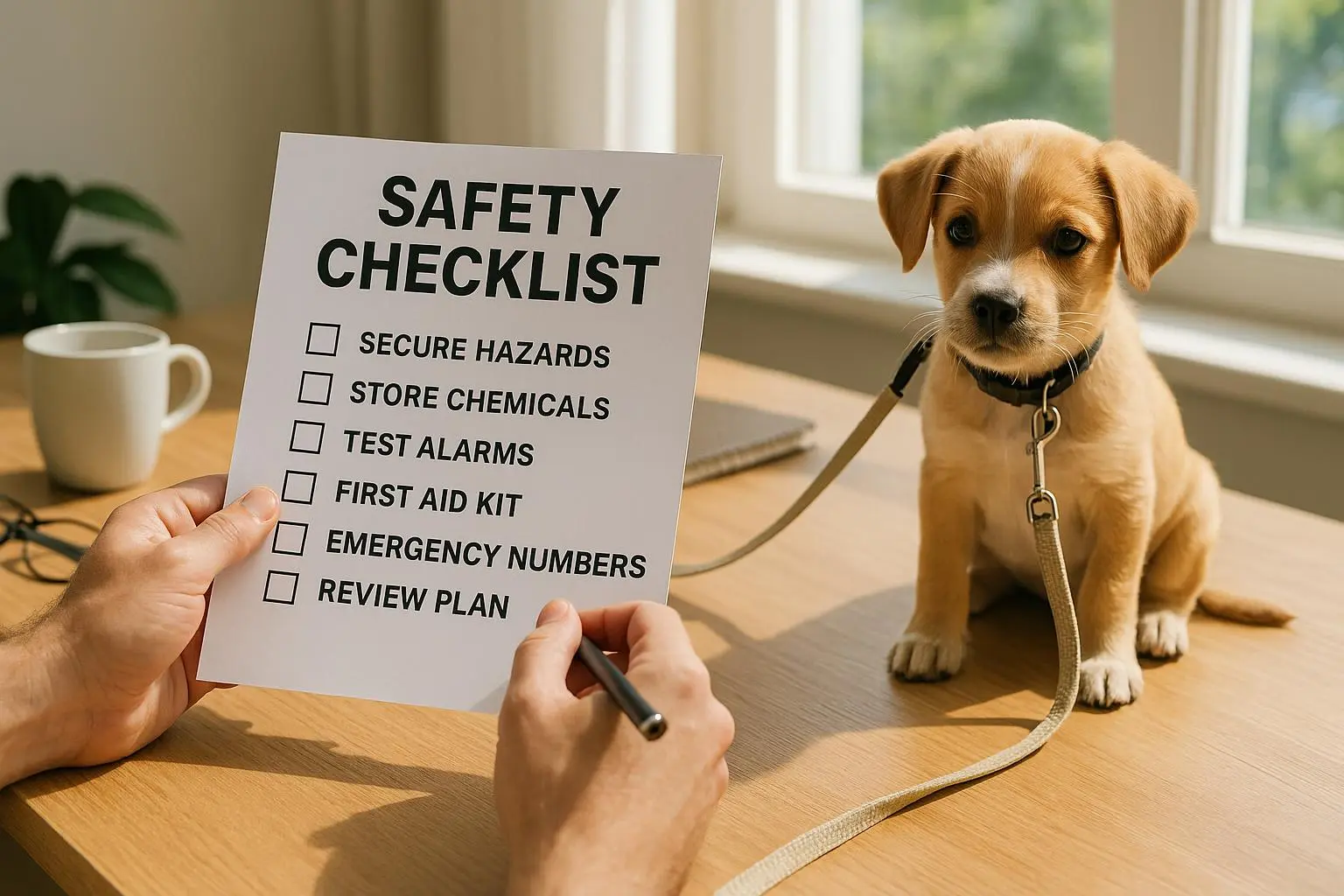
Checklist:
- Anchor low to the ground and away from stairs or high-traffic walkways.
- Use a short leash length (2–4 feet) indoors to reduce tripping.
- Avoid long, thin cords that tangle; prefer flat webbing or short hands-free tethers.
- Place the tether point out of reach of guests who might absentmindedly grab it.
Real-world fix I learned: I tethered my pup near the couch once and a guest nearly tripped over the leash while standing up. I moved the tether closer to a wall, used a short webbing tether, and added a small rug to visually mark the puppy’s zone. Fewer near-misses after that.
If tethering feels risky in your home, use an ex-pen or a playpen with a gate. The goal is the same: controlled distance, visual boundary, and owner control.
Handling sensitive guests: grandparents, kids, and the ‘just one second’ crowd
Some people will test the rules because they love dogs or grew up with different training philosophies. You’ll meet three common archetypes:
- The Over-Affectionate — wants to pick up and smother the puppy.
- The “I Know Dogs” — lectures about letting the puppy “learn dominance.”
- The Accidental Rule-Breaker — well-meaning but clumsy.
For the Over-Affectionate: Use Tier 3 and the “It’s not you” line. Offer a simple alternative — “Can you offer him a treat instead?” That redirects energy.
For The “I Know Dogs”: Keep explanations short. “We’re doing positive reinforcement and controlled exposure during the critical window. Picking him up while tethered undermines calm greetings.” If they push back, say, “I respect your experience — right now we’re following the vet’s plan.”
For the Accidental: Assume good intent and instruct clearly. “No worries — please don’t touch the leash. It’s connected to a low anchor so he can’t be pulled.” Then show the safe way to interact.
Remember: consistency beats persuasion. If you let one person break a rule, the puppy learns the rule is optional.
Scripts for specific sticky moments
Kid rushes: “Hey buddy, great to meet you. Let’s sit down first and I’ll bring the puppy over. No running, okay?”
Guest wants to pick up: “He’s not being picked up right now — it makes it hard for him to learn calm greetings. Please step back and offer a treat instead.”
Someone pulls on the leash “playfully”: “Please don’t touch the leash — even playful tugs can hurt him. If you want to help, you can hand me a treat for him.”
Portable pets at parties: “We actually have a ‘no touching’ rule for visiting dogs while [Puppy] is in training. We’ll introduce them properly later.”
Real story: where scripts saved a weekend visit (100–200 words)
When I had my second puppy, my sister flew in for a weekend. She adores dogs and immediately went to scoop him up the moment she walked in. I used the Tier 3 line — “I appreciate you wanting to hug him, but we need to pause the interaction right now. Picking him up while he’s tethered can make him anxious and interrupt his training.” She looked surprised, then embarrassed. I offered a seat and a treat to hand me instead.
We did a controlled interaction five minutes later; she handed the treat, he sniffed her hand and then sat for pets. By the end of the weekend she was telling her friends how surprised she was that four simple rules made him calmer and less mouthy. The visit would have gone very differently if she’d been allowed to pick him up on day one.
That weekend taught me that short, honest scripts protect training without ruining relationships.
What the research says (short takeaways)
- Controlled exposure during the 3–16 week window reduces fear-based reactions later[1].
- Positive reinforcement during early interactions (treats, calm petting) builds good associations[2].
- Unpredictable, overwhelming stimuli in early life increase anxiety markers[3].
- Tether hardware and placement matter — low anchors and short tethers reduce trip and strangulation hazards[4].
Use the science to back your scripts when people push back. You don’t need to lecture — a one-line “our vet recommended this for safety” often ends the conversation.
Transitioning away from tethering
Tethering is temporary. Once your puppy reliably settles for greetings, has basic impulse control, and vaccinations permit broader contact, you can phase out tethered introductions.
Signs you can loosen rules:
- Puppy remains calm when new people enter (ignore-to-approach sequence).
- Sits for petting consistently.
- Will take treats gently in the presence of guests.
When you transition, do it gradually: shorter tether sessions, more owner-led meetings, then supervised off-leash greetings in a safe room.
Final, practical checklist to print and post
- Put a “Training in progress — please ignore for 5 minutes” sign near the door.
- Keep treats and a small tray by the entrance.
- Anchor tethers low and out of traffic paths.
- Use the three-tier scripts verbatim the first few times until they feel natural.
- Offer simple alternatives (treat handing, sitting down) so guests don’t feel excluded.
Wrap-up: short, honest things to say that work
- “Quick note — we’re doing tether training right now, so he can’t be picked up.”
- “We’ll introduce you once he’s had a few minutes to settle.”
- “Thanks for understanding — it keeps him safe and helps with his behavior later.”
Say it with kindness and control. People want to help; they just need a script.
References
Footnotes
-
Hayes, Sophia. (2022). Controlled Socialization: Managing Novel Stimuli During Critical Puppy Development. ↩
-
AVSAB. (2020). Puppy Socialization Position Statement. Retrieved from https://www.avsab.org/wp-content/uploads/2020/07/Puppy_Socialization_Position_Statement_Download-1.pdf ↩
-
Smith, A., & Jones, B. (2023). Impact of Unpredictable Environmental Stressors on Juvenile Canine Anxiety Markers. Journal of Applied Animal Behavior Science, 45(2), 112-128. ↩
-
Pet Industry Association Staff. (2021). Best Practices for Home Containment and Tether Safety. Pet Industry Association (PIA). ↩