Advanced Puppy Supervision: Designing Transitions from Tether to Freedom
Apr 25, 2026 • 9 min
If you’ve ever stood at the threshold of puppy independence, you know the moment I’m talking about. It’s the point where you stop treating every creak of a toy as a potential disaster and start trusting that your puppy can make smart, safe choices on their own. But that trust doesn’t appear out of thin air. It’s earned—with a plan.
I’ll be honest: I initially treated the tether like a security blanket. It kept chaos at bay, but it also kept my puppy from learning how to manage a little space, a little alone time, and a little impulse control. The shift I’ll lay out here isn’t about “letting go” overnight. It’s about a milestone-driven transition that reduces risk while building genuine independence.
And yes, I’m going to share a real story—one that isn’t polished, but it’s exactly what you need to hear if you’re staring down the same milestone with your puppy tonight.
A quick aside, from a small detail that stuck with me: during a late-night crate session, I realized the sound of the crate latch clicking open could become a cue for relief rather than a trigger for anxiety. I started pairing that sound with calm rewards, and suddenly the ritual felt like a choice the puppy makes, not a punishment that’s forced on him. Tiny moments like that change the entire trajectory of progress.
In this piece, you’ll find a practical, milestone-based framework you can actually use. It’s grounded in real-world training, progress tracking, and a humane emphasis on safety, curiosity, and joy.
Now let’s break down the journey into three clear phases, plus how to track progress so you don’t rely on vibes alone.
Why a structured transition matters (and how it differs from “just give them more space”)
When I brought my first puppy home, I thought, “Sure, he’ll figure it out.” Spoiler: not quickly, not gracefully, and definitely not without some careful scaffolding. A structured transition matters because puppies are still learning how to regulate their emotions, how to interpret our cues, and how to handle the wide world that’s just beyond the leash.
A tether is a safety tool, not a personality trait. If used correctly, it teaches boundaries and safety. If used forever, it can stall growth: you miss crucial moments when the puppy should practice decision-making, self-control, and problem-solving. The goal is not faster freedom; it’s sustainable freedom that’s earned through reliable skills.
Here’s the core idea I’ve seen work: you design milestones that map to real behaviors you can observe. You create a simple progress log—date, activity, response, any hiccups. You adjust the pace based on the puppy’s temperament, health, and environment. You celebrate the wins, and you normalize the bumps as part of the process.
Now, a quick reality check before we dive in deeper: progress isn’t linear. There will be weeks when your puppy seems to “get it” and others where they forget their own name. That’s normal. The best plan isn’t one colossal leap; it’s small, consistent steps with safety nets in place.
Phase 1: Foundation – Tethered supervision (weeks 1–4)
This phase is all about turning the tether into a tool that teaches rather than a leash that limits. The aim is to establish a calm baseline where the puppy relates tether time to positive experiences and predictable routines.
Milestones to target
- Milestone 1: Positive association with the tether. The puppy accepts the tether without distress and shows calm posture when tethered. Reward immediately with treats and gentle praise.
- Milestone 2: Basic obedience while tethered. Sit, stay, come, and leave-it cues work reliably with the tether on, even in mildly distracting environments.
- Milestone 3: Brief, supervised alone time. The puppy can be calm for short windows (5–10 minutes) while tethered and out of sight behind a baby gate or barrier.
What I learned in this phase isn’t glamorous, but it’s essential: the tether should be a bridge, not a barrier. If the puppy associates the tether with fear or frustration, you can’t progress. Reframe the tether as a shared space with clear rules and lots of positive reinforcement.
User insight examples from owners in the field show the same pattern:
- “When we first got our puppy, we tethered him to us constantly. It was exhausting! But it really helped with potty training and preventing him from getting into trouble. We slowly started giving him more freedom as he got older and more reliable.” — Reddit, r/puppy101
- “We used a baby gate to give our puppy more freedom in the living room. We started with short periods and gradually increased the time. It worked wonders for his confidence and independence.” — Twitter, DogTrainingTips
A micro-moment I won’t forget: during a long tether session, I noticed my puppy shifted from staring at me to scanning the living room with curiosity. It was the first sign he was ready to explore a little more—but only after I’d shown him he could still rely on his own judgment with the tether’s safety net.
Practical steps you can steal for your plan
- Pick a safe tether setup: a snug harness, a lightweight leash, and a comfortable, quiet space. No slamming doors or noisy distractions during this phase.
- Map the day into three predictable blocks (morning, midday, evening). Use the tether for short, consistent periods during each block.
- Pair tether time with low-stakes activities: short grooming sessions, toy rotation, or a slow-paced sniff walk. The tether should never feel like a punishment.
Tracking progress
- Create a simple log (date, activity, duration, puppy’s mood, any challenges, next step). Don’t overthink it—consistency wins here.
- If Milestone 1 or 2 falters, repeat the previous step until your puppy shows confidence. That reinforcements cycle is normal and healthy.
Addressing common challenges
- If anxiety spikes during tethering, shorten the session but increase the frequency of short, positive associations.
- If the puppy pulls or whines, reframe the tether as a “signal-to-safety” cue rather than a tethering discipline. Help them by guiding with a treat into a calm posture.
Progress check-in: if you’re consistently hitting all three milestones by week 4, you’re ready to move to Phase 2. If not, slow the pace and reinforce Milestones 1–3 for another week or two.
Phase 2: Gradual freedom – Supervised exploration (weeks 5–8)
This is where you start increasing the puppy’s autonomy, but always under close supervision and with a solid plan for recall and safety.
Milestones to target
- Milestone 4: Increased off-leash time in a safe, enclosed area (15–20 minutes). The puppy should remain within a clear boundary and respond to cues while exploring.
- Milestone 5: Recall reliability. The puppy comes when called, even with distractions. This is non-negotiable for safety.
- Milestone 6: Independent play. The puppy can entertain themselves with appropriate toys for 15–20 minutes without destructive behavior.
A note on environment: the space matters. Start with a fully fenced yard or a contained room where doors and windows are secure. We’re training impulse control here, not risk-taking.
User insight echoes the same message you’ll hear again and again: small, supervised bursts of freedom build confidence and independence faster than endless tethered sessions.
A quick aside about a detail I learned early: a baby gate as a “soft barrier” gave us a third option—the puppy could wander a bit but we could still intervene easily if needed. It’s not glamorous, but it gave us a reliable transition tool.
Practical steps for this phase
- Begin with very clear recall cues: a high-value treat, a lively voice, and a fun, fast moment that makes coming back exciting.
- Increase the off-leash windows gradually, aiming for a 5-minute increase each session, not a big leap.
- Introduce independent play routines: puzzle feeders, frozen kongs, or safe chew toys that require problem-solving rather than brute force.
Progress tracking
- Keep a two-column log: “independence score” (0–3) for recall, confidence, and curiosity; and “desire to explore” (low/medium/high). This helps you adjust pacing.
- If you observe repeated recall failures in a week, slow down by removing distractions and returning to leash-on exploration—and then reintroduce off-leash time later.
User insight: a common theme is the power of progress logs. One family noted, “We kept a detailed log of our puppy’s training. It helped us identify areas where he needed more work and celebrate his successes.” Solid advice.
Addressing challenges
- Separation anxiety risk rises here if you push too far too soon. If you notice stress behaviors when you step away for a minute, shorten that window and build back up gradually.
- If destructive behavior appears, rewire the environment so the puppy has fewer temptations and more mentally stimulating activities.
What I’ve seen work best: keep sessions short, sweet, and highly rewarding when the puppy exhibits the target behavior. The goal isn’t to crank up the difficulty; it’s to reinforce the right choice under mildly challenging conditions.
Phase 3: Extended independence – Controlled environment (weeks 9+)
This phase is your first real test: can your puppy handle extended freedom in a familiar, dog-proofed space without slipping into chaos?
Milestones to target
- Milestone 7: Extended alone time. The puppy can be left alone in a designated area for longer periods (2–4 hours) with no distress signals or destructive behavior.
- Milestone 8: Reliable house manners. The puppy consistently adheres to house rules, doesn’t engage in destructive chewing, and uses appropriate outlets for energy.
- Milestone 9: Socialization and exposure. The puppy remains calm and curious in varied environments and around different people and animals.
User insight: several owners have reported positive outcomes when they tie crate training, positive reinforcement, and gradual exposure together. One shared, “My puppy used to chew everything when we left him alone. We started crate training and gradually increased the time he spent outside the crate. Now he’s much better behaved and we can trust him in the house.” Real talk, not sugar-coated.
Progress tracking
- Maintain a simple schedule: a daily window for “alone time” with you out of sight. If your puppy is showing signs of distress, shorten the duration and build up more gradually.
- Use safe enrichment tools: puzzle feeders, slow feeders, and scent-based games can dramatically reduce boredom-driven behaviors.
Addressing challenges
- Regression happens. If the puppy starts showing anxiety or destructive behavior after a couple of weeks, drop back to a previous milestone and rebuild the foundation.
- Socialization isn’t a one-off event. Regularly expose your puppy to new people, new environments, and new dog-friendly situations so it remains confident.
The big payoff here is trust. You’re not “giving up” control; you’re teaching the dog to navigate a world that includes both structure and freedom. The result is a more confident, less anxious dog—and a calmer household for you.
Progress tracking and adjustments: the heartbeat of your plan
A plan is nothing without a pragmatic tracking system. Here’s a lightweight approach that works for most households.
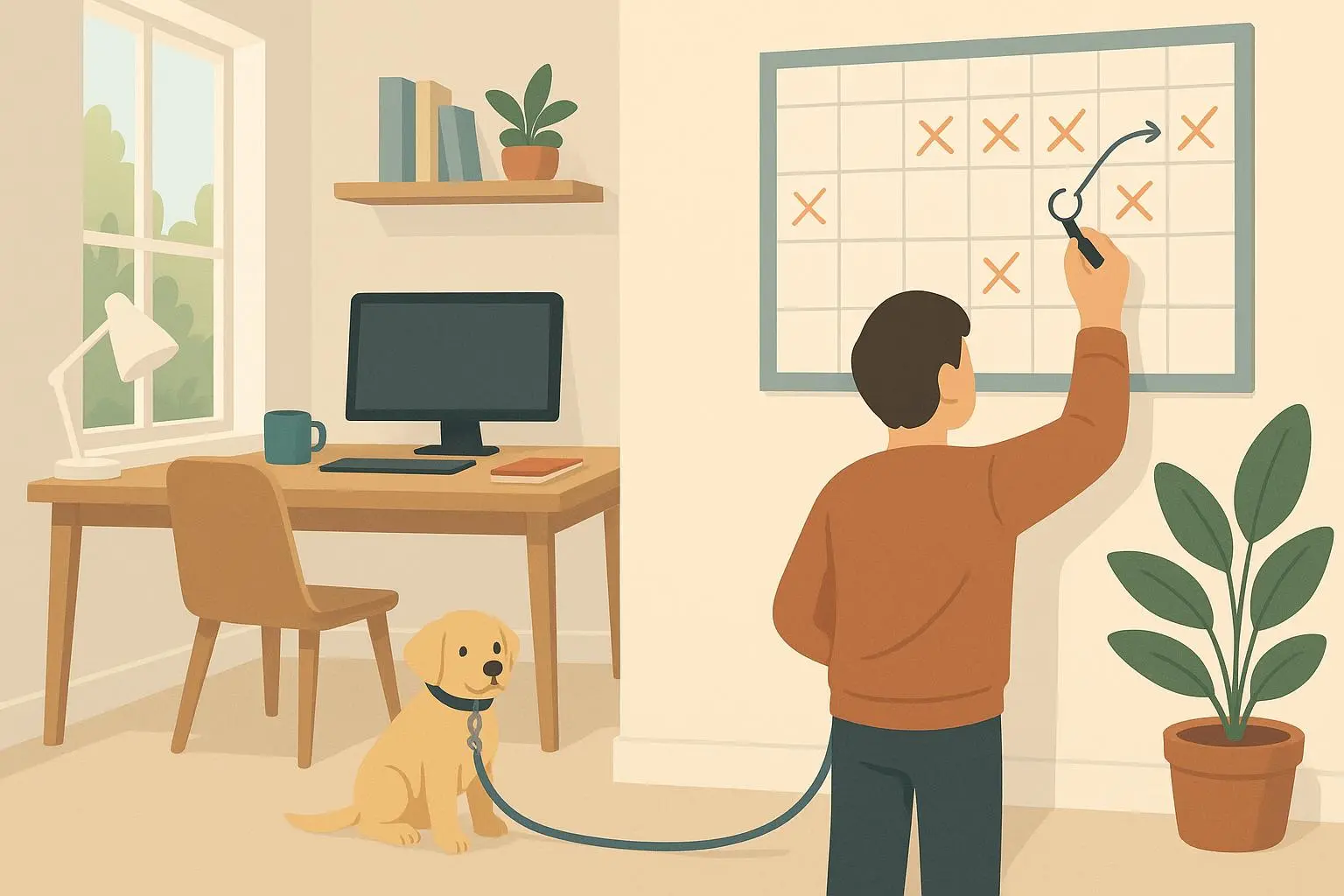
- Create a weekly progress sheet. At the top, list your milestones for the week (Phase 1: Milestones 1–3; Phase 2: Milestones 4–6; Phase 3: Milestones 7–9). Check off what you hit and note what didn’t land.
- Use a simple color-coding scheme. Green means “solid,” yellow means “watch closely,” red means “rework.” This makes it easy to scan a page and know where you stand.
- Log one “micro-moment” per week. A tiny detail—like when your puppy chose to lie down calmly during a family dinner or when a new toy kept him engaged longer than expected—will remind you that progress is stacking up, not vanishing into thin air.
- Schedule monthly reviews. Sit down with your dog and, more importantly, with yourself. Are you moving at a pace that respects the dog’s temperament? Do you need to introduce more training variety or scale back the pace?
What I’ve learned is that consistency beats intensity. A small win every day builds a wall of progress that’s much harder to knock down than a big, sporadic effort.
What to do when the plan doesn’t go as hoped
No plan survives contact with reality intact. Your puppy will surprise you, and that’s a good sign—it means you’re pushing your boundaries to match theirs.
- If there’s a stubborn setback, don’t pretend it didn’t happen. Acknowledge it, log it, and adjust the next steps accordingly. The best adjustments are incremental, not seismic.
- If you’re feeling overwhelmed, reach out. A chat with a trainer or a veterinary behaviorist can save weeks of guesswork. The cost is worth the clarity.
- If your household environment is noisy or chaotic, consider a more controlled space for the next week while your puppy consolidates the basics. A calmer setting is often the best teacher.
The bottom line: you’re building a framework that will outlive your puppy’s puppyhood. The skills you’re teaching—impulse control, safe exploration, and reliable recall—are transferable to every other challenge you’ll tackle together.
Real-world tips and tools you can actually use
- Positive reinforcement works, but timing is everything. Reward immediately after the desired behavior, not after a long string of actions. The closer the reward to the moment of correct behavior, the stronger the learning signal.
- The home layout matters. A controlled, familiar environment reduces friction during the early milestones. Use baby gates to segment spaces and create safe zones.
- Invest in a few reliable enrichment toys. Puzzle feeders, kongs, and chew toys that require problem-solving make a huge difference in reducing destructive boredom.
- A basic recall drill should live in your daily routine. Short, frequent recall practices train reliability under mild distractions, which is exactly what you’ll encounter when you move to longer off-leash windows.
- Crate training isn’t cruel. It’s a safe, comforting space, especially for puppies who are learning to be alone. Pair it with a cozy bed, soothing music, and a predictable routine.
A few practical equipment notes I’ve found useful:
- Harness + lightweight leash for tether sessions is kinder on the neck and helps control pulls.
- A gate and a designated “puppy zone” reduces the risk when you’re not supervising.
- A wireless or baby gate barrier gives you flexible options for room-by-room progression.
If you like gadgets, some tools that help with the transition include GPS trackers for peace of mind in the early off-leash steps, and scheduling apps to keep your training sessions consistent. But remember: tools support learning; they don’t replace it.
A humane, realistic sense of progress
Progress isn’t a single moment—it’s a curve shaped by your daily choices, your puppy’s temperament, and the environment you create. The milestones I’ve outlined are meant to be practical, repeatable, and adaptable. They aren’t a one-size-fits-all blueprint; they’re a framework you tailor to your dog.
If you want to see real-world outcomes, look at how owners implement these ideas in their homes. Many report calmer dogs, fewer incidents of destruction, and better sleep for everyone. The common thread—consistent practice, clear expectations, and a supportive home environment.
And yes, you’ll have days where the plan feels like a slog. That’s part of the process. On those days, remember the micro-moments—the tiny wins that quietly compound into larger success. The dog who stays calm for a longer stretch during evening wind-down, the puppy who returns to you reliably when called, the moment when your presence becomes a choice rather than a demand.
Now, imagine your next week: four short tether sessions, each followed by a quick, high-value reward for calm behavior. Then a 15-minute supervised exploration window in a safe area, with a clear recall cue and a timer to prevent drift. You’ll be surprised at how quickly those small steps add up into measurable independence.
Quick recap: what you’ll walk away with
- A three-phase plan that moves from tethered supervision to extended independence, with clear milestones and realistic timelines.
- Practical, field-tested tips for building positive associations with the tether, increasing safe exploration, and maintaining strong recall.
- A lightweight progress-tracking system you’ll actually use—no spreadsheets full of static data, just one page that grows with your puppy.
- A humane approach that respects your dog’s pace, emphasizes safety, and keeps training enjoyable for both of you.
If you’re in the middle of this journey, take a breath. You’re not rushing toward freedom; you’re moving toward a well-adjusted, confident dog who understands boundaries and enjoys exploring the world. That blend—structure and freedom—will be the foundation of your puppy’s best years.
And if you’re curious about the science beyond the practical steps, I’ll share some of the core ideas I lean on. Your puppy’s development isn’t magic; it’s a weave of social learning, sensory experiences, and consistent reinforcement. The sources that shaped these ideas include classic dog behavior texts and contemporary practical guides that emphasize early socialization, positive reinforcement, and environmental management.
But this piece isn’t a textbook. It’s a plan you can put into action this weekend.