Calm Confidence for Puppies: Gentle Play Protocols for Building Resilience
Dec 18, 2025 • 9 min
You brought home a squirming, dopey-headed puppy and somewhere between the joy and the sleepless nights you heard the phrase “socialize early.” But what that usually translates to—parade the pup through a noisy market or force five dog introductions in a day—can backfire.
Here’s a different plan: short, low-arousal play sessions that teach a puppy the world is safe, not scary. The goal isn’t to exhaust them into complacency. It’s to build calm confidence—step by tiny step—during the 3–16 week socialization window when their brains are unusually plastic.
This isn’t theory only. Below you’ll get a practical, day-by-day style approach (5–15 minute modules), the toys and scent games that actually work, how to read subtle stress signals, a real-life story where I learned to slow down, and a checklist you can print and follow for 16 weeks.
Why low-arousal? The short version
Puppies who are flooded—exposed to too much too fast—can go quiet, shut down, or later react with fear. Modern guidance from behaviorists and organizations like AVSAB and UC Davis advises positive, controlled exposure instead of shock-and-awe socialization[1][2].
Low-arousal play taps into two instincts puppies have by default: sniffing and problem-solving. Those activities calm the nervous system. They’re also measurable: you can watch engagement length, body softness, and tail movement. If it’s calm and curious, you’re on the right track.
Read the room: early stress signals that matter
Before any protocol, learn to read puppy body language. This isn’t optional; this is the safety switch.
Watch for:
- Lip-licking or yawning when not sleepy
- Turning the head away, advancing-then-freezing
- Whale eye (showing more white than usual)
- Stiff, low posture or tucked tail
- Refusal to eat a known favorite treat
If you see these, you dial back immediately. The puppy didn’t fail socialization. You just moved too fast.
Micro-moment: The stubborn little flash of white in a puppy’s eye—whale eye—stopped me cold the first time I missed it. It felt like the single best signal I had for “pause.”
The 16-week gentle play curriculum (overview)
Short sessions. High frequency. Two to three times per day. Focus on one module at a time.
- Weeks 3–6: foundational sensory exposure (5-minute sessions)
- Weeks 7–10: novelty and scent games (5–10 minutes)
- Weeks 11–16: controlled social exposure and toy play (10–15 minutes)
You’ll rotate modules, not do every module every day. Think: consistent micro-investments, not once-in-a-giant-event.
Weeks 3–6: Texture, sounds, and gentle handling (5 minutes)
What you want: safe, predictable novelty.
Module: Texture exploration (5 minutes)
- Lay down 3–4 surface types within a small area: towel, yoga mat, smooth tile, supervised bubble wrap.
- Encourage the puppy to move across them with soft praise and tiny treats.
- Reward calm investigation. If the puppy freezes, back off and make the path longer and gentler next time.
Module: Very-low-volume sound exposure (5 minutes)
- Use graduated sound files (vacuum, traffic, thunder) at a whisper-level while you feed or play.
- The trick: sound first, then food. Not the reverse. You want “that noise equals good things.”
- If the puppy moves toward the sound and eats—success. If they hide, raise the distance and lower the volume.
Why this matters: Sensory confidence prevents later fear generalization. Puppies who know their paws on different surfaces and that strange noises predict food are calmer overall[3].
Weeks 7–10: “Look at that” and scent puzzles (5–10 minutes)
What you want: controlled curiosity around new things and focus through scent.
Module: “Look at That” Game (10 minutes)
- From a safe distance, present a single novel thing: a hat, wheeled suitcase, or person with a mask.
- Mark (click or say “Yes!”) the moment the puppy looks, then treat. Repeat four to six times; end while still interested.
- Gradually reduce distance over days only if the puppy stays loose and tail-waggy.
Module: Beginner scent work (5–7 minutes)
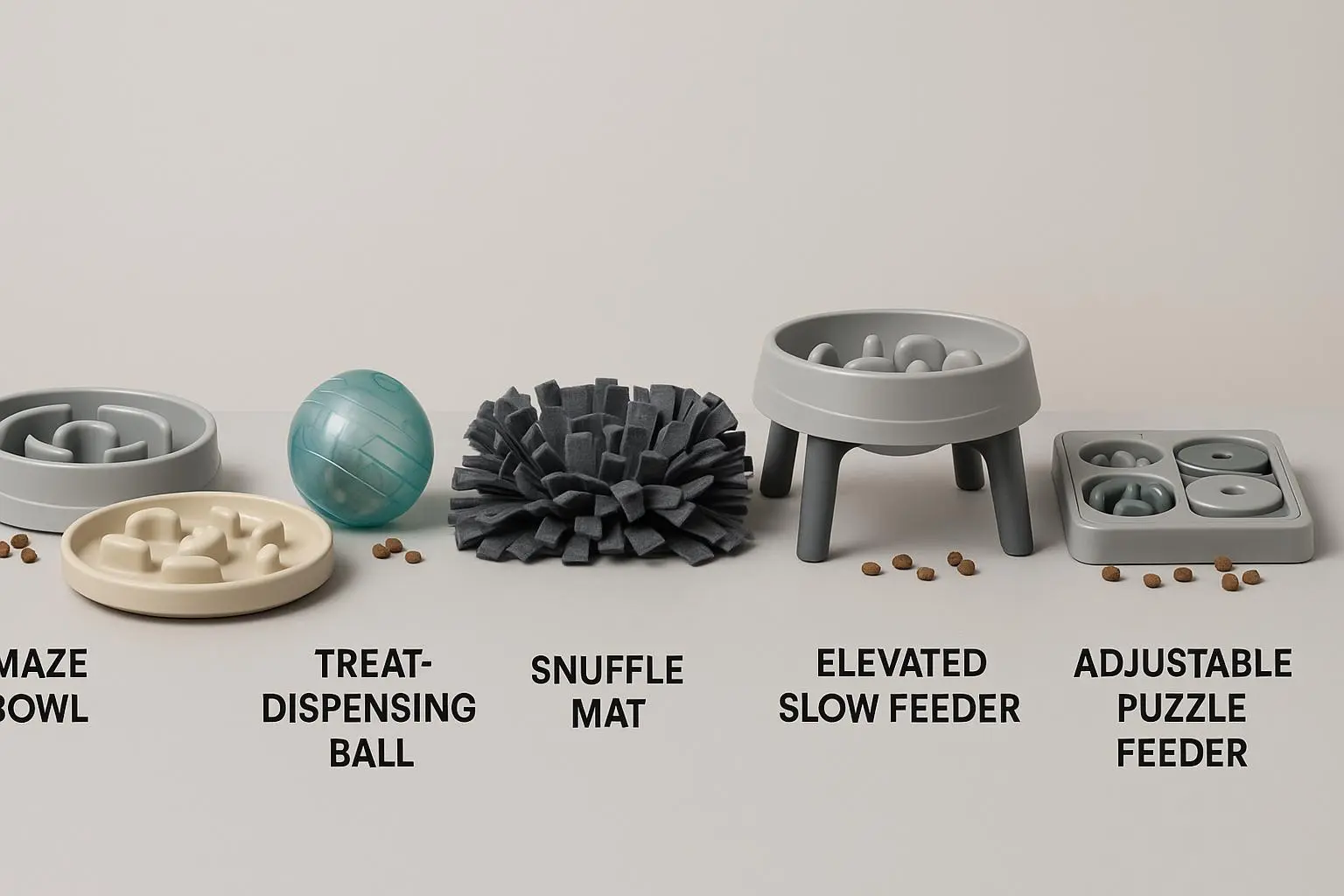
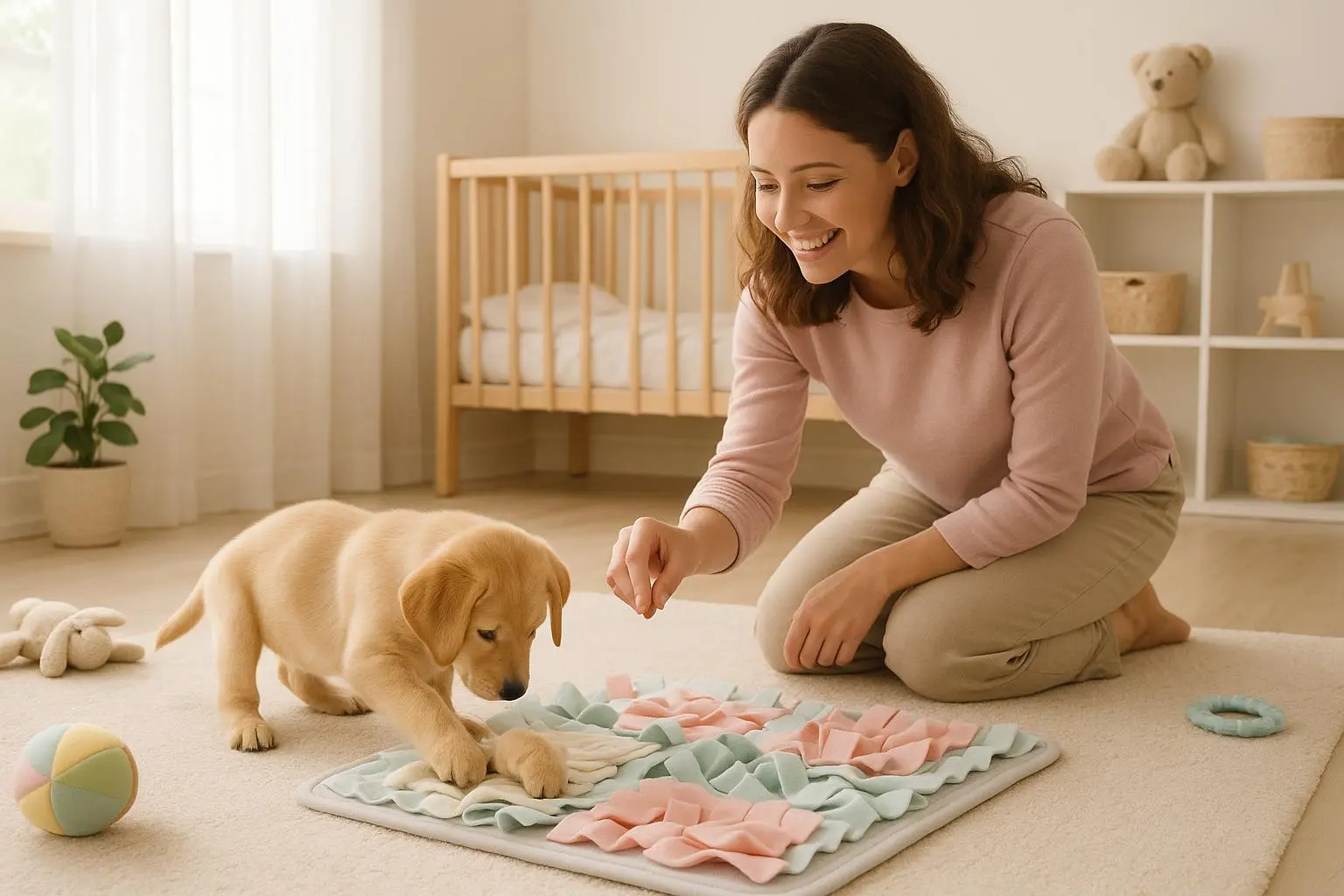
- Hide small kibble pieces under lightweight cups or inside easy snuffle mats.
- Let the puppy nose them out. Don’t time them or scold. Praise for sustained search.
- Do this before nap or bedtime—it’s mentally tiring in a good way.
Why scent? Dogs’ brains light up for smell. Scent work lowers heart rate and channels energy into focused actions. Owners report calmer evenings after a short scent session[4].
Weeks 11–16: Toy manners and controlled greetings (10–15 minutes)
What you want: positive, predictable social and play experiences without high arousal.
Module: Gentle toy introductions (10 minutes)
- Start one toy at a time. For tug, play low-to-the-ground, let the puppy “win,” and practice “drop it” with food rewards.
- Avoid high-speed chase games that encourage over-arousal and hard mouthing.
- Rotate toys so they remain interesting without becoming obsessions.
Module: Controlled greetings (15 minutes)
- Arrange very brief (1–3 second) calm greetings with vaccinated, stable adult dogs or polite people.
- Keep each exposure short and sweet. Reward calmness. Move away before the puppy gets wound up.
- Use private yards or SniffSpot-style spaces rather than crowded parks for first meetings.
Why this pacing works: Puppies learn that meeting new beings doesn’t need a spike of energy. A 3-second-calibrated interaction teaches restraint and positive expectation.
Toy safety: what to buy and what to skip
Good picks:
- Soft rubber toys (KONG-style) sized for the puppy’s mouth
- Food-stuffable toys and puzzle feeders
- Soft plush toys without small detachable parts (supervise)
Avoid:
- Antlers, hard bones, or very hard nylon (can break baby teeth)
- Long ropes that encourage high-arousal body shaking
- Tiny toys that can be swallowed
Veterinary techs report baby tooth damage from hard chews. I’ve swapped antlers for soft, food-stuffed KONGs and reduced dental drama dramatically.
A real story: when slow was the smartest choice (120–170 words)
When I fostered a jittery border collie mix, I followed every “expose to everything” rule on day one. I took him to three parks, a pet store, and the neighbor’s noisy BBQ. He shut down—eyes glazed, no interest in treats. I felt like I’d broken something.
So I started over. Five-minute windows: a towel on the porch, a cup with kibble under it, five minutes of quiet watching people pass from the car. Each day we stretched one tiny step. Two weeks later, he trotted into a calm backyard and sniffed a sleeping Labrador for ten seconds. That was the breakthrough: the world returned to curiosity rather than threat. Months later he was reliable on recall in the park. The lesson: quality, not quantity, and that “too much” can erase progress overnight.
Quick starters: 10 games that fit 5–15 minutes
- Cup hide (scent work): kibble under cups
- Texture trail: walk across three surfaces
- Sound-and-treat: whisper traffic sounds + kibble
- Look-at-that: mark and reward attention to novelty
- Snuffle mat session: slow, calm foraging
- Gentle tug short rounds: practice drop it
- Quiet fetch: low energy, soft ball
- Treat trail: small trail of treats leading back home
- Crate calm: sit 3 minutes in crate with a frozen treat
- Window watch: watch street activity from a safe distance
These are actionable—no special equipment required for most.
Teaching “drop it” gently
- Trade, don’t yank. Offer a high-value treat when the puppy has the toy.
- Use a consistent cue (“drop it”). Mark and reward the moment they release.
- Repeat short sessions. Let them win sometimes to build confidence.
- Stop tug if body goes stiff or growl becomes low and tense—seek professional help if that persists.
This method builds trust: the puppy learns giving up a toy equals something better, not punishment.
When to introduce other dogs and people
Introduce adult dogs only if:
- They’re vaccinated and stable
- They have a calm temperament around puppies
- The meeting is controlled (on-leash introductions in a neutral area or short, supervised off-leash in a private yard)
Introduce people slowly: distance first, then approach only if the puppy remains loose. Ask them to be quiet, crouch sideways, and offer a tiny treat rather than looming.
Never force a puppy to endure an interaction. Short, successful encounters are far better than long, scary ones.
The “fear period” and what it means
After about 12 weeks many puppies experience a fear period where things that were fine suddenly spook them. This is normal. The response should be to slow the pace, increase distance, and add more control—not to stop socialization. Keep exposures positive and predictable.
Printable 16-week checklist (short version you can copy)
Weeks 3–6
- Texture session 3x/week
- 5-minute sound desensitization 2x/day
- Daily calm handling (touch paws, ears) 1–2 minutes
Weeks 7–10
- “Look at That” practice 3–4x/week
- Beginner scent game 1–2x/day
- Short, calm people exposures (distance) 2–3x/week
Weeks 11–16
- Gentle toy play 3x/week
- Controlled dog/person greetings 2–3x/week
- Reinforce “drop it” daily in short sessions
If you want a printable PDF version, paste this checklist into any document and save as PDF.
FAQ for worried owners
Q: Did I miss the window if my puppy is older than 16 weeks? A: No. Later socialization is possible but needs gentler pacing and professional guidance for significant fear responses.
Q: My puppy growls during tug—should I stop? A: If it’s loose and bouncy, fine. If it’s stiff, stop and consult a professional. Always practice “drop it.”
Q: Aren’t puppies supposed to meet lots of dogs early? A: They should meet calm, vaccinated dogs in controlled settings. Quantity without quality is risky.
Tools and resources that actually help
- Use sound libraries with graduated volumes for desensitization to avoid DIY mistakes.
- SniffSpot or private yards for controlled, pressure-free socialization.
- A simple clicker or a single-word marker (“Yes!”) for precise timing during scent and look-at-that games.
Final note: small steps, big returns
I know the urge—to cram every experience into the first weekend. Resist it. Two five-minute focused sessions a day over weeks builds the kind of steady, calm confidence that looks boring in the moment and brilliant a year later.
Be consistent, be patient, and pay attention to the tiny signals. Your puppy is learning how the world works. Help them learn that it’s interesting, safe, and worth exploring slowly.
References
Footnotes
-
American Veterinary Society of Animal Behavior. (2019). Puppy Socialization Position Statement. Retrieved from https://avsab.org/wp-content/uploads/2019/01/Puppy-Socialization-Position-Statement-FINAL.pdf ↩
-
UC Davis Veterinary Behavior Team. (n.d.). Puppy Socialization Guidelines. Retrieved from https://www.vetmed.ucdavis.edu/sites/g/files/dgvnsk491/files/inline-files/Puppy_Socialization.pdf ↩
-
American Kennel Club. (n.d.). Puppy Training Timeline — Teaching Good Behavior Before It’s Too Late. Retrieved from https://www.akc.org/expert-advice/training/puppy-training-timeline-teaching-good-behavior-before-its-too-late/ ↩
-
Guidedog UK. (n.d.). Socialization Guidelines Under 16 Weeks. Retrieved from https://www.guidedog.org/PuppyRaising/PuppyRaiserManual/StartHere/Socialization_Guidelines_Under_16_Weeks.aspx ↩