The Cyclic Sigh for Creators: 90‑Second Breath Sets to Unstick Ideas
Jul 7, 2026 • 7 min
The blinking cursor, the blank canvas, the document you keep renaming—creative blocks feel loud because your body is loud. Tight chest. Shallow breath. Thoughts tunnel into one rigid loop: “I can’t do this.”
Here’s what I learned the hard way: you can’t think your way out of that tunnel. You have to change the body first. The cyclic sigh (a.k.a. the physiological sigh) is a two-inhale, one-long-exhale pattern that flips the nervous system from “alarm” to “curious.” It takes 30–90 seconds and, when used with a tiny prompt, reliably clears the fog so your brain remembers how to make connections again.
This isn’t vague wellness fluff. There’s lab work showing measurable shifts in respiratory rate, mood, and cognitive flexibility after brief practice. Use this exact mini-protocol before ideation, in the middle of a stall, or after a frustrating meeting. It’s cheap, portable, and usually stops the spiral fast.
Why breath actually matters for creativity
When you’re stressed your sympathetic nervous system narrows attention. That’s great for threats, terrible for ideas. Shallow breathing follows stress, which messes with CO2 levels and makes the body think there’s danger. The cyclic sigh corrects that by maximizing alveolar inflation with the second inhale, then forcing a long exhale to offload excess CO2 and stimulate the vagus nerve. The result: heart rate calms, breathing steadies, and your brain shifts toward the “rest-and-digest” mode where associative thinking likes to live.[1][2]
A controlled Stanford study compared cyclic sighing to other breathing patterns and found bigger gains in positive affect and reduced respiratory rate for people who practiced the sigh regularly.^[2] In plain terms: people felt calmer and breathed more efficiently after a few minutes a day.
The exact 90‑second protocol you actually use
No rituals. No apps required (but I’ll give options). Do this at your desk, in a hallway, or even in the bathroom stall if that’s where your ideas die.
The basic cycle:
- Inhale 1 (nose): 2–3 seconds, gentle
- Inhale 2 (nose): 2–3 seconds, a little sharper — top up the lungs
- Exhale (mouth, pursed lips): 4–8 seconds, slow and complete — like blowing a candle without snuffing it
Timing rules:
- Your exhale should be roughly twice as long as the combined inhales. If your double inhale totals 4 seconds, make the exhale ~8 seconds.
- Keep the exhale smooth; don’t force it out.
Session lengths (pick one):
- 30 seconds — ~4 cycles. Quick reset between tasks or pre-meeting.
- 60 seconds — ~8 cycles. Mid-session refresh during brainstorming.
- 90 seconds — ~12 cycles. Use before deep ideation or when you’re truly stuck.
Start with what feels comfortable. If 90 seconds sounds intense, do 30. Consistency beats intensity.
How to pair the sigh with a micro-script (this is the secret sauce)
Breathing calms the body. A quick verbal or written prompt directs the brain’s new openness toward your problem. Say the script aloud or type it into a note immediately after your set.
Script: Unstick a specific project “My nervous system is calm. My mind is open. What unexpected connection between [A] and [B] could move this forward?”
Script: Restart after frustration “I’m letting go of perfect. Show me one small, interesting move I can take right now.”
Script: Expand options “Name three weird directions this could go—nothing is off-limits.”
Those eight words after a 90‑second reset do more than feel nice. They provide a low-stakes invitation to associative thinking, which breathwork makes possible.
A short story: how I used a 90‑second set to salvage a pitch
Last year I had a pitch that went sideways. My slides felt flat, my voice tightened, and an hour before the client call my brain locked. I remembered the sigh, shut my laptop, and did a 90‑second set in the stairwell. After the third cycle I said, “Find a human moment we can show.” The idea that surfaced was embarrassingly simple: replace a statistic slide with a real client quote and a three-frame storyboard. We ran the call and the client leaned in. The meeting turned from a checklist to a conversation, and we landed the project that week.
What stuck with me: the change wasn’t dramatic. It wasn’t a revelation. It was a quiet loosening. The room felt a degree softer, my questions came from curiosity rather than defense, and the client responded. That’s the practical win.
Micro-moment: I still remember the faint mint smell in that stairwell and how the exhale felt like letting go of a small stone. It’s such a tiny sensory thing, but it anchors the memory and makes me reach for the technique again.
Troubleshooting — avoid dizziness and overdo
A few creators told me they tried this and felt dizzy or more anxious. Totally fixable.
If you get lightheaded:
- Slow down. Most dizziness comes from exhaling too forcefully or doing too many cycles in a row.
- Reduce cycles: do 4–6 per set for the first week.
- Pause: wait 30 seconds of normal breathing between sets.
If you feel tense in your face/shoulders:
- Drop your shoulders before you start.
- Keep your jaw soft. The double inhale should feel inviting, not strained.
If the second inhale feels impossible:
- Make your first inhale a touch shallower so the top-up can happen.
- Or skip the two-inhale pattern and do a slightly deeper single inhale followed by a long exhale, then work toward the double inhale over a few sessions.
Don’t exceed ~15 cycles per set. One 90‑second reset before a major session is enough for most people.
When to use it in your workflow
This technique is a micro-habit. Use it like you would stretch before heavy lifting.
- Morning ideation: 90 seconds before you open a new project.
- Mid-brainstorming slump: 60 seconds to break fixation.
- Before feedback: 30–60 seconds to soften defensiveness.
- When you procrastinate out of fear: 90 seconds to lower resistance and begin.
Consistency is more powerful than a single heroic session. In lab studies, people who practiced briefly across days showed cumulative mood and respiratory benefits.^[2]
What to expect — not a magic trick, a reset
This won’t instantly make you brilliant. It removes barriers: anxiety, narrowed attention, and shallow breathing. With the barrier lowered, you get better access to the brain’s natural associative engine. If you still need craft work (practice, research, iteration), those things still matter. But the sigh often makes the first step feel tolerable again.
People report:
- Faster idea emergence within minutes
- Less defensiveness during critiques
- Easier transition from stuck to sketching or drafting
And some won’t feel it—some people prefer a ten-minute walk or a different technique. That’s fine. This is a tool, not a mandate.
Tools and apps (if you want guidance)
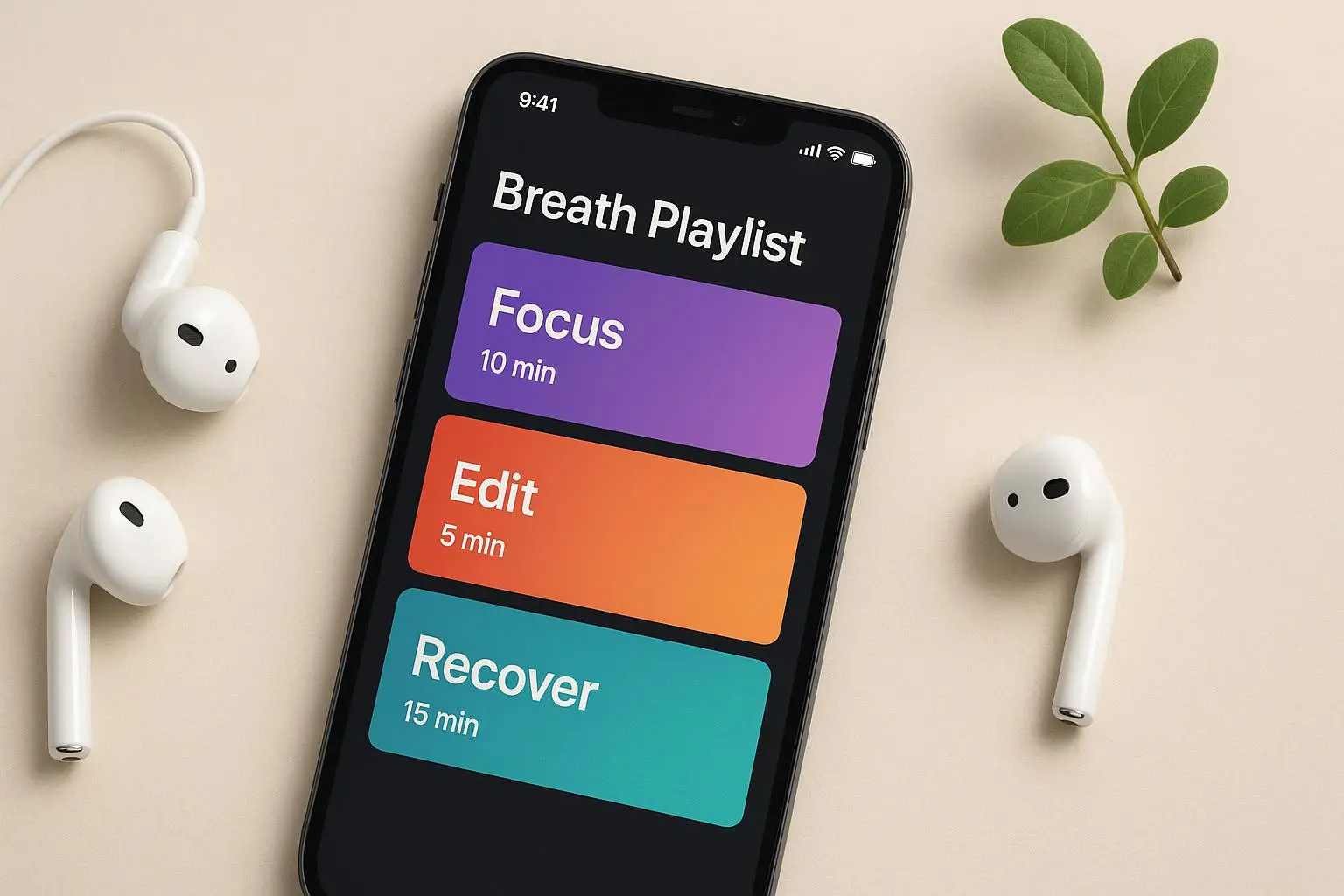
If you like visual pacing, a simple breathing app that lets you set custom inhale/exhale ratios helps. I prefer an app that offers haptic or visual cues rather than guided voice instructions — you want to be able to say your script right after the set.
Try:
- A simple breathing timer with customizable ratios
- The Huberman Lab resources for the neuroscience background[3]
- Insight Timer or a basic visual web timer if you want community-guided sessions
Quick FAQ
Q: How often can I do it safely? A: Several times a day is fine. Practically, one to three 30–90 second sets per work session is enough.
Q: Is it better for writers or visual artists? A: Works across domains. Anyone whose work requires generative, associative thinking benefits.
Q: What’s the main physiological change? A: Faster CO2 offload, vagal activation, and a reduction in respiratory rate—shifts that favor parasympathetic dominance and broader attention.
Q: Can breathing solve chronic creative block? A: It’s a tool. For persistent issues tied to deeper anxiety or depression, combine this with therapy or professional support.
The simplest way to start (do this now)
- Close your laptop.
- Do one 90‑second cyclic sigh set (or 30 if you prefer).
- Say: “What’s one small, interesting move I can take now?”
- Open a blank doc and write the first thing that comes, even if it’s messy.
That first messy thing is the important part. Breath clears the path; you still need to walk it.
References
Footnotes
-
Stanford Medicine. (2023). Cyclic sighing for stress relief. Retrieved from https://stanmed.stanford.edu/cyclic-sighing-stress-relief/ ↩
-
National Library of Medicine. (2023). Clinical and affective effects of cyclic sighing practice: randomized trials and daily-use studies. Retrieved from https://pmc.ncbi.nlm.nih.gov/articles/PMC9873947/ ↩
-
Huberman Lab. (2021). Science of Breathing for Stress, Sleep, Focus & Mood. Retrieved from https://hubermanlab.com/science-of-breathing-for-stress-sleep-focus-and-mood/ ↩