The 20-Minute Two-Bucket Method: Speed Variants That Don’t Swirl Your Paint
May 22, 2026 • 9 min
If you always end your car wash thinking, “Did I just trade grime for swirl marks?”—welcome. I’ve been washing cars for years and learned a simple truth: speed doesn't have to mean sloppy. The 20-minute two-bucket method is a compact, disciplined version of the classic two-bucket wash that protects paint without eating your whole afternoon.
This isn't a gimmick. It's a checklist of small, deliberate choices: which mitt you use, how often you rinse, where you apply pressure, and a strict sequence of panels. Do the little things right and you can leave the driveway with a clean car and no new micro-marring.
Below I’ll walk through a timed workflow, explain why each moment matters, share a real-world story where I learned the hard way, and give micro-timing drills you can replicate immediately.
Why the two-bucket method still matters when you're rushing
The core idea is painfully simple: keep dirty water away from your wash water. That prevents abrasive particles from riding back onto the paint via the mitt. The longer you spend scrubbing without rinsing the mitt properly, the higher the odds you’ll grind grit into clear coat.
In a 20-minute routine, you accept one reality: you won't deep-detail. You will, however, remove road grime safely if you structure the contact time and honor mitt cleanliness. That tradeoff—speed for careful contact—is where the two-bucket method shines.
What you need before you start (2 minutes to set up, not to be skipped)
Do not start the clock until everything is ready. The 20 minutes is contact time, not setup and teardown.
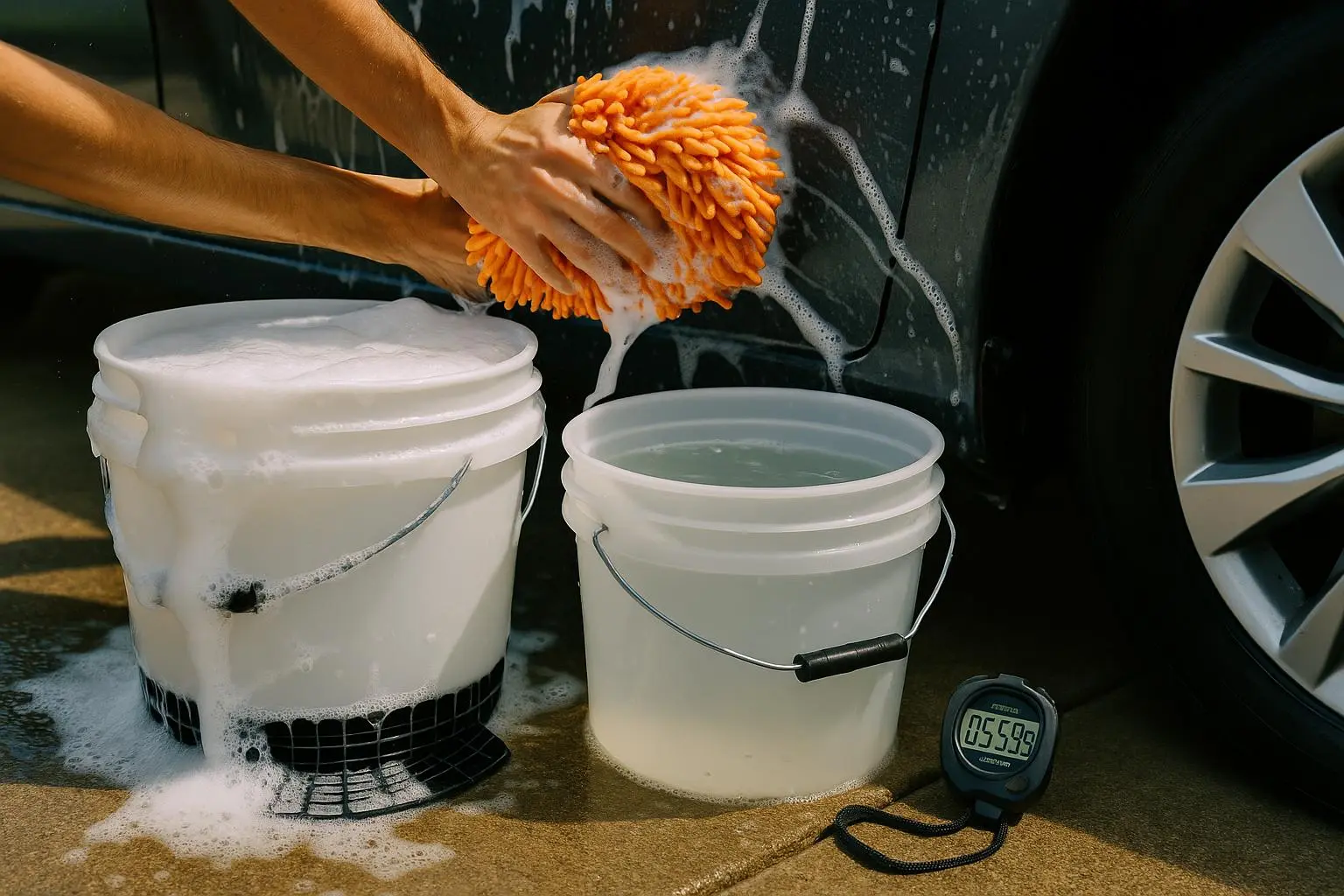
- Two buckets with grit guards. One for soap + mitt, one for rinsing.
- High-pile microfiber mitt (or lambswool). One spare mitt if you can swing it.
- pH-neutral car soap (concentrated; more lubrication).
- A leaf blower or car dryer and a 1000+ GSM drying towel.
- Hose with a spray tip, or a pressure washer/foam cannon if available.
Micro-moment: lay the towel flat in the shade near your exit point. You’ll be grateful later when you’re not fishing for a dripping towel while the car dries.
The timeline: 20 minutes, broken down realistically
Think of this as a clock you follow like a recipe. I’ll give time allotments and explain why they’re short but safe.
Phase 1 — Pre-soak and rinse (3 minutes)
- 0:00–0:30 — Quick setup and grab mitts.
- 0:30–2:30 — Blast loose dirt off the lower panels and wheel wells with a pressure washer or strong hose. If you have a foam cannon, 60 seconds of snow foam will help lift road film.
- 2:30–3:00 — Let the foam dwell briefly while you prep your buckets. If no foam cannon, spend the full time on a higher-pressure pre-rinse.
Why: chemical dwell time reduces the mechanical force you must use. That equals fewer swirls.
Phase 2 — The optimized wash sequence (12 minutes) This is the core. The sequence is top-to-bottom and one-pass per small section.
- 3:00–5:00 — Roof and upper glass (2 minutes)
- 5:00–8:00 — Hood and trunk (3 minutes)
- 8:00–12:00 — Passenger-side panels (4 minutes)
- 12:00–16:00 — Driver-side panels (4 minutes)
That's roughly 90 seconds for large, cleanable areas and 60 seconds for smaller panels. Why top-to-bottom? Dirt falls downward; start clean and work toward the dirtiest areas last to avoid reintroducing grime.
Mitt management (do this every 30–90 seconds) After every panel or half-door:
- Dunk the mitt in the rinse bucket.
- Rub it aggressively on the grit guard—twice.
- Wring it by hand or squeeze, then dip into the wash bucket.
If you have a second mitt, use one for the roof/upper panels and the other for lower panels. That buys safety for minimal added time.
Why it matters: the rinse bucket is your single biggest defense against sanding the paint.
Phase 3 — Pressure and motion check (2 minutes) Before you go wild, rehearse two things on an inconspicuous area (like inside the wheel arch or the lower corner of the trunk).
- Arm pressure: use only the weight of your arm. Think "feather touch." If the mitt compresses flat, you’re pressing too hard.
- Motion: strict straight-line strokes—front-to-back or side-to-side. No circles.
Do this twice for 30–45 seconds. It resets your muscle memory so you don’t ramp up pressure when under time pressure.
Phase 4 — Rinse and dry (3 minutes)
- 16:00–17:00 — Final rinse with an open hose for sheeting action. Low pressure sheets water away and reduces spotting.
- 17:00–19:00 — Hit crevices and mirrors with the blower for 60–90 seconds.
- 19:00–20:00 — Towel finish: pat and lay the high-GSM towel flat and drag gently.
Drying with a blower first is faster and far safer than towel-only finishing.
The tools and why they matter (skip the fluff)
- Mitt: high-pile microfiber or lambswool. The pile traps grit; short-pile or cheap sponges push grit around.
- Grit guard: worthless if you don’t scrub the mitt on it. Use it properly.
- Soap: pH-neutral, highly lubricating. Concentrated formulas reduce drag.
- Dryer/leaf blower: a 1,200–2,000 CFM unit cuts drying time and touch-time risks.
If you buy one upgrade: a second mitt. It’s the cheapest insurance against rushed contamination.
Real story: the wash that taught me to slow down (110 words)
A few years ago I tried a 15-minute “fast” wash before a weekend meet. I skipped the foam can and rinsed the mitt lazily. The car looked great until I parked under the mid-morning sun—spiderweb swirls everywhere on the hood. Fixing it cost me an evening of compounding and a costly polish. After that I started timing every step. The 20-minute routine is born from that mistake: a few extra minutes for pre-soak and aggressive mitt rinsing saved me hours of correction later. Fast felt great then; costly felt worse for longer.
Quick troubleshooting: common speed-wash mistakes and fixes
- Problem: visible swirls after drying. Fix: you likely compressed the mitt or used circular motions. Re-learn straight-line passes and reduce pressure.
- Problem: mitt still gritty after rinsing. Fix: scrub it harder on the grit guard and consider a second mitt for lower panels.
- Problem: drying drags dirt. Fix: blow more water out of crevices first; use high-GSM towel and pat instead of harsh dragging.
Variants for different scenarios
Apartment dweller (limited water): use a rinseless wash product for the panels you can’t reach with a hose. Save the two-bucket for weekends.
Coated cars: ceramic or sealant reduces friction. You can be a touch faster—but don't skip the rinse steps. Coatings make things safer, not indestructible.
Heavily soiled car: not a 20-minute job. Pre-soak longer or postpone. Trying to compress a filthy car into 20 minutes invites scratches.
The arm-pressure and motion drill you can do in 60 seconds
Set a timer for 60 seconds. With a loaded mitt on the roof:
- 0–20s: front-to-back strokes using only the weight of your forearm.
- 20–40s: repeat on hood.
- 40–60s: repeat on a lower panel with the second mitt (if you have one).
If you feel yourself pushing, stop. Reset. That small discipline carries into the whole routine.
Small sacrifices that save big time later
- Use a foam cannon if available. Two minutes of foam can save polishing hours.
- Spend 60 extra seconds on the rinse bucket routine—it's the cheapest time investment for paint safety.
- Keep a dedicated “lower panel” mitt. It costs $12–$20 and prevents an expensive polish.
When not to use the 20-minute method
If the car is caked in tar, bird droppings, or road salt, the 20-minute method is a risk. So is washing a gritty, dried-on film without proper pre-soak. Know when the shortcut becomes a liability.
Quick checklist to hang near your buckets
- Buckets filled, grit guards in place
- Two mitts (optional), soap diluted, towel ready
- Blower/dryer near exit point
- Pre-rinse or foam cannon ready
- Timer set to 20:00
If setup takes more than two extra minutes, treat the 20 minutes as strictly contact time—not total time.
Final thought: consistency beats heroics
Doing a careful 20-minute wash once every week will keep your paint in better shape than an hour-long deep detail once every three months. The method isn’t magic. It’s about honoring the small things—mitt cleanliness, gentle pressure, one-pass discipline—that professionals have practiced for years.
If you take away one piece of advice: don’t let “fast” be an excuse for sloppy mitt management. Rinse. Scrub on the grit guard. Repeat.