Ceramic Coating vs Paint Protection Film: A Practical Decision Flow for Every Driver
May 20, 2026 • 8 min
If you’ve ever stared at a brand-new hood and wondered which hype to believe — “ceramic for the shine” or “PPF for the chips” — you’re in the right place. I’ll avoid the marketing fluff and walk you through a practical, use-case-first decision flow that matches protection to how you actually drive.
Short version: PPF is physical armor. Ceramic coating is a slick shield. Often the best choice is both — but only if it fits your driving patterns and budget. Here’s how I decide, and how you can too.
How these two actually protect paint
Quick primer — two-sentence definitions so we’re not arguing semantics.
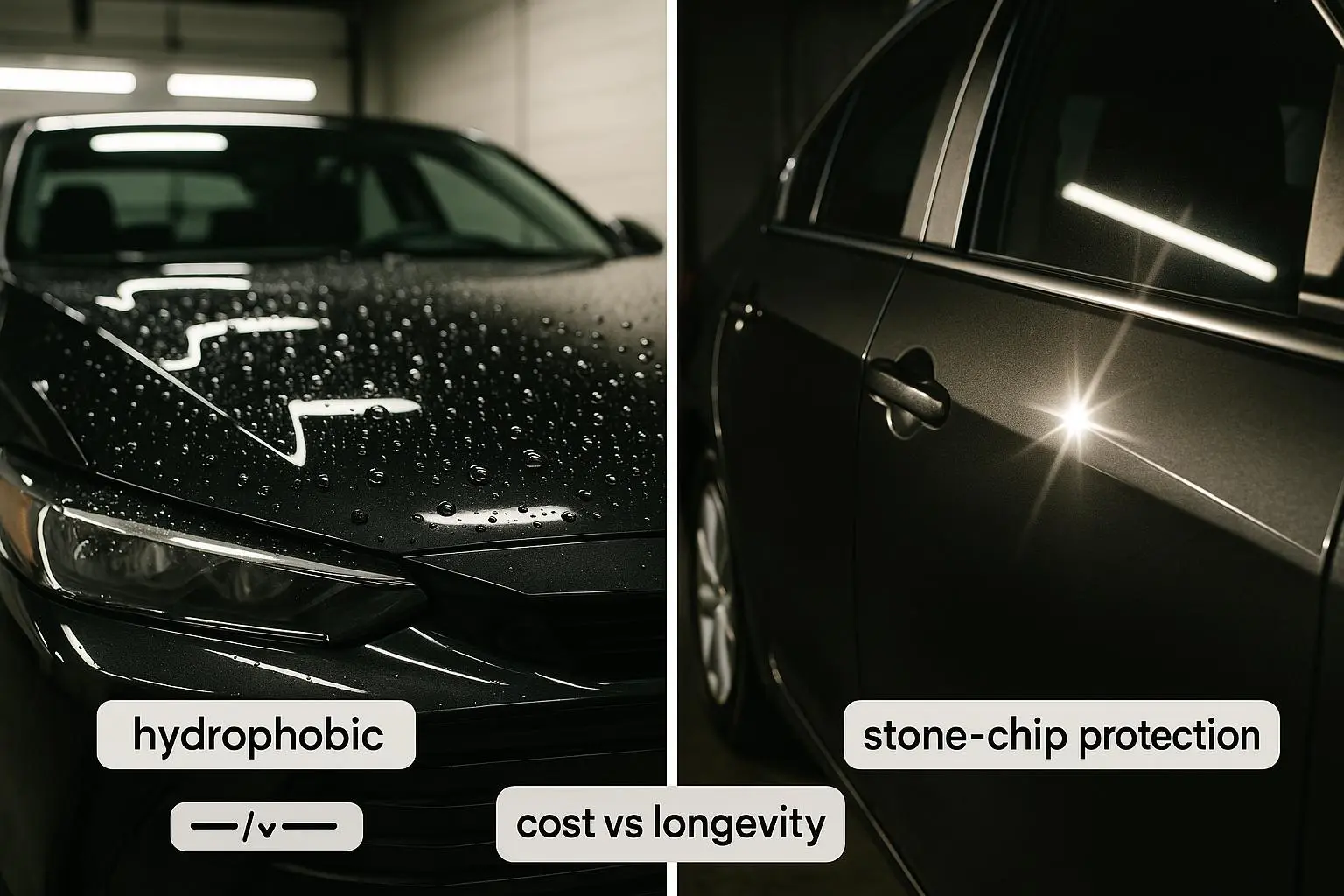
- Ceramic coating: a liquid SiO2 (or similar) polymer that bonds to your clear coat and makes the surface extremely hydrophobic, chemically resistant, and glossy. Great for ease of cleaning and swirl resistance; not made to stop rocks.
- Paint Protection Film (PPF): a thick thermoplastic urethane film applied over paint that absorbs impacts, self-heals small scratches, and physically blocks chips and abrasions.
They overlap on UV protection and easier cleaning, but they solve different problems.
What matters most: real-world performance, not marketing
Here’s how they compare in the things you actually care about.
- Scratch & chip protection: PPF wins. Period. It’s the sacrificial layer that takes the abuse. Ceramic helps with micro-scratches from washing but won’t stop a rock.
- Hydrophobicity & cleaning: Ceramic wins. Water beads and rolls off. PPF with a ceramic-like topcoat helps, but usually not to the same extreme.
- Durability: High-quality PPF can last 5–10+ years. Ceramic coatings are typically 2–5 years depending on the product and prep.
- Cost: PPF costs more up front (often $2k–$8k for large coverage). Ceramic professionally applied usually runs $500–$2k. On a per-year basis PPF can be competitive because it lasts longer.
- Installation: PPF is a pro job. Ceramic can be DIYed with decent results if you’re meticulous about prep.
If you want the receipts, installers and manufacturers publish longevity and warranty details — read them, don’t just look at glossy ads.[1][2]
A practical decision flow (read this like a flowchart)
Think of these as questions you’re answering about your vehicle.
- What's your primary use?
- Daily commuter on highways: If you hit lots of gravel or road debris frequently, prioritize PPF on the front clip (bumper, hood, fenders, mirrors). If most of your driving is clean city streets, a ceramic coating is usually enough.
- Off-road or rural roads: PPF. Full-coverage PPF if trails and brush are regular. Ceramic alone won’t save you.
- Show car / garage queen: Ceramic coating for the gloss and effortless maintenance. PPF if you still plan to drive and want chip protection.
- Highway commuter in a sunny climate: Ceramic + targeted PPF for the nose if bugs and small road debris are an issue.
- What’s your budget?
- Tight budget: Start with a ceramic coating (DIY kits exist). Accept shorter lifespan and reapply as needed.
- Willing to invest for long-term protection: PPF on high-impact areas, ceramic on top for gloss and easier cleaning. Yes, it’s the most expensive route, but it’s also the most protective.
- Do you want to DIY or use pros?
- PPF: pro-only, unless you’ve installed countless films before.
- Ceramic: DIY is doable, but paint correction and prep matter. If you want warranty-backed longevity, go pro.
- Do you have ADAS or special glass concerns?
- Anything applied to windshields or around cameras requires an installer who understands ADAS calibration. Ask them directly; improper film or adhesive can interfere with sensors.
How I decided for my own cars (a real story)
I’ve bought protection for three cars in the last five years and learned the expensive way that “one size fits all” doesn’t work.
My commuter (2017 hatchback): drove 25 miles each way on a highway with a lot of loose gravel. First year I ceramic-coated it and loved the shine — and hated the chips that showed on the bumper. Year two I paid for a PPF install on the front bumper and hood edges, then ceramic coated the entire car. Outcome: zero paint chips after two seasons and washing dropped from weekly to every other month. Total spent: $3,200 (PPF front + full ceramic). Resale impact: sold the car two years later at market rate but with no visible chips — it made the listing easier and avoided negotiation headaches.
My weekend car (black coupe, garage-kept): ceramic only. It lives indoors, rarely sees gravel, and I care about depth of gloss above all else. Cost: $900 pro ceramic. It looked showroom-fresh with minimal upkeep.
The lesson: match coverage to risk. I saved money by not wrapping every inch of the commuter, and I didn’t overbuy for the garage car.
Micro-moment: I still remember the way rain beaded on the coupe after the ceramic job — like tiny glass beads sliding off a mirror. Small things add up to big satisfaction.
Installation and maintenance — what to expect
- Prep is the secret. Ceramic coatings only last as long as the prep work. If paint correction isn’t done, the coating traps defects. Ask your installer about the number of correction stages.
- PPF installers use plotter templates and heat shaping to avoid seams and lifting. Cheap installs show edges and bubbles months later.
- Washing: use pH-neutral soap, soft mitts, and avoid abrasive brushes. For PPF edges, keep pressure washers at an angle and not too close.
- Reapplication signals: PPF that yellowed or peeled, ceramic that loses hydrophobicity (water stops beading), or visible wear on high-contact zones.
- Warranties: read the fine print. Some PPF makers offer 7–10 year warranties against yellowing; ceramic warranties are often product-duration-based but may require professional maintenance checks.
ADAS and glass — don’t guess here
If your car has lane-keep assist, adaptive cruise cameras, or windshield-mounted sensors, have the installer confirm compatibility before applying film or coating to glass. Improper application can affect sensor calibration and liability. If they can’t answer confidently, find another shop.
Printable placard you can bring to a shop
Cut-and-paste this into a note or print it out before you meet an installer.
- Vehicle protection goals: (circle) chip resistance / gloss / ease of cleaning / UV protection
- Preferred protection: (circle) PPF front clip / full-vehicle PPF / ceramic coating / PPF + ceramic
- ADAS: (circle) Yes / No — if yes, model and features: ****___****
- Prep expectations: paint correction stages required? Y / N
- Warranty: product length ___ ; installation coverage ___
- Maintenance: recommended products & schedule ****___****
- Timeline: expected duration of work ___ ; pickup date ___
Hand that to the shop and ask them to initial each item. It clarifies expectations and reduces “I thought you meant…” moments.
Common mistakes people make
- Buying the prettiest brochure instead of asking about prep stages and warranties.
- Assuming ceramic prevents rock chips. It doesn’t.
- Trying DIY PPF on curved, detailed panels. Bubbles and trimmed corners are common.
- Not asking about ADAS — this can be costly if sensors need recalibration later.
Final, practical recommendations
- If your priority is preventing rock chips and you drive on highways or gravel: PPF on the high-impact areas.
- If your priority is gloss, easier cleaning, and chemical resistance: ceramic coating.
- If you want both: PPF over the most exposed areas, ceramic over the whole car (including the PPF top coat) is ideal.
- If budget is the limiting factor: start with a pro-applied ceramic or a DIY ceramic for older daily drivers. Upgrade to PPF in high-risk zones later.
- Always vet installers: ask for before/after photos of the exact model, a written warranty, and a clear prep checklist.
There’s no single “best” product for everyone. Protect what matters, spend where the risk is highest, and make your decision based on how, where, and how often you drive.
References
Footnotes
-
AutoCosmetics. (2023). Understanding the Difference Between Paint Protection Films and Ceramic Coatings. Retrieved from https://www.autocosmetics.org/blog/understanding-the-difference-between-paint-protection-films-and-ceramic-coatings ↩
-
Hexis Americas. (2024). Paint Protection Film vs Ceramic Coating: Which is Better for Your Car?. Retrieved from https://www.hexisamericas.com/2024/06/27/paint-protection-film-vs-ceramic-coating-which-is-better-for-your-car/ ↩