Reversible Redaction + PCC: Practical Patterns to Keep Sensitive Drafts Local
Mar 31, 2026 • 9 min
You want the power of system AI—summaries, suggestions, code fixes—without handing your secrets to the outside world. I’ve seen two naïve responses to that problem: (1) lock everything down and never use AI, or (2) hope nothing leaks. Both are reasonable until your legal team waves the compliance documents at you.
There’s a third way that actually works in production: reversible redaction combined with Privacy‑Preserving Computation (PCC)-aware workflows. It’s not magic. It’s a set of practical patterns—token generation, secure mapping stores, UI approval flows, and CI checks—that let AI touch drafts without touching secrets.
Here’s how to build that middle path, what to watch for, and concrete recipes I’ve used that caught actual mistakes before anyone saw them.
Why reversible redaction matters (and what it really does)
Permanent anonymization destroys data. Reversible redaction temporarily replaces sensitive values (names, keys, account numbers, proprietary phrases) with safe tokens. The redacted draft goes to your AI or to reviewers. The mapping between tokens and originals lives in a vault under strict control. Rehydration—turning tokens back into originals—only happens in audited, authorized contexts.
This is useful because models can still understand structure, intent, and context without ever seeing a secret value. You get the benefit of AI’s language understanding while shrinking the blast radius of a leak.
Think of it like sending a labeled sketch to a consultant instead of the original blueprint: they can comment on layout and flow without learning your trade secret.
Pattern 1 — Token generation: recipes that actually hold up
Bad tokens are worse than none. If someone can guess or brute force tokens, you’ve just papered over risk.
Here are token recipes I’ve used, with trade-offs and one-line examples:
UUIDs (v4): quick, collision-resistant, but offer no cryptographic binding to data. Use when mapping store is heavily protected and you need simple tooling.
- Example token: 3f9a4f1e-6b2c-4d8a-9f2e-7a8b5c1d2e3f
Salted hash (SHA-256 + per-item salt): deterministic if you store the salt, harder to brute force than plain hashes.
- Example: token = SHA256(sensitive_value || random_salt)
- Use when you need idempotent tokenization (same input yields same token) for deduplication.
Format-Preserving Encryption (FPE): keeps data format (e.g., credit card 16 digits), good when downstream tools require valid-looking formats.
- FPE is heavier—use NIST-recommended modes and audited libraries[1].
Deterministic encryption with envelope keys: encrypt value with a data key, then encrypt the data key with a master key stored in Vault. This supports search and rehydration while limiting key exposure.
My rule: pick the simplest approach that meets the operational need and regulatory constraints. Start with salted hashes or UUIDs for drafts; move to FPE where formats drive UX.
Pattern 2 — The mapping store: treat it like an HSM even if it isn’t
The mapping store links tokens to originals. It’s the crown jewels. Design it as if an attacker will target it tomorrow:
- Use a dedicated secret store (HashiCorp Vault, cloud KMS-backed DB) and enable field-level encryption.
- Enforce strict RBAC plus MFA. Only the tiniest number of service principals and humans should ever be able to rehydrate.
- Audit everything. Logs should include who requested rehydration, why, the token, timestamp, and approval chain.
- Add geographic isolation if you have data residency rules. Keep mapping stores in the required region, separate from AI processing clusters.
A warning from experience: storing mappings in the same database as your app’s dev data is where mistakes happen. Separate the store and manage it with secret-tooling people actually understand.
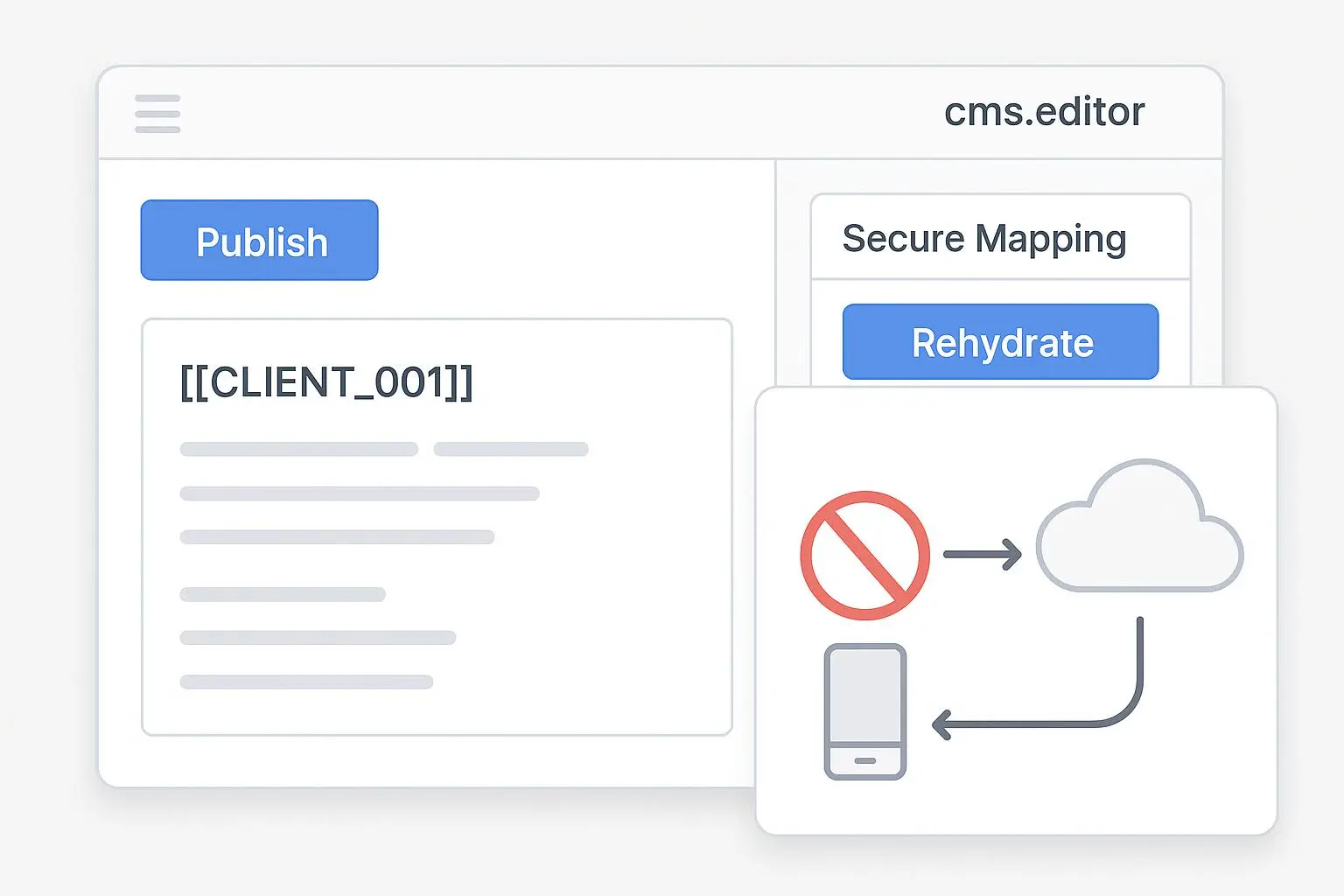
Pattern 3 — UI approval flows: make rehydration a deliberate act
If rehydration can occur with a single click, it will happen accidentally.
Design the UI so revealing sensitive data is a multi-step, resist-easy path:
- Default view shows tokens and redactions.
- To rehydrate, require an explicit justification field (free text), manager approval, or a second auth factor.
- Display the audit implications up front: “This action will be logged and emailed to security.”
- Provide a temporary reveal window (e.g., 5 minutes) and automatic masking after the session ends.
- Record the exact rehydrated snippet and context in a tamper-evident audit trail.
I once watched an engineer accidentally paste a rehydrated snippet into a public sandbox. The UI saved us: after typing a justification and getting manager approval, she had to confirm a second time. That pause was the hot second for sanity checks. It should be awkward to rehydrate.
Pattern 4 — CI/CD: automated checks that stop mistakes before they hit production
Treat accidental rehydration like any other code bug—catch it in CI.
- Pre-commit hooks: scan for sensitive patterns (API keys, SSNs, prod DB URIs). Reject commits that contain them.
- CI linters: fail builds if unredacted patterns appear in artifacts, generated logs, or test fixtures.
- Integration tests: verify that pipelines only feed tokenized data to AI endpoints.
- Secret scanning in build artifacts: stop builds that include mapping-store credentials or decryption keys.
- Policy-as-code: encode who can approve rehydration, and enforce via CI gates.
DevOps teams I worked with found these checks caught stray secrets in .env files, logs, and test dumps that would have leaked in a million small ways. One saved incident where a test suite printed production emails to CI logs—caught and stopped automatically.
Pattern 5 — Key management and crypto hygiene (don’t wing this)
Key management is the weakest link if treated casually.
- Use a dedicated KMS (cloud provider KMS or Vault).
- Rotate keys regularly and automate rotation.
- Separate keys for token generation, mapping-store encryption, and transport-level TLS.
- Implement key usage policies: keys that decrypt mapping stores should live on different principals than keys that generate tokens.
- Consider hardware-backed modules (HSMs) for higher assurance.
If you can’t explain your key hierarchy on a whiteboard in under five minutes, simplify it. Complexity invites mistakes.
Operational considerations and costs
Yes, there’s overhead. Expect:
- Storage and compute costs for mapping stores and additional cryptographic operations.
- Engineering time to instrument approval flows and CI checks.
- Possible latency when rehydration requires live vault access.
But the ROI shows up in two ways: risk reduction (fewer incidents, regulatory fines, and reputational damage) and practical ability to use AI safely. IBM’s 2023 breach cost report gives this a hard number: a breach is expensive—often millions[2]. Investing in controls that reduce blast radius is cheaper than the cleanup.
Real story: how this saved a release (100–200 words)
A while back my team was running a model-assisted redline for internal contracts. We tokenized client names and account numbers and let the model suggest clause edits. On the final sprint, a contract reviewer accidentally triggered a local script that rehydrated tokens into a staging document and pushed it into a shared S3 bucket. CI scans flagged the staged artifact—our pre-deploy linter found patterns matching the client account format and failed the pipeline.
Because we had an audit trail and clear rehydration approvals, we traced the misstep to a developer test script that bypassed the client app’s rehydration API. Fixing it took two hours and a postmortem; without those CI checks and the mapping-store protections we’d have leaked a client name to contractors. The small investment in the tokenization and CI linters saved us from a data breach and a scrambling exec meeting.
Micro-moment: a tiny detail that stuck with me (30–60 words)
During that postmortem, the thing that stuck with me was a single log line: "REHYDRATION_REQUEST user=alice justification='for release note verification'". Seeing a human phrase in a machine log reminded me that security is as much about human workflows as it is about crypto. Make the UI require intentional words—people pause when they have to explain themselves.
How to get started this week (concrete next steps)
If this is new for your org, don’t boil the ocean. Do these four things:
- Identify the top 5 sensitive patterns (PII, client names, secret tokens, project codenames).
- Implement a tokenization library (UUID + salted hash) and protect the mapping store in Vault.
- Add a CI lint rule to fail builds that contain any of those raw patterns.
- Design a one-page UI flow for rehydration that requires justification and a second approval.
Ship the minimal viable redaction. Iterate after one month of real use. Expect friction—measure it. If your legal and privacy teams still hate it after a month, you’ve learned fast. If they love it, you’ve earned trust.
When reversible redaction isn’t enough (and what to do)
Sometimes tokenization isn’t the right answer:
- If analytics require raw values for model training, consider privacy-preserving alternatives: secure enclaves, federated learning, or homomorphic/SMC approaches.
- For regulatory obligations requiring irreversibility, you’ll need true anonymization or data minimization.
- For high-throughput systems where token-decisions must be realtime, FPE or deterministic encryption may be necessary for performance.
Treat reversible redaction as a practical tool in a larger privacy toolbox—not the only tool.
Final checklist before you rely on this in production
- Tokens are cryptographically suitable for your threat model.
- Mapping store is isolated, encrypted, and audited.
- UI requires explicit justification and approval to rehydrate.
- CI prevents accidental leakage into artifacts or logs.
- Keys are managed by a KMS and rotated.
- You’ve run a tabletop exercise simulating accidental rehydration.
If you can tick those boxes, you’ve built a system that lets teams safely use AI on sensitive drafts without giving the AI free access to secrets.
References
Footnotes
-
Elaine Barker. (2016). Recommendation for Block Cipher Modes of Operation: Methods for Format-Preserving Encryption. National Institute of Standards and Technology (NIST). Retrieved from https://nvlpubs.nist.gov/nistpubs/SpecialPublications/NIST.SP.800-38G.pdf ↩
-
IBM Security. (2023). Cost of a Data Breach Report 2023. Retrieved from https://www.ibm.com/reports/data-breach ↩