Microportioning: How to Use a Kitchen Scale to Feed Your Dog Precisely
Aug 6, 2026 • 8 min
If you’re still eyeballing scoops or "winging it" with measuring cups, you’re not doing your dog any favors. Scoops lie. Kibble density lies. Your good intentions don’t change the math.
Microportioning—measuring dog food by weight (grams) and calories—fixes that. It’s the difference between "close enough" and "exactly what the vet ordered." Below I’ll walk you through why grams beat cups, how to get from daily calories to grams, quick workflows for busy mornings, how to account for treats and toppers, and what to do if you have multiple dogs with different diets.
I’ll also tell a real story about when I switched my own dog to gram-based feeding and what happened. Short version: the scale paid for itself in sanity and fewer vet visits.
Why grams beat cups (and why you should care)
A cup is a volume. A gram is a mass. That sounds obvious, but it’s the whole problem.
Different kibbles have wildly different densities. One brand’s "1 cup" might be 90 grams; another brand’s might be 130 grams. How tightly you pack the scoop, whether you level it, and the kibble shape all change the result. Studies and vets report people commonly overfeed by 15–25% when relying on cups or scoops. For a 20 kg dog, that’s hundreds of extra calories a day.
Feeding by grams removes those variables. One gram is always one gram. When weight—and therefore calories—matter (weight loss, kidney disease, diabetes, puppy growth), precision stops guessing and starts working.
Micro-moment: When I first weighed a "level" cup from a fresh bag, it was 20 grams heavier than the label implied. That was the little reveal that made me stop blaming metabolism and start tracking grams.
The one-time setup (do this before you weigh anything)
You only have to do a few things once per food type:
- Get the kibble’s calorie info (kcal/cup or kcal/kg) from the bag or manufacturer.
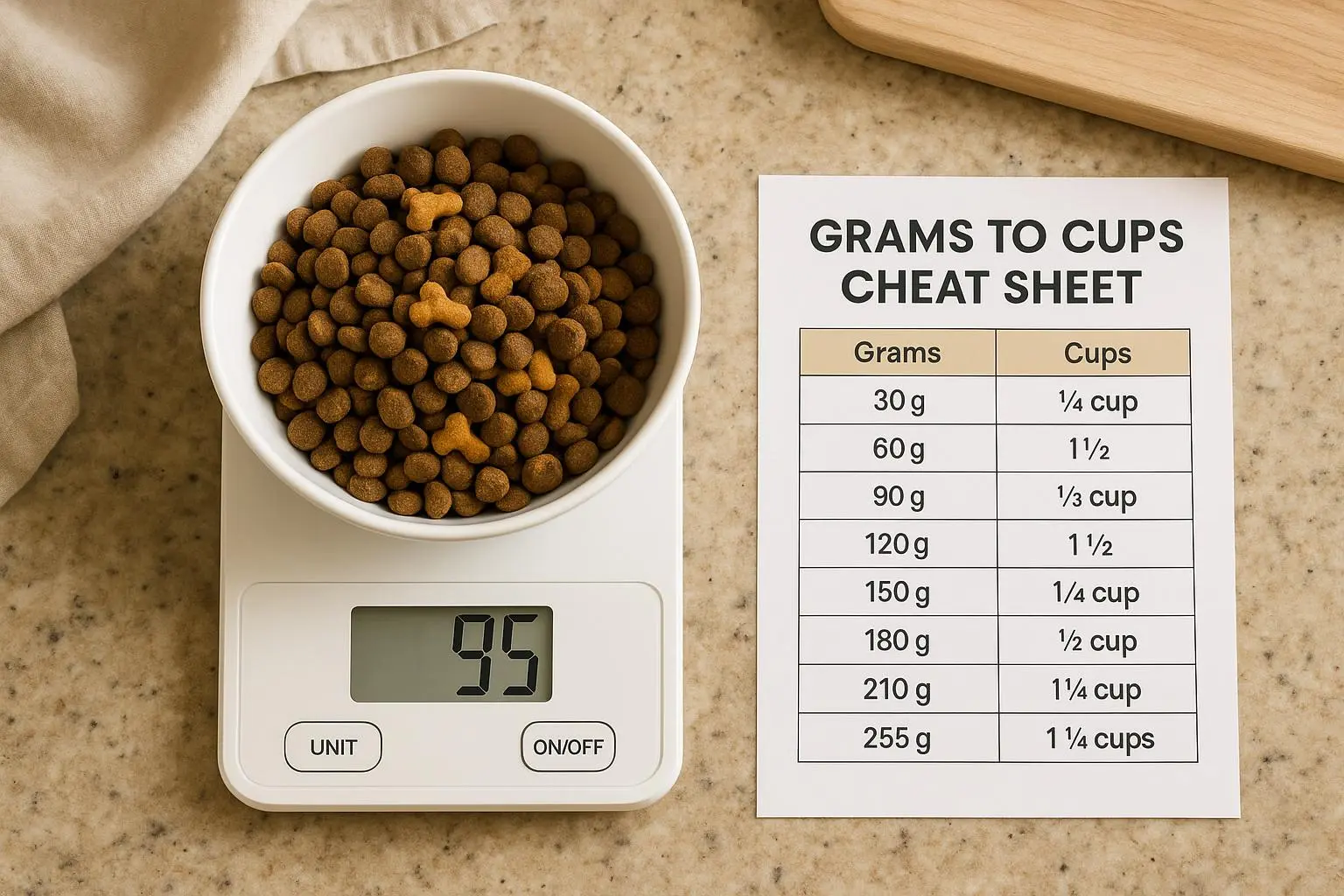
- Weigh a level cup of that kibble to find grams per cup.
- Calculate kcal per gram (kcal/cup divided by grams per cup).
After that you can convert any calorie target into grams quickly. Repeat if you change foods or batches.
Step-by-step: From vet’s calorie target to grams on the scale
Step 1 — Find the daily calorie target
- Ask your vet for your dog’s daily maintenance calories (MER). Don’t rely on the bag chart; it’s generic.
- Example: Vet says 700 kcal/day.
Step 2 — Find the kibble’s caloric density
- If the bag lists kcal/cup and you now know the weight of a cup of that kibble (we’ll measure that next), divide kcal by grams.
- Example: Bag says 400 kcal/cup. You weigh 1 cup = 115 g. Density = 400 / 115 = 3.48 kcal/g.
Step 3 — Convert calories to grams
- Divide daily kcal by kcal/g to get grams/day.
- Example: 700 kcal / 3.48 kcal/g = 201 g/day.
Step 4 — Weigh and serve
- Tare (zero) your scale with the empty bowl.
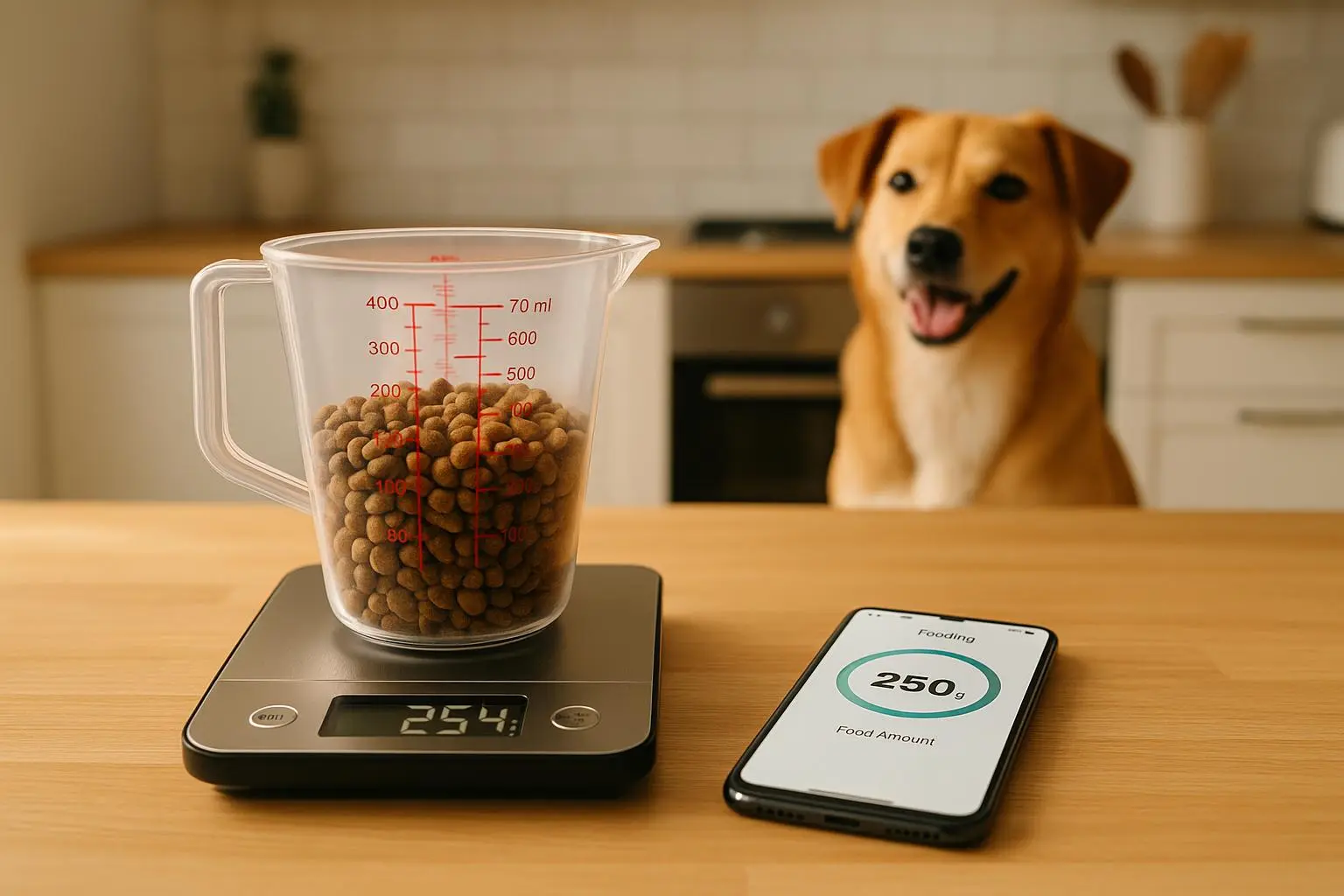
- Pour kibble until the scale reads the meal’s gram target (or pre-portion for the day).
- Divide into meals if needed. 201 g/day → two meals of ~100.5 g.
Quick tip: Keep a simple note on your fridge: "Food X = 3.48 kcal/g → 201 g/day" so you don’t recalc every time.
How to weigh 1 cup of kibble (so your conversions are accurate)
- Place an empty bowl on the scale, press TARE.
- Fill a standard measuring cup (level it like you normally would).
- Pour that cup into the bowl and record grams.
Do this three times and take the average. Kibble can settle differently depending on the bag and the scoop, so averaging reduces one-off errors.
Factoring treats, toppers, and squeezes of love
Treats add calories—and quietly so.
If your dog’s MER is 700 kcal and you give 100 kcal in treats/toppers, your main food should supply 600 kcal. Convert that 600 kcal to grams with the same kcal/g number and adjust portions accordingly.
Weigh treats too. A single dental chew can be 50 kcal or 150 kcal depending on the brand. That adds up.
Practical approach:
- Weigh and log the treats you give in a week. Average the daily treat calories.
- Subtract that from the daily MER.
- Convert the remainder to grams of kibble.
Storytime (real): My dog, Ruby, was on a weight-management plan. I thought her morning "training handful" was nothing. One vet visit later, the tech pointed out the training treats were 120 kcal/day. After swapping them for air-dried liver pieces that were 10 kcal each and adjusting her kibble grams by 35 g/day, Ruby lost the stubborn pound in five weeks. Small treats make big differences.
Busy mornings: quick workflows that actually work
If you dread adding "weigh dog food" to your AM checklist, try one of these:
- Batch prep: Sunday night, weigh daily portions into labeled bags or containers for the week. Takes 10–15 minutes for two dogs. Grab-and-go solves mornings.
- Pre-weighed containers: Use small airtight containers or collapsible silicone "dog bowls" you can take on walks.
- Scale on a shelf: Keep the scale and a bowl in the feeding area. When it’s visible and handy, you’re less likely to skip weighing.
If you’re doing batch prep, label each bag with dog name, day, and grams (e.g., "Ruby — Tue — 100 g"). Small upfront time saves daily friction.
Multi-dog households: the real trick isn’t weighing, it’s enforcement
Measuring precisely is only half the battle. If dogs steal food, it doesn’t matter how perfect your math is.
Do this:
- Feed in separate rooms or use baby gates.
- Color-code bowls or use labeled containers.
- Consider microchip-activated feeders if one dog needs a special diet or serious calorie restriction.
A friend of mine bought a microchip feeder for their senior dog after a puppy learned to charm them into sharing. The feeder returns peace—and the scale made each portion accurate once the puppy couldn’t help themselves.
Troubleshooting common problems
Scale shows weird decimal numbers
- Round to the nearest gram for simplicity. Most kibble weight calculations tolerate ±1 g error.
Dog refuses new portions
- Slow transition. Mix the original measured scoop with the gram-measured portion over 7–10 days.
Weights don’t change
- Track weight weekly, not daily. Small changes need time. If weight stalls despite correct calories, revisit activity level, medical causes, or vet guidance.
Labels are missing kcal per cup
- Contact the manufacturer or use an online lookup. If all else fails, weigh 100 g, feed it for a day, and monitor — but get vet input for precise medical needs.
Tools that make microportioning painless
You don’t need fancy gear. Here’s what I recommend:
- A basic digital kitchen scale with 1-gram precision ($15–$30). Make sure it has a stable tare function.
- Standard measuring cup for the initial density test.
- Small zipper bags or food-safe containers for batch prepping.
- Optional: a microchip feeder for multi-dog enforcement.
Apps: Use a simple calorie calculator app to compute MER and log weight. PetDesk and small "pet calorie" apps can keep your numbers in one place.
When microportioning is essential (not just "a good idea")
- Weight loss or gain plans
- Diabetes or other metabolic disease
- Puppies with growth needs
- Senior dogs with restricted protein or caloric needs
- Any time a vet prescribes a precise kcal/day
If your dog is generally healthy and at ideal weight, microportioning still helps you catch creep before it becomes a real problem.
What I learned the hard way (short story, 150 words)
I switched to a scale after my vet asked why my Labrador, Max, wasn’t losing the extra five pounds. I was measuring "level" cups for two years. Once I weighed a cup, it read 140 g—not the 110 g I assumed. I started weighing every meal. Within six weeks, Max had dropped 3 pounds, his energy improved, and my anxiety about accidental overeating vanished. I also discovered that treating during training was the real culprit—those ten training treats a day totaled 180 kcal. Subtracting those from his meals and replacing high-calorie chews with low-calorie training treats made the rest straightforward. The scale cost $20; the clearer vet visit and better health were worth way more.
Two-minute social video script (shareable)
"Hey dog parents—ditch the scoop. Step 1: Tare your bowl. Step 2: Scoop your dog’s food until you hit the grams your vet gave you. Step 3: Weigh treats and subtract their calories from the daily total. Batch prep on Sundays to save time. One scale, one week, less guesswork. Your vet will thank you."
Final checklist before you start
- Get your dog’s calorie target from the vet.
- Weigh one cup of kibble (average 3 runs).
- Calculate kcal/gram.
- Decide batch prep or daily weighing.
- Weigh treats and adjust daily grams.
- If multi-dog, enforce separation or consider a smart feeder.
Microportioning isn’t dramatic. It’s careful, repeatable, and kind. Your dog doesn’t know grams—just a reliably filled bowl and steady energy. You’ll notice the difference in weeks, not months.