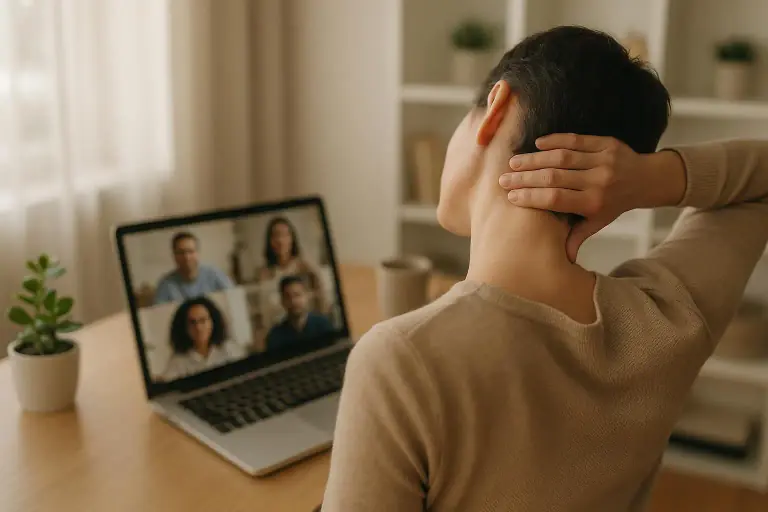
Desk-Discreet Jaw & Neck Release: 3-Minute Invisible Micro-Scan
Nov 11, 2026 • 8 min
If your day is a parade of back-to-back video calls, you already know what it does to your neck, shoulders, and jaw. You feel tightness behind your ears, a constant low-level headache, or the jaw clench that shows up in the mirror at 5 p.m.
Here's a three-minute, camera-safe routine you can do on calls. Tiny movements. No one notices. You’ll walk out of the meeting slightly looser and less foggy. Plus: manager-friendly copy to normalize these micro-breaks for your whole team.
Why this works (fast)
- Small, slow mobility reduces muscle guarding.
- Coordinated breathing lowers sympathetic arousal.
- Micro-breaks stop tension from accumulating across the day.
No medical miracle here—just practical, evidence-backed moves you can actually do while taking notes or listening.
The quick anatomy to care about
You don’t need a degree to get this. A few things to keep in mind:
- Masseter and temporalis: the jaw muscles that clench when you’re stressed.
- Cervical extensors and upper traps: the neck and shoulder muscles that lock up from poor posture.
- Breathing pattern: shallow chest breathing fuels tension. Diaphragmatic breaths help reset it.
Those are the three targets for the micro-scan: jaw, neck, upper traps—paired with breath anchors.
How the 3-minute invisible micro-scan fits into your day
Do this at the top of the hour, between meetings, or whenever you sense the jaw clench creeping in. It’s short enough that you won’t miss anything important and subtle enough to do on camera.
Timing breakdown (minute-by-minute) Minute 1 — Jaw focus + breath anchor Minute 2 — Neck mobility (tiny, controlled) Minute 3 — Upper traps and posture reset
All moves are small, slow, and designed to look like normal head/shoulder gestures.
The routine (readable, do-able, camera-safe)
Minute 1 — Jaw release (0:00–1:00)
- Sit upright and relax your shoulders.
- Practice a small, soft jaw “yawn” — not a big gape, just a slight opening of 1–2 cm, then close.
- Without forcing it, move your lower jaw right-left a few millimetres (10–12 reps total). Keep your lips closed so it reads as a facial expression.
- Fingertip cue: using two fingers at the angle of your jaw, apply a gentle circular massage for 10 seconds. This looks like you’re rubbing your chin—totally video-appropriate.
- Breath anchor: inhaling for 3 counts through the nose, exhale 4 counts through the mouth. Repeat twice.
Why: tiny jaw movements reduce masseter tension and the breath anchor drops the stress response.
Minute 2 — Neck micro-mobility (1:00–2:00)
- Chin tuck: draw your chin slightly back (imagine tucking it toward your throat). Hold 3–4 seconds, relax. Do this twice.
- Slow head turns: slowly rotate your head to the right 10–15 degrees, hold 2–3 seconds, return. Repeat left. These are small enough to look like you’re following a second screen.
- Ear-to-shoulder tilt: tilt your head very slightly to the right—again 10–15 degrees—and hold 2–3 seconds. Repeat left.
- Breath anchor: inhale as you prepare, exhale slowly as you release each tilt/turn.
Why: the chin tuck strengthens deep cervical flexors and improves posture. Small rotations mobilize the neck without shouting “I’m doing yoga on a call.”
Minute 3 — Upper-trap release + posture reset (2:00–3:00)
- Shoulder rolls: shrug up towards your ears for one second, then roll back slowly. Do three reps. Keep motion tight and controlled.
- Scap squeeze: pinch your shoulder blades together gently as if holding a pencil between them. Hold 3 seconds, release. Repeat twice.
- Final posture check: sit tall, roll the shoulders down, and slightly tuck the chin. Imagine a string at the crown of your head lifting you.
- Breath anchor: 30 seconds of diaphragmatic breathing—inhale through the nose, belly expands; exhale fully through the mouth.
Why: subtle scapular work relieves upper traps and counteracts the “rounded shoulders” posture from laptops and phone peering.
Micro-moments that matter
Sometimes the best detail is tiny: I always notice my jaw unclench when I take two slow exhalations. It’s almost instant—like untightening a knot.
Camera-safe cues (what these moves look like on video)
- Slight chin tucks look like active listening.
- Small head tilts read as curiosity.
- A fingertip jaw massage looks like you’re thinking.
- Subtle shoulder rolls are easy to pass off as stretching.
If someone asks, say: “Just resetting my posture—my neck’s been acting up.” No one bats an eye.
When to stop and see a pro (red flags)
Stop and seek professional help if you have:
- Sharp jaw pain, locking, or persistent clicking.
- Numbness, tingling, or radiating pain down an arm.
- Frequent, intense headaches after these movements.
This routine is for mild to moderate tension. It’s not a treatment for TMJ disorders, cervical radiculopathy, or other serious issues. If in doubt, call your dentist, physio, or primary care doctor.
Troubleshooting common bumps
- My jaw clicks when I move: stop the jaw movements and only do breathing and neck mobility. Book a dental/medical assessment.
- Movements make headaches worse: shorten the routine or switch to breath-only anchors until you can see a clinician.
- I forget to do it: set a gentle hourly reminder on your phone or use an app like Stretchly.
Manager copy you can paste (normalize the habit)
Use these short messages to make micro-breaks team policy without preaching:
- “Quick reminder: take a 3-minute micro-scan before the next meeting. Small breaks = clearer thinking.”
- “We encourage desk-discreet movement during long calls. If you need to reset your posture, please do.”
- “Try the 3-minute invisible micro-scan at the top of the hour—no video off required.”
Say one of these at the start of a meeting and the permission ripple is immediate. People do what they’re allowed to do.
Real story — what happened when I made this a habit
Last winter I was doing weekly all-hands—five hours of camera time across three days. By week two my right temple throbbed every afternoon. I started doing the three-minute micro-scan between meetings—no dramatic stretching, just the small jaw and neck moves and a breath anchor. After ten workdays I noticed fewer afternoon headaches and better focus on late calls. My calendar shows the real outcome: three fewer sick-hour logins in the month I used the routine, and my posture photo (yes, I take those) looked measurably less forward-rolled. The kicker: when I suggested the practice to my manager she added a one-minute reset into our team standup. People thanked her. That was the moment I realized small, normalized rituals actually change behavior.
Tools to automate the habit
- Stretchly (free): hourly reminders with short stretch suggestions.
- Posture Pal or phone timers: nudge you with a gentle vibration.
- Put micro-scan text in your team’s meeting agenda so everyone gets the cue.
Quick tips for making it stick
- Pair it with the top of the hour or meeting end.
- Start with breath-only anchors if you’re self-conscious.
- Teach one teammate; peer pressure is great when it’s positive.
Evidence and safety
Small, frequent mobility and breathwork help reduce muscle tension and lower stress markers. The moves here follow general recommendations from reputable health resources for neck and shoulder mobility and are designed to be gentle and unobtrusive.[1][2][3][4][5][6]
Remember: if you have a diagnosed TMJ disorder, recent neck injury, or neurological symptoms—get a professional evaluation first. This routine is meant to relieve the kind of day-to-day tension that builds during long stretches of video calls.
Final note
You don’t need permission to take care of your body, but it helps when managers lead by example. Three minutes, a few slow breaths, and some tiny, intentional movement can keep you clearer, calmer, and less tense through a long day of screens.
Try it now: two slow breaths, a tiny chin tuck, and a mental note to do the full micro-scan at the top of the next hour. That small act is the whole point.
References
Footnotes
-
Mayo Clinic. Neck stretches (video). Retrieved from https://www.mayoclinic.org/healthy-lifestyle/adult-health/multimedia/neck-stretches/vid-20084697 ↩
-
Healthline. Deskercise: How to Move at Your Desk. Retrieved from https://www.healthline.com/health/deskercise ↩
-
YouTube. Desk-discreet mobility techniques for office workers. Retrieved from https://www.youtube.com/watch?v=FRNtLrMf-1A&vl=en ↩
-
YouTube. Subtle upper trap release and shoulder mobility for desk workers. Retrieved from https://www.youtube.com/watch?v=RtuDx19TJdo ↩
-
YouTube. TMJ-friendly jaw release techniques. Retrieved from https://www.youtube.com/watch?v=5lbe9oZbpDs ↩
-
DeskBreak. Desk exercises and micro-break reminders. Retrieved from https://www.deskbreak.app/features/desk-exercises ↩