Advanced Techniques: Optimizing Graded Exposure
Aug 11, 2026 • 9 min
You missed the puppy socialization window. Or you rescued a teen dog with zero positive experiences. That stings—and it changes everything.
Late-start puppies (and young adults with limited early exposure) don't respond well to "just throw more experiences at them." They need surgical precision: strict threshold calibration, high-value counter-conditioning, measurable progress metrics, and conservative adjustment rules. Do this wrong and you make the fear worse. Do it right and you can compress months of progress into weeks—safely.
This post is for trainers and experienced owners who already know the basics. I’ll walk through advanced graded exposure (GE) strategies, the exact metrics I use, rules for when to push and when to back off, and real-case examples so you can copy what works.
Why late-start pups are different
If a puppy missed 3–16 weeks of positive socialization, the brain’s “this is safe” wiring isn’t built. Instead you often have one of two profiles:
- Chronic avoidance: freeze, shut down, hide.
- Over-arousal/reactivity: lunging, barking, intense focus on the trigger.
Both respond poorly to standard desensitization because those protocols assume a baseline tolerance that doesn’t exist. You need to rebuild tolerance from scratch—and that starts with the threshold.
Threshold calibration: the non-negotiable first step
Before you change anything, find the puppy’s threshold: the exact point where calm becomes a noticeable behavior shift (avoidance, freeze, panting, lip-licking, stiffening, increased yawning, or an immediate physiological change).
Simple example: if a puppy freezes when another dog is 50 feet away, 50 feet is the threshold. Anything closer risks triggering. Advanced work means training strictly below that line—often well below it—until the dog shows consistent, positive engagement.
How to find it in practice:
- Observe baseline reactions in a neutral spot.
- Introduce the stimulus at increasing distances in single increments.
- Watch micro-signals (head turn latency, lip-licking, pupil dilation if you can see it).
- Log the distance and physiological cues.
Don’t guess. Measure.
The metrics that matter (not just "didn't bark")
Most people celebrate when barking stops. That’s not success. Those moments are usually trade-offs: a different stress response is hiding under the surface.
Here are the advanced metrics I track, session to session:
- Latency to engagement: time from noticing stimulus to looking back at handler.
- Duration of calm: how long the dog maintains relaxed posture while stimulus is present.
- Reward acceptance rate: percentage of offered rewards taken within two seconds of presentation.
- Recovery time: how long to return to baseline behaviors after stimulus disappears.
- Stress index: simple composite score of panting, yawning, lip-licking, and body tension (0–5).
These give you nuance. A dog that stops barking but shows a 4/5 stress index hasn't improved—we've only shifted the problem.
The 10% Rule and Two-Step Back: your intensity guards
Two simple, powerful rules that keep progress safe and predictable.
The 10% Rule: Only increase difficulty by about 10% at a time—whether that’s distance (decrease distance by ~10%), duration (increase time by ~10%), or complexity (add a mild distraction 10% of the current intensity). And only do that if the dog has shown clear, relaxed engagement across three consecutive sessions at the current level.
Why three sessions? One good session can be fluke. Three suggests learning has started.
The Two-Step Back: If you see any sign of stress—lip-licking, frozen posture, refusing a treat—go backward immediately. Reduce intensity by about 20–30% for the next two sessions, even if the previous sessions looked fine. This resets confidence and prevents new negative associations from forming.
Use both. The 10% Rule says when to push. Two-Step Back tells you when to protect.
Precision counter-conditioning: timing beats quantity
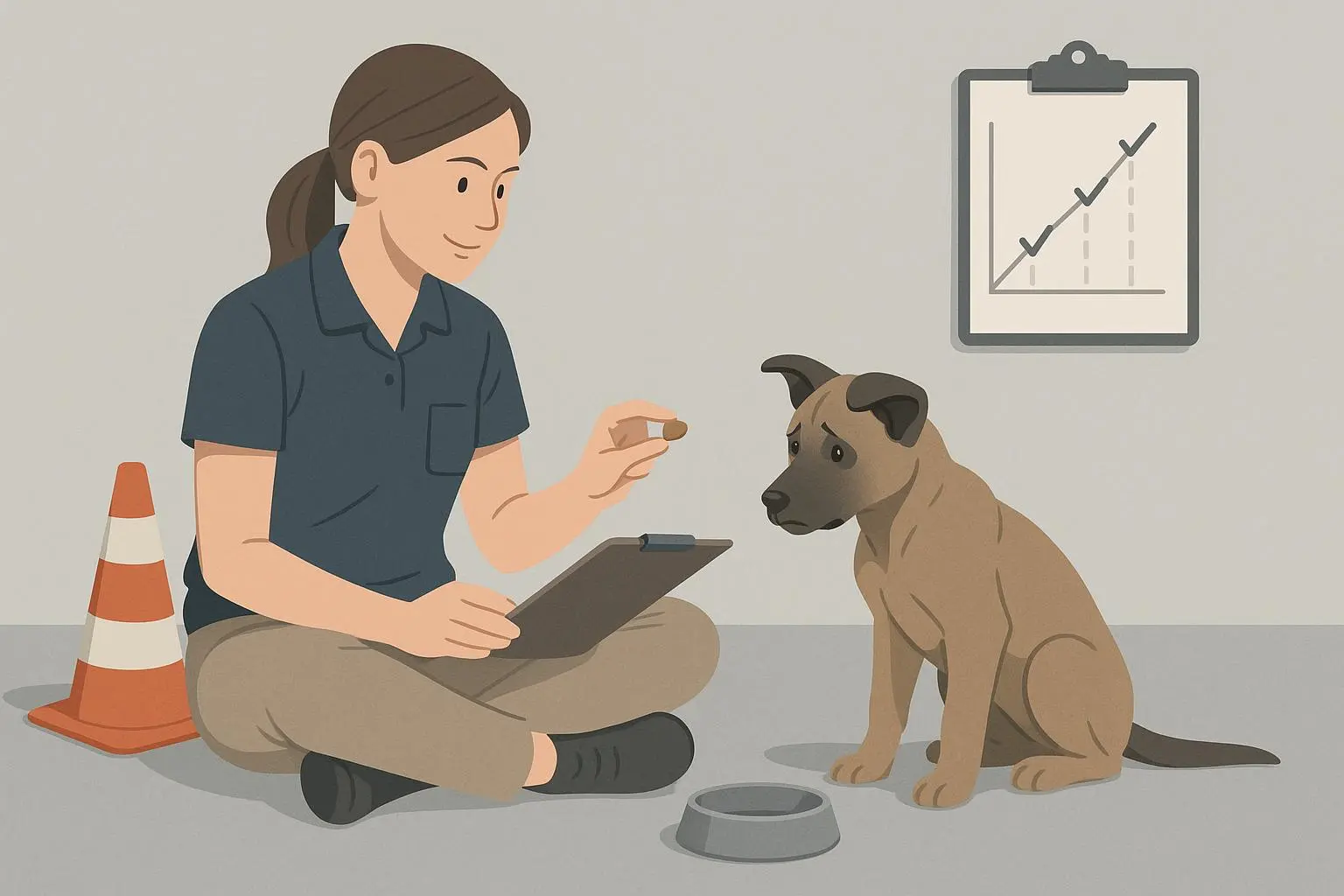
Counter-conditioning (CC) pairs the stimulus with something the dog loves. For late-start pups, "treat" is not enough. I'm talking boiled chicken, liver paste, high-quality cheese—rare, ultra-valuable rewards that the dog only gets in training.
Timing is everything:
- The marker/treat must arrive the moment the dog notices the trigger—before any reactive behavior.
- If the dog reacts and then gets the treat, you taught the dog that reacting = reward.
I use an auditory marker (a clicker or short verbal marker) timed to the instant the dog registers the stimulus. Then immediate delivery of the high-value reward. Over time, the presence of the trigger predicts the reward, and the dog’s emotional response shifts.
Don't skimp on the reward—and don't delay it.
How I actually made this work (my rescue case)
Three years ago I adopted a 10-month-old mutt named Mabel who'd had minimal outside exposure. She panicked at bikes. At first she simply froze when a bike was 70 feet away—no barking, but eyes wide, tail tucked.
We spent nine training sessions just mapping Mabel's thresholds. Turns out her visual threshold for bikes was 80 feet, but her auditory threshold (the noise of a rackety chain) was almost immediate. So we trained two tracks: sight GE and sound GE, separately.
For sight GE I started at 110 feet with a confederate holding a stationary bike. I used boiled turkey as the reward, clicker for the marker, and tracked latency to engagement. After three clear sessions, I reduced distance by 10%. For sound GE I played recordings of bike chain noise at a barely-audible level while giving identical rewards.
At session 14 we integrated both: an approaching bike at 70 feet with the chain noise low. Mabel stayed engaged and took treats. Her recovery time after the bike passed dropped from 5 minutes to 60 seconds over three weeks. Two lessons stuck: (1) split sensory channels when thresholds differ, and (2) be ruthless about timing—every feed happened before any sign of stress. That precision saved weeks of backsliding.
Micro-moment: the thing that stuck with me
One session I dropped a single, tiny piece of liver paste too late. Mabel barked once. The rest of the session collapsed. I learned that one tiny timing error undoes a lot. Timing is fragile—and everything.
Intensifying safely: phase-based example (skateboard case)
This is a reproducible sequence I use for complex triggers like skateboards, strollers, or scooters.
Phase 1 — Sub-threshold baseline:
- Trigger stationary, far beyond threshold.
- Continuous CC: high-rate reward for any look-back to handler.
- Goal: consistent look-back, 90% reward acceptance.
Phase 2 — Controlled motion:
- Trigger moves briefly (5–10 feet) at a slightly closer distance.
- Reward schedule increases if calm persists.
- If any stress, stop, Two-Step Back applies.
Phase 3 — Cognitive load:
- Add mild distractions (quiet ball toss nearby) while trigger moves at moderate distance.
- This tests focus under low-level cognitive demand.
Phase 4 — Real-world generalization:
- Move to a new environment with similar trigger.
- Start sub-threshold again. Treat the new environment as a fresh target.
A common mistake: owners skip Phase 3 and move straight to Generalization. That’s why a dog that succeeds in a park fails at a grocery store entrance—the environment changed the thresholds.
When graded exposure struggles (and what to do)
If progress stalls, run this diagnostic checklist:
- Are you truly below threshold? Double-check micro-signals.
- Are rewards high enough and delivered on time?
- Is the environment introducing uncontrolled variables?
- Has the dog had enough rest and satiation? Stress compounds with fatigue.
- Are sessions too long? Sometimes 2–5 minute focused windows beat 20-minute stretched-out sessions.
If you can't fix it, pause and reassess. Sometimes the right call is to slow down, or to consult a veterinary behaviorist for medication support in severe cases. Exposure without control equals trauma.
Tools and tracking: make it objective
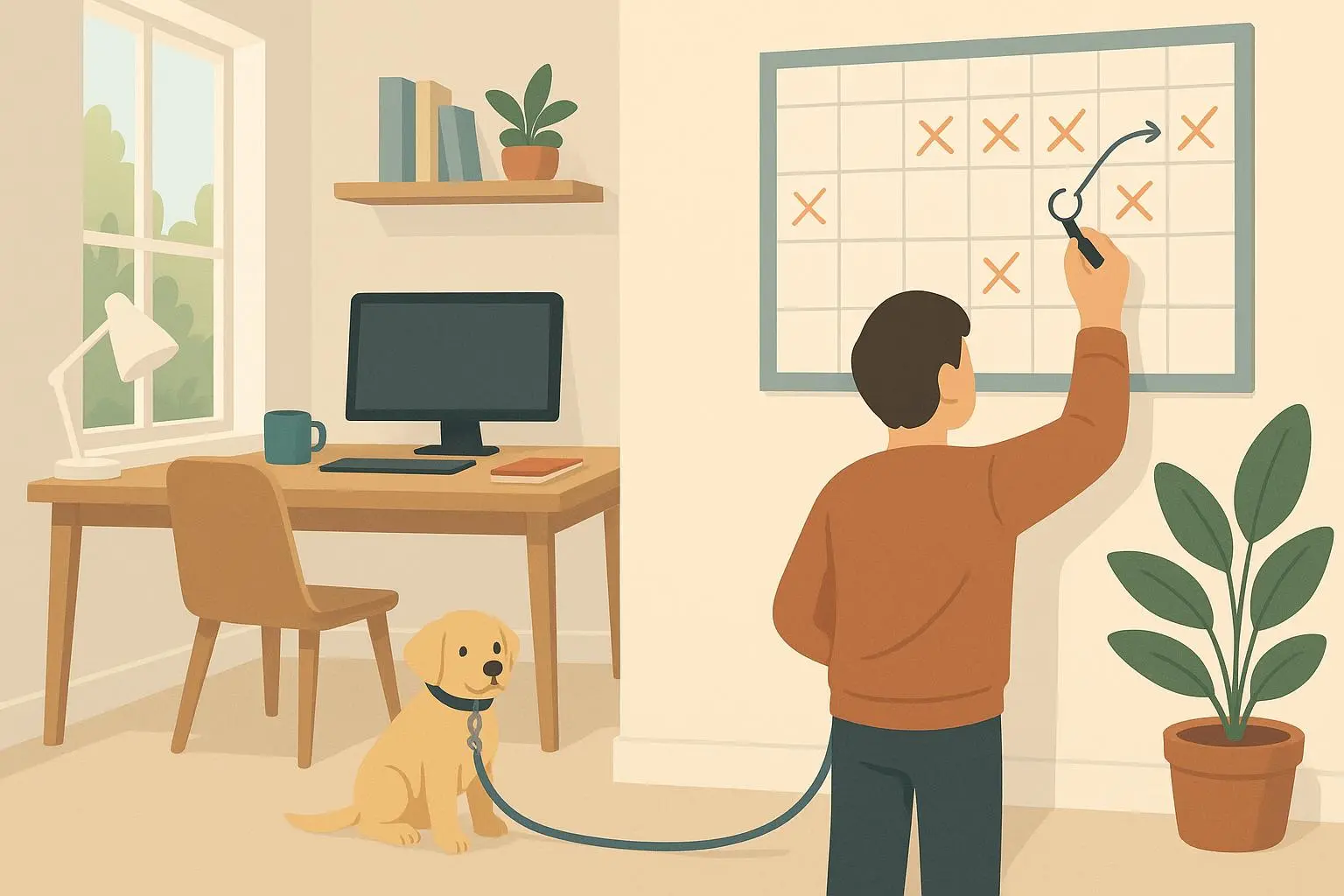
Use a simple spreadsheet or the "Canine Behavior Metrics Tracker" template to log:
- Date, time, environment
- Trigger and intensity (distance/sound level)
- Latency to engagement (seconds)
- Duration calm (seconds)
- Reward acceptance (%)
- Recovery time (seconds)
- Stress index (0–5)
Aim for small, measurable wins. When the numbers improve, the behavior follows.
Generalization: treating each new place as a fresh start
Generalization is not automatic. Transfer success from one context to another by treating each new environment as a separate GE step. Start sub-threshold, use the same CC, and work through the phases again. That looks slow, but it's faster than repeated collapses in uncontrolled places.
A quick note about ethics and safety
If a dog shows escalating aggression (lunging with intention to harm) or extreme freeze that impairs well-being, stop exposure and consult a qualified behaviorist or veterinary behaviorist. Advanced GE can accelerate change—but only when paired with careful monitoring and conservative escalation rules.
Final checklist before you intensify
- Threshold mapped and documented? Check.
- Metrics logged consistently? Check.
- High-value rewards identified and reserved for sessions? Check.
- 10% Rule adopted and understood? Check.
- Two-Step Back in your playbook? Check.
- Emergency plan for escalation? Check.
Follow the rules. Be boringly consistent. Patience and precision win faster than bravado.