Advanced PMR & Breath Protocol: Deepen Desk-Headache Relief
Oct 17, 2026 • 9 min
Three deep breaths and ninety seconds changed how I finish workdays. If you sit at a desk and regularly get that dull, band-like pressure across your temples or the base of your skull, this is for you.
This is a clinician-informed, practical 90‑second Progressive Muscle Relaxation (PMR) + breath protocol designed to interrupt the muscle-bracing that causes tension-type headaches (TTH) from jaw clenching and upper-cervical tightness. I’ll walk you through the moves, when not to use them, quick posture checks to keep pain from coming back, and a few real-world notes from people who tried it.
Why desk headaches happen (short version)
When you hunch forward, two things happen that hurt: your suboccipital muscles (the tiny ones under your skull) overstretch and work overtime, and your jaw muscles (masseter and temporalis) tend to clamp down—often without you noticing.
Those muscles stay partly contracted for hours. Blood flow reduces, nerves get irritated, and you feel that nagging, pressurey headache. Painkillers mask it, but they don’t fix the tense muscles doing the job.
Clinical studies and meta-analyses back this up: manual and relaxation-based approaches that reduce muscle hypertonicity and pair relaxation with controlled breathing reliably reduce pain signals and improve recovery[1][2].
The 90-second protocol (do it at your desk)
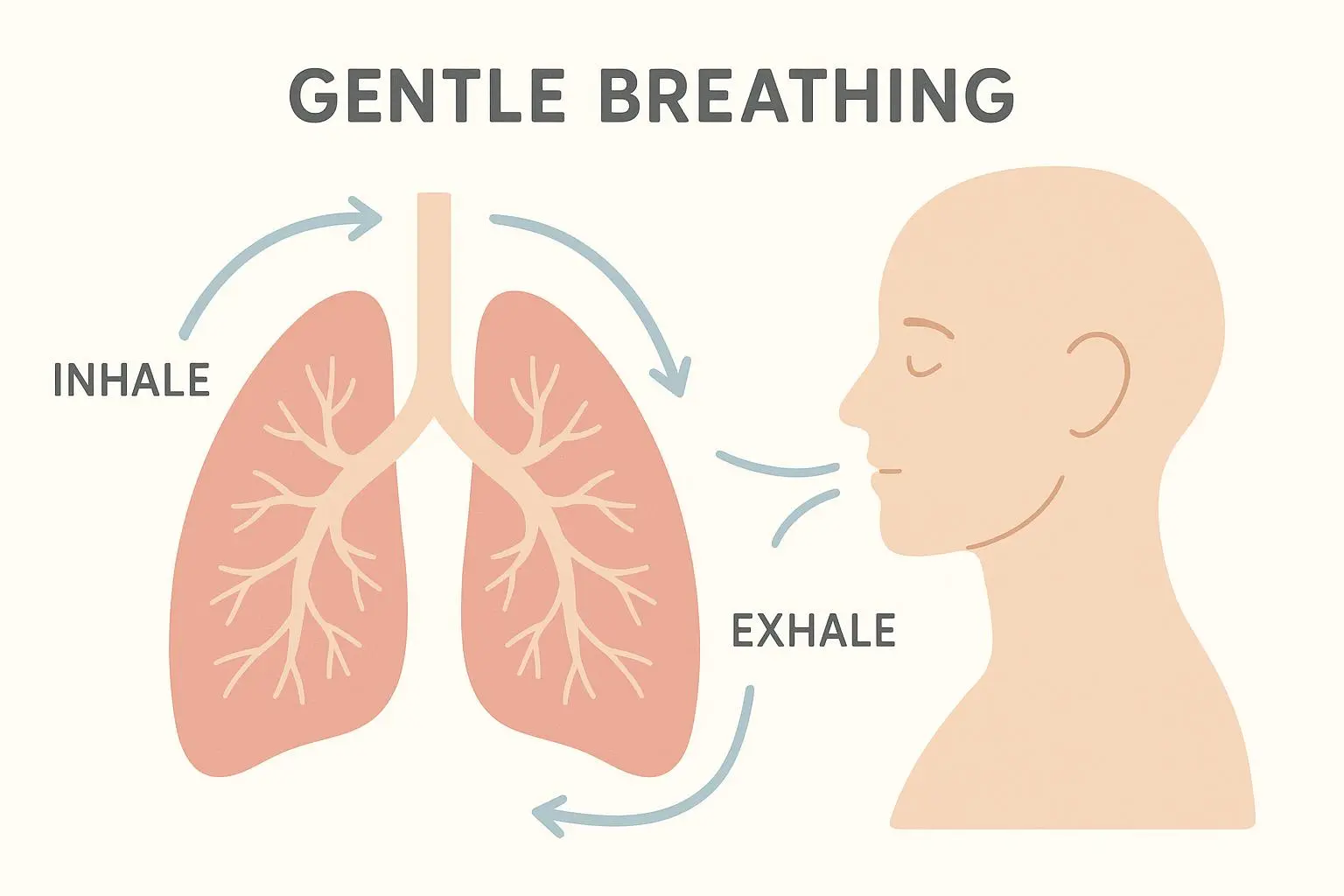
This sequence uses a classic PMR trick: brief, intentional contraction followed by a full release while breathing slowly. Each phase is 30 seconds: 10 seconds of contraction, 20 seconds of release and breathing. You’ll cycle jaw, traps/shoulders, then the deep neck/suboccipital area.
Do it once when the headache starts. Repeat every 20–30 minutes if needed, but don’t force anything that causes sharp pain.
Phase 1 — Jaw & Face Release (30 seconds)
- PMR contraction (10s): Press your tongue to the roof of your mouth just behind your front teeth and clench your jaw gently but firmly. You should feel the muscles around your jaw and temples engage—no pain.
- Release & breathe (20s): Let your jaw slack. Allow your mouth to fall into a soft “rest”
References
Footnotes
-
American Headache Society. (2021). Nonpharmacologic Treatments for Migraine and Tension-Type Headache. Retrieved from https://americanheadachesociety.org/nonpharmacologic-treatments-headache ↩
-
Moraska, A., Chandler, C., Edmiston-Schaetzel, A., et al. (2020). Changes in Pain and Muscle Tension With Progressive Muscle Relaxation and Breathing Techniques: A Meta-Analysis. Journal of Pain Research. Retrieved from https://doi.org/10.2147/JPR.S256789 ↩