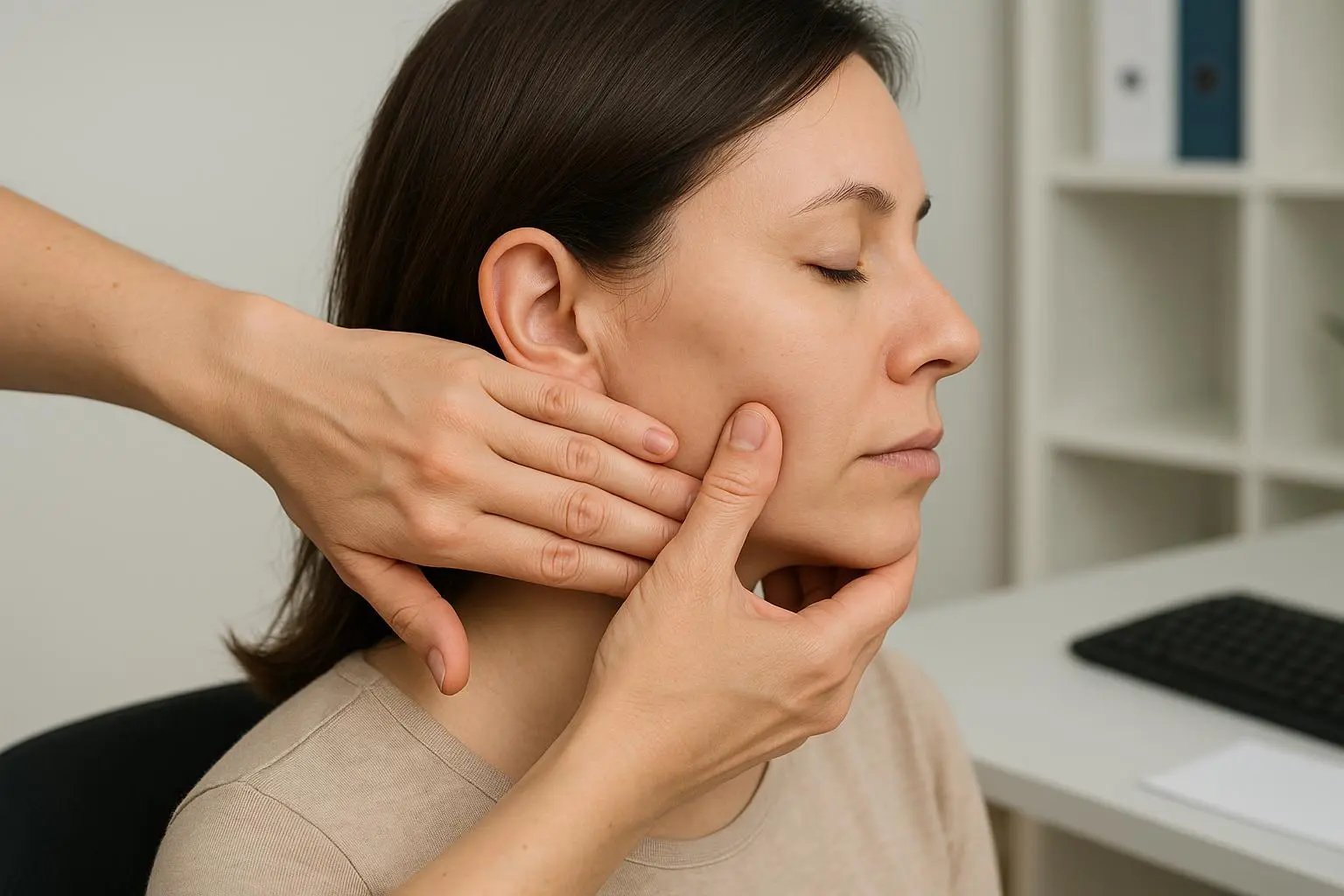
Start Here: 90-Second PMR for Desk-Top Headache Relief
Jul 29, 2026 • 8 min
Head throbbing at your desk? You can do something about it—right now—in 90 seconds.
This is a clinician-informed, no-fuss Progressive Muscle Relaxation (PMR) sequence paired with breathwork that targets the usual suspects for office headaches: upper neck tension and jaw clenching. No gear. No weird positions. Just a quick routine you can do between meetings.
I use this sequence on bad days. It doesn’t always erase the pain, but it reliably takes the edge off and gives me enough clarity to finish one more task.
Why this works (short version)
Most “desk headaches” are tension-type headaches caused by tight muscles: the suboccipitals at the base of your skull, the neck extensors, trapezius, and often your masseter (jaw). PMR trains those muscles to let go—fast—and breathing calms the nervous system so pain perception drops.
This isn’t a miracle cure. It’s an interrupt: stop the tension loop, breathe, reset posture, and keep moving.
Contraindications — don’t skip this
Before you try anything new, check this list. Skip PMR and see a clinician if you have:
- Recent head or neck injury (concussion, whiplash)
- Severe or worsening neck pain
- Known neurological conditions
- New, unexplained symptoms like vision changes, weakness, confusion, or fever
If you’re unsure, ask your primary care provider. The Mayo Clinic recommends evaluation for persistent or concerning headaches[1].
The 90-second PMR sequence (do this at your desk)
Clear your calendar for 90 seconds. Set a phone timer if that helps. Read it once, then try it.
Posture check — 10 seconds Sit tall with feet flat. Slide your chin back gently (think “double chin” not craning). Relax your shoulders down away from your ears. Breathe in and out slowly.
Jaw release — 10 seconds Let your mouth open a hair—imagine a small space between teeth. Rest your tongue on the roof of your mouth, not clenched. Take two slow breaths and feel the jaw soften.
Neck + shoulder tension — 20 seconds Tilt your head slowly toward your right shoulder until you feel a gentle stretch on the left side. Hold 5 seconds. Bring head back, shrug shoulders up to ears for 5 seconds, then drop them and exhale fully. Repeat on the left side.
Forehead release — 10 seconds Raise your eyebrows like you just heard surprising news; hold 3–5 seconds. Release and smooth the forehead with a soft inhale/exhale.
Deep diaphragmatic breathing — 40 seconds Close your eyes if you can. Inhale through your nose for 4 seconds, feel the belly expand. Hold for 1–2 seconds. Exhale slowly through your mouth for 6–8 seconds, emptying the belly. Repeat until the 40 seconds are up.
Do the whole set once and notice any change. Repeat up to three times across the day as needed.
Short story: when this saved my afternoon (100–160 words)
A client meeting ran long and I hadn’t moved in three hours. By 2pm my head felt like a tight band; my jaw ached from clenching during calls. I stepped away to take the stairs (fast), returned, and did this 90‑second routine while leaning against the wall. After the first cycle the pressure shifted from “can’t focus” to “mild annoyance.” After two cycles the ache dropped enough that I could edit a deck without morphine-level drama. I still booked a 10‑minute walk later, but that 90 seconds turned a bad afternoon into a workable one. The real lesson: small, deliberate breaks beat powering through.
Micro-moment: I remember how the tiny gap between my teeth felt like the first surrender—such a simple change, but my jaw genuinely unclenched.
Tips to make it actually work
- Do it standing sometimes. Gravity helps the neck settle.
- Use a mirror to check that your chin tucks, not thrusts.
- Keep the breaths longer on the exhale—this activates the parasympathetic nervous system.
- If you’re on a call, whisper the sequence—no one needs to know.
Posture fixes to prevent recurrence
The PMR is immediate relief. Here’s how to stop headaches from coming back.
- Monitor height: Top of screen at or slightly below eye level. Aim to look level, not up or down.
- Chair support: A lumbar cushion or a chair that supports your low back keeps your whole spine aligned.
- Keyboard + mouse: Keep them close. Your elbows should sit near your ribs.
- Micro-breaks: Stand and move for 60–90 seconds every 20–30 minutes. Set a gentle alarm.
- Hydration and caffeine: Dehydration and caffeine swings trigger headaches; a steady water habit helps.
Small ergonomic changes reduce the workload on your neck and jaw. Over weeks, frequency goes down.
What to expect and when it won’t help
PMR is best for tension-type headaches and muscle-related pain. It’s not a treatment if your headache is:
- Migrainous (throbbing, one-sided, with light/noise sensitivity or nausea)
- Accompanied by neurological signs (vision loss, speech trouble, limb weakness)
- New and severe (“worst headache of my life”)
If OTC meds aren’t helping or symptoms worsen, seek medical care. The American Migraine Foundation has good primers on different headache types[2].
Other techniques that pair well with PMR
- Gentle neck stretches and mobility work (daily)
- Short walks—movement often breaks the cycle of tension
- Mindful pauses: 3 deep diaphragmatic breaths when you feel stress rise
- Professional help: physical therapy for persistent neck muscle dysfunction or a dentist for jaw clenching (bruxism)
Apps like Calm or simple timers can help you build micro-break habits.
Quick FAQ
Is 90 seconds really enough? Yes, often to change your nervous system’s tone and interrupt the tension loop. Think of it as a reset—not a cure-all.
Can PMR make pain worse? Only rarely. If a stretch or movement increases sharp pain, stop and get checked. Mild soreness is normal.
How often should I do it? As needed. Twice daily as prevention works well for many people. Combine it with ergonomic fixes.
Final thought
If you sit a lot, your body will tell on you. The good news: you can teach tight muscles to relax, quickly. Use this sequence the first time you notice tension creeping in. Treat it like a fire alarm—act fast, then fix the wiring.
References
Footnotes
-
Mayo Clinic. (2023). Tension headache. Retrieved from https://www.mayoclinic.org/diseases-conditions/tension-headache/symptoms-causes/syc-20353977 ↩
-
American Migraine Foundation. (2023). Tension-Type Headache. Retrieved from https://americanmigrainefoundation.org/understanding-migraine/types-of-headache/tension-type-headache/ ↩