Nov 27, 2025 • 14 min
Quick Quiz: What Do These Have in Common?
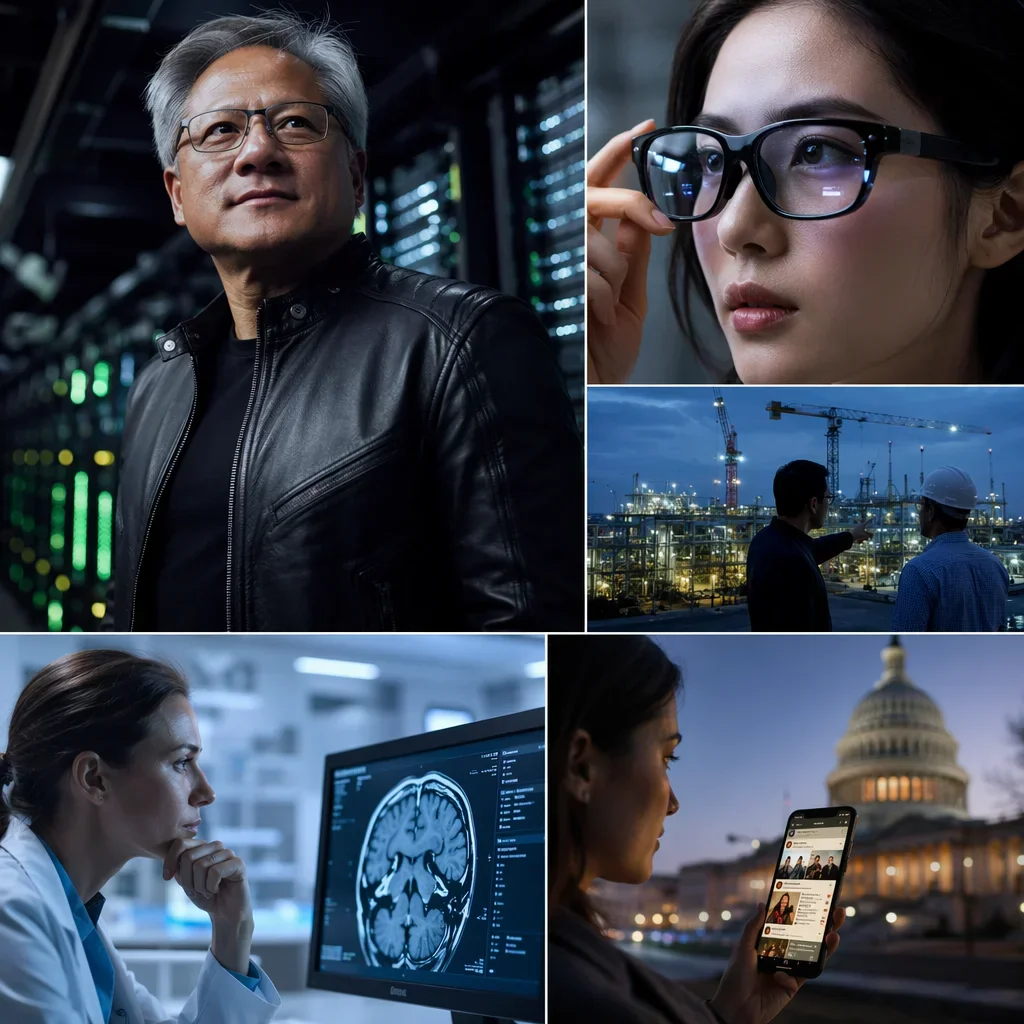
A $5 trillion company, glasses that see for you, $40 billion flowing into Texas, and AI detecting dementia before doctors can? Answer: They're all reshaping how AI integrates into our daily lives. Let's break them down.
AI Business: Nvidia Becomes First $5 Trillion Company
The Story
Nvidia just crossed a historic threshold: $5 trillion market valuation—the first company in history to reach this milestone. For context, that's larger than the entire GDP of Japan.
Why Start Here?
This isn't just about one company getting rich. Nvidia makes the chips that power virtually every AI system. When Nvidia grows, it signals where the entire AI industry is heading.
Building the Concept
- Step 1: Every AI model (ChatGPT, Claude, Gemini) runs on specialized chips called GPUs
- Step 2: Nvidia makes approximately 80% of these AI chips
- Step 3: As AI demand explodes, Nvidia's revenue explodes with it
- Step 4: The $5 trillion valuation reflects Wall Street betting AI will transform everything
The Bigger Picture
This valuation came the same week TrendForce predicted AI server shipments will boost 20%+ year-over-year in 2026. Companies are racing to build AI data centers, and Nvidia is supplying the gold rush picks and shovels.
Recap: Nvidia hitting $5T = AI infrastructure is now the most valuable asset class in the world. The AI era isn't coming—it's here.
Consumer Tech: Alibaba's AI Glasses Launch
The Hook
Pop Quiz: What if your glasses could translate foreign signs in real-time, recognize products, and check prices—all while looking like normal eyewear?
The Discovery
Alibaba launched Quark AI glasses powered by their Qwen AI model. Unlike clunky VR headsets, these look like everyday glasses while packing serious AI capabilities.
Let's Build This Up
Level 1 - The Form Factor: These aren't AR headsets. They're lightweight glasses that blend in.
Level 2 - The Features:
- Real-time translation of text you're looking at
- Object and product recognition
- Price comparison while shopping
- Integration with Alibaba's ecosystem (Alipay, Taobao)
Level 3 - The Ecosystem Play: This connects directly to Alibaba's shopping and payment platforms. See something? Know the price. Want it? Buy instantly.
Level 4 - The Market: China's 1.4 billion consumers get AI assistance integrated into daily life—shopping, traveling, learning.
Why This Matters
This is ambient AI—technology that helps without demanding attention. While Meta and Apple focus on expensive headsets, Alibaba is making AI invisible and useful.
Recap: AI glasses that look normal + connect to shopping/payment = AI becoming as common as smartphones.
Infrastructure: Google's $40 Billion Texas Bet
Start Simple
Question: Where does AI physically live? And why does Texas suddenly matter?
The Situation
Google CEO Sundar Pichai and Texas Governor Greg Abbott announced a $40 billion investment in AI and cloud infrastructure across Texas. This is one of the largest single corporate investments in state history.
Breaking It Down
Concept 1 - AI Needs Real Estate: Every ChatGPT response, every AI-generated image requires massive data centers with thousands of specialized chips.
Concept 2 - Why Texas?:
- Abundant land for massive facilities
- Cheaper energy (critical for power-hungry AI)
- Business-friendly regulations
- Growing tech talent pool
- Less restrictive water access (data centers need cooling)
Concept 3 - The Scale: $40B builds multiple hyperscale data centers—facilities larger than dozens of football fields each.
Concept 4 - The Competition: This follows similar investments from Microsoft in Wisconsin, Amazon in Virginia, and Meta across multiple states. AI infrastructure is the new space race.
The Jobs Angle
Google claims this will create "thousands of jobs"—both construction and long-term technical roles. But data centers are highly automated; the real economic impact comes from the tech ecosystem that follows.
Recap: Google picking Texas for $40B = AI infrastructure becoming critical national asset. States are competing for AI investments like they once competed for auto plants.
Healthcare AI: Detecting Dementia Before Symptoms
The Socratic Approach
Think: What if a 60-second brain scan could predict Alzheimer's years before memory loss begins?
Story: AI Reads Brain Waves to Spot Dementia
The Research: Scientists at Örebro University developed AI systems that analyze EEG brain-wave data to distinguish between healthy individuals and those with dementia.
The Numbers:
- First model achieved 80%+ accuracy
- Second model using federated learning reached 97%+ accuracy
- Analysis takes seconds, not hours
How It Works:
- Patient wears EEG cap (non-invasive, painless)
- Brain waves recorded during simple tasks
- AI analyzes patterns invisible to human doctors
- Risk assessment generated
Why This Changes Everything
Current dementia diagnosis often comes too late—when significant brain damage has already occurred. Early detection enables:
- Lifestyle interventions that slow progression
- Earlier medication when effective
- Better family planning and preparation
- Clinical trial eligibility for experimental treatments
The Federated Learning Innovation: The 97% accuracy model learned from multiple hospitals' data without any patient data leaving those hospitals. This "federated" approach means better AI without privacy compromises.
Recap: AI + brain waves = catching dementia years earlier. Combined with privacy-preserving techniques, this could become standard screening like blood pressure checks.
Regulation: TikTok's AI Transparency Push
The Setup
While governments struggle to regulate AI, TikTok just made a significant voluntary move toward AI transparency.
What's Happening
TikTok announced several new features to give users control over AI-generated content:
- New settings to adjust how much AI content appears in feeds
- Enhanced labeling clearly marking AI-generated videos
- Invisible watermarking tests for AI content detection
- $2 million global AI literacy fund for education
Building the Context
Concept 1 - The Problem: AI can now generate videos that look completely real. How do you know if that political speech or celebrity endorsement is authentic?
Concept 2 - Platform Responsibility: Social media companies face pressure to prevent AI-powered misinformation, especially ahead of elections.
Concept 3 - User Control: Rather than just labeling, TikTok is letting users choose how much AI content they want. Don't trust AI videos? See fewer of them.
Concept 4 - The Virginia Connection: The same week, Virginia moved to restrict how minors interact with AI chatbots—particularly in sensitive contexts like therapy. The concern: poorly moderated AI responses causing harm to vulnerable users.
The Bigger Pattern
We're seeing a split approach to AI regulation:
- Governments: Slow, reactive, focused on bans and restrictions
- Platforms: Faster, focused on transparency and user control
- The tension: Who should decide how AI interacts with us?
Recap: TikTok adding AI controls + Virginia restricting youth AI access = society figuring out AI governance in real-time. No playbook exists for this.
Why These 5 Stories Matter Together
The Pattern
Notice what connects them?
- Nvidia's $5T → AI infrastructure is now world's most valuable
- Alibaba AI glasses → AI becoming invisible and ubiquitous
- Google's Texas investment → Physical infrastructure for AI future
- Dementia detection → AI augmenting healthcare fundamentally
- TikTok transparency → Society negotiating AI's role
The Bigger Question
We're past the "Will AI matter?" phase. Now we're in the "How do we live with AI?" phase. These stories show:
- Companies betting tens of billions it's transformative
- Products making AI invisible helpers
- Healthcare using AI to save lives earlier
- Society setting boundaries and norms
The Takeaway
The AI infrastructure buildout is accelerating faster than anyone predicted. The winners will be those who figure out how to make AI useful without being intrusive, powerful without being harmful.
Conclusion
Today showed us:
- AI companies reaching valuations never seen before
- Consumer AI going invisible (glasses, not headsets)
- Physical infrastructure races heating up
- Medical AI achieving breakthrough accuracy
- Platforms and governments scrambling to establish norms
The thread? AI is becoming infrastructure—as essential as electricity or internet, as invisible as plumbing. The question isn't whether AI will be everywhere. It's whether we'll shape how it shows up.
Your move: Where do you want AI helping in your life? Because the decisions being made now will determine what's possible tomorrow.
References
- Nvidia Reaches $5 Trillion Valuation
- TrendForce 2026 AI Predictions
- Alibaba Quark AI Glasses Launch
- Google $40B Texas Investment
- Örebro University Dementia AI Research
- TikTok AI Transparency Features
- Virginia AI Chatbot Restrictions for Minors