Dec 5, 2025 • 15 min
Quick Quiz: What Do These Have in Common?
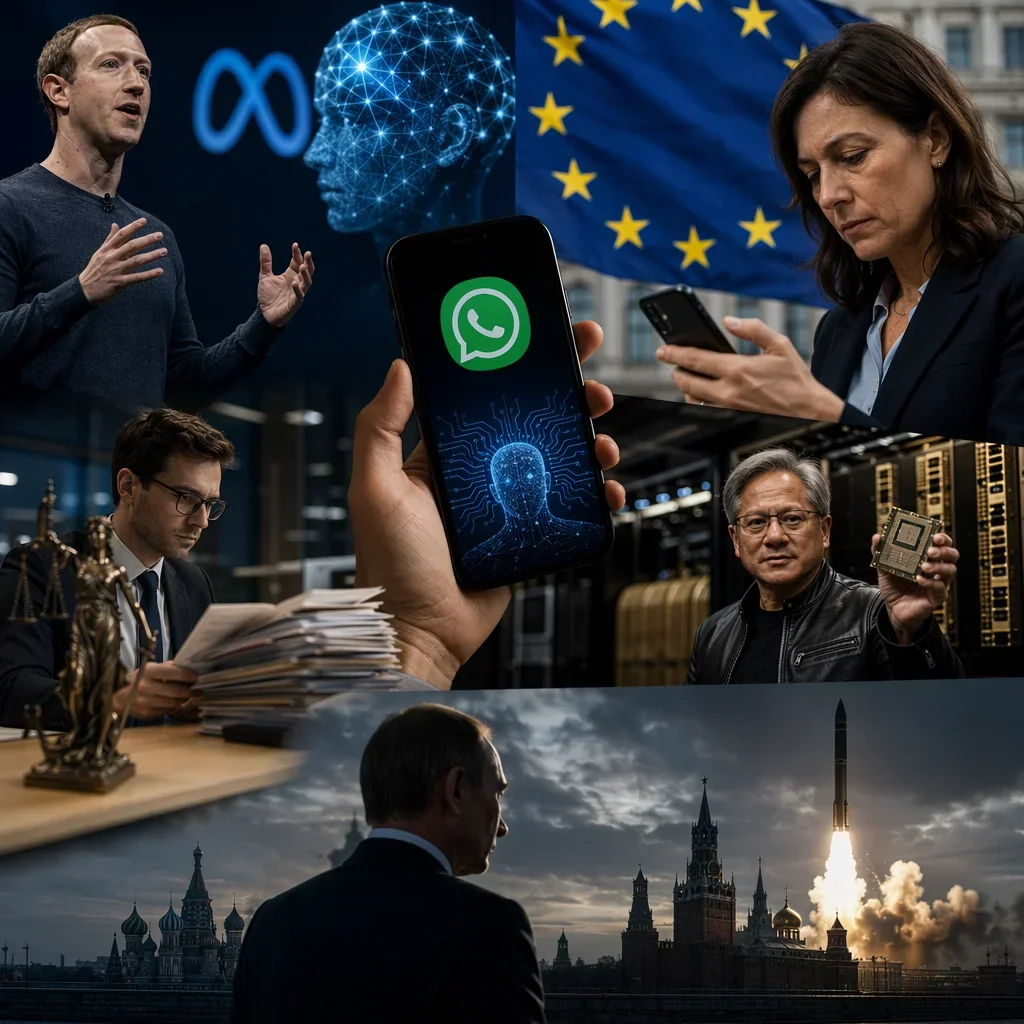
A wearable AI company getting acquired, EU regulators investigating WhatsApp, an AI lawyer worth $8 billion, Nvidia buying into chip design, and Russia warning about AI "nuclear clubs"? Answer: They all show how AI is becoming a strategic asset—for companies and nations alike. Let's break them down.
Acquisitions: Meta Buys AI Wearable Startup Limitless
The Story
Meta acquired Limitless, the AI startup that made a wearable pendant to record and transcribe conversations. The company, previously known as Rewind, built an AI-powered device that captured audio and created searchable transcripts of your day.
Why Start Here?
This acquisition tells us where Meta thinks AI is heading: always-on, ambient computing. Not just phones and headsets, but AI that's with you constantly.
Building the Concept
- Step 1: Limitless made a pendant you wear that records conversations
- Step 2: AI transcribes and summarizes everything automatically
- Step 3: You can search "What did Sarah say about the project?" and get the answer
- Step 4: Meta wants this tech for their AI assistant ecosystem
The Transition
Limitless announced it will no longer sell hardware devices following the acquisition. Existing customers get one year of support. This signals Meta is integrating the technology into its own products—likely Ray-Ban Meta glasses or future wearables.
The Bigger Picture
Meta is building an AI assistant ecosystem that spans:
- Ray-Ban smart glasses (already shipping)
- WhatsApp and Messenger (Meta AI integration)
- Quest VR headsets
- And now, always-on transcription technology
Recap: Meta buying Limitless = betting that AI needs to hear everything to be truly useful. Privacy implications are significant.
Regulation: EU Opens Antitrust Investigation Into WhatsApp AI Policy
The Hook
Pop Quiz: Can a messaging app block rival AI assistants? The EU says maybe not.
The Investigation
The European Commission launched a formal antitrust investigation into Meta over a new WhatsApp policy that could block competing AI assistants from accessing users on the platform.
Let's Build This Up
Level 1 - The Policy: WhatsApp's updated terms (effective January 15, 2026) may shut out competing AI chatbots and privilege Meta's own "Meta AI" assistant.
Level 2 - The Concern: If you have 2 billion users and block rival AI, you're potentially creating an AI monopoly within messaging.
Level 3 - The Precedent: The EU's Digital Markets Act specifically targets "gatekeeping"—when dominant platforms block competition.
Level 4 - The Stakes: This could set the template for how AI assistants compete across all platforms.
The AI Act Delay
In the same announcement, the European Commission proposed delaying stricter AI Act rules on high-risk use cases from August 2026 to December 2027. This "regulatory simplification" responds to Big Tech criticism that compliance timelines are unrealistic.
Why This Matters
We're seeing the first major regulatory battles over AI assistant access:
- Platforms want control: Meta wants Meta AI to be the only assistant in WhatsApp
- Regulators want competition: EU wants users to choose their AI assistant
- Developers want access: Third-party AI makers want to reach WhatsApp's users
Recap: EU investigating WhatsApp + delaying AI Act = regulators struggling to keep pace with AI while trying to prevent monopolies.
Startups: Legal AI Startup Harvey Hits $8 Billion Valuation
Start Simple
Question: What happens when AI meets a $900 billion industry run on documents?
The Funding
Harvey, the legal AI startup backed by OpenAI's startup fund, closed a new funding round at an $8 billion valuation. The company raised about $160 million, led by Andreessen Horowitz.
Breaking It Down
Concept 1 - What Harvey Does: AI copilots for law firms focusing on:
- Contract analysis (finding risks in thousands of pages)
- Legal research (finding precedents in seconds)
- Document drafting (first drafts of legal documents)
Concept 2 - Why Law?:
- High hourly rates = willingness to pay for efficiency
- Document-heavy = perfect for AI
- High stakes = need for accuracy AI can provide
- Large firms = big contracts and budget
Concept 3 - The Validation: $8B valuation suggests investors believe Harvey can capture meaningful market share of legal services spending.
Concept 4 - The Implication: If AI can assist with legal work (highly specialized, requires judgment), it can assist with almost any knowledge work.
The Competitive Landscape
Harvey faces competition from:
- Casetext (acquired by Thomson Reuters for $650M)
- Spellbook (contract drafting)
- Robin AI (contract review)
- And increasingly, general-purpose AI from OpenAI, Anthropic, and Google
Recap: Harvey at $8B = legal AI proving that specialized AI assistants can build massive value in professional services.
Investments: Nvidia's $2 Billion Chip Design Play
The Socratic Approach
Think: If you make the chips AI runs on, what else might you want to own?
Story: Nvidia Invests in Synopsys
The Deal: Nvidia invested $2 billion in Synopsys, acquiring about 4.8 million shares and becoming one of its largest shareholders.
Who is Synopsys?: They make Electronic Design Automation (EDA) software—the tools used to design computer chips before they're manufactured.
The Partnership: Synopsys will use Nvidia's developer tools and libraries to build AI-powered applications for chip design.
Why This Changes Things
Layer 1 - Chips Need Design: Before any chip is manufactured, it's designed in software. This takes months and millions of dollars.
Layer 2 - AI Can Help Design: AI can simulate chip designs, find optimizations, and reduce design time.
Layer 3 - Nvidia's Position: By investing in the design tools AND making the AI chips, Nvidia creates a flywheel:
- Better AI chips → Better chip design AI → Even better AI chips
Layer 4 - Vertical Integration: Nvidia already controls AI chip manufacturing. Now they're moving into the tools that design all chips.
Recap: Nvidia investing $2B in chip design tools = expanding from "we make AI chips" to "we influence how all chips get designed."
Geopolitics: Russia Warns of AI 'Nuclear Club'
The Setup
While Western companies race for AI dominance, Russia is framing AI development in stark national security terms.
The Warning
Alexander Vedyakhin, first deputy CEO of Russia's Sberbank, argued that AI will create a "nuclear club" of nations with their own large language models, conferring influence comparable to nuclear technology.
Breaking It Down
Concept 1 - The Analogy: Just as having nuclear weapons defined superpower status in the 20th century, Vedyakhin argues that having indigenous AI capabilities will define power in the 21st.
Concept 2 - Russia's Position: Vedyakhin stated Russia must maintain "at least two or three homegrown models" for sensitive domains—military, government, critical infrastructure.
Concept 3 - The Dependency Risk: Countries without domestic AI capability become dependent on foreign technology for everything from military to healthcare.
Concept 4 - The Fragmentation: This signals AI may not globalize like the internet did. Instead, we may see distinct "AI blocs"—American, Chinese, European, Russian.
The Researcher Reality
Meanwhile, a survey of 2,400+ researchers found that 62% now use AI for tasks related to research or publication—up from 45% in 2024. AI is becoming as essential as email for knowledge workers globally.
Why This Matters
The "AI nuclear club" framing suggests:
- Nations will subsidize AI development as strategic priority
- Export controls on AI technology will increase
- AI sovereignty becomes a foreign policy issue
- Global AI governance becomes much harder
Recap: Russia calling AI a "nuclear club" asset = AI becoming part of geopolitical competition, not just business competition.
Why These 5 Stories Matter Together
The Pattern
Notice what connects them?
- Meta buying Limitless → AI wearables becoming strategic assets
- EU investigating WhatsApp → Regulators trying to prevent AI monopolies
- Harvey at $8B → Professional services being transformed
- Nvidia investing in chip design → AI infrastructure race deepening
- Russia's AI warning → AI becoming geopolitical competition
The Bigger Question
We've shifted from "Can AI do X?" to "Who controls AI and where does it run?"
The stories show:
- Corporate consolidation: Big players acquiring AI capabilities
- Regulatory tension: Governments trying to shape AI competition
- Professional transformation: High-value work being AI-augmented
- Infrastructure deepening: Investment in AI's physical foundation
- Geopolitical stakes: Nations treating AI as strategic asset
The Takeaway
AI is no longer just a technology story. It's a:
- Competition story (who owns the AI assistants?)
- Regulation story (who sets the rules?)
- Jobs story (which professions transform first?)
- Investment story (where does the money flow?)
- Geopolitics story (which nations lead?)
Conclusion
Today showed us:
- Ambient AI is valuable enough for billion-dollar acquisitions
- Regulators are waking up to AI platform power
- Specialized AI can reach unicorn status quickly
- Infrastructure players are integrating vertically
- Nations are framing AI in national security terms
The thread? AI is becoming too important to leave to the market alone. Expect more regulation, more investment, more consolidation, and more geopolitical tension around who controls AI.
Your move: In a world where AI becomes strategic infrastructure, what's your relationship with these systems? Consumer? Creator? Something else?
References
- Meta Acquires Limitless
- EU WhatsApp Antitrust Investigation
- Harvey $8B Valuation
- Nvidia Synopsys Investment
- Russia AI Nuclear Club Warning
- Meta Publisher AI Agreements
- AI in Research Survey
- European Commission AI Act Delay