When and Why to Check Tire Pressure: Best Time of Day and Quick Routine
Dec 12, 2025 • 7 min
If you own a car, tire pressure is the small thing that quietly impacts big things: safety, fuel bills, and the life of your tires. It’s not glamorous, and it’s not sexy in the way a new exhaust is, but it’s one of those habits that pays off every day you drive. I learned this the hard way on a winter road trip when a simple, overlooked detail almost turned a good morning into an unwanted scare.
I was commuting through a snowy valley with two coworkers who were counting on a smooth drive to catch a flight. We’d spent the night in a motel that offered a free breakfast that tasted like it came from a vending machine, which, let’s be honest, is a strong reminder that happiness on the road is not always a given. By the time we topped the pass, the TPMS light started a quiet glow that said something was off. We pulled off at the next exit, checked the tires, and found one in the danger zone for low pressure. It wasn’t flat, but it was dangerously close. We aired it up at a gas station, but the ride home afterwards was never quite the same. That day stuck with me: a few minutes of the right habit could have prevented a detour I didn’t want.
Here’s what I changed after that trip. I started treating tire pressure like a tiny investment account. You might call it a routine, but to me, it’s a daily safety check with a big payoff—better handling, better fuel economy, and less anxiety whenever the road gets hairy.
A micro-moment that stuck with me: the feel of a car at the end of a long day, when a slight bump or uneven road suddenly reminds you that tires are your first line of defense. It’s not loud or flashy, but it’s real, and it’s doable.
If you’re new to this or you’ve been half-assing tire checks for years, you’re not alone. A lot of us rely on the TPMS light or the sidewall pressures alone, and that’s fine as a loose guide. But the science behind “cold tires” is simple and merciful: read the pressure after the tires have cooled, and you’ll get the number your car’s maker actually designed the tires to perform at.
Here’s the practical part—the clean, repeatable system I use now. It’s quick, it’s reliable, and it doesn’t require any fancy gear beyond a decent gauge and a moment of quiet in your driveway or garage.
The Golden Rule: Always Check Cold Tires
The core idea is straightforward: tire pressure numbers you read after a drive aren’t the numbers the manufacturer wants you to run. Heat from driving makes the air expand, which pushes the gauge reading higher. If you adjust to that high number while the tires are hot, you’ll end up under-inflated when the tires cool down. And that’s a weekly ritual you don’t want to repeat.
Think of it as laundry or brushing your teeth. It’s not glamorous, but if you skip it, you’ll see the consequences in fuel economy, tire wear, and even how your car handles in a corner.
Why cold matters? The manufacturer’s recommended PSI is based on cold readings. It’s the baseline for predictable handling, braking response, and tire life. If you read hot tires and aim for the same PSI, you’re setting yourself up for under-inflation once the tires cool off. And under-inflation is where most tire failures trace back to.
To get that baseline right, you need three things: time, temperature, and a reliable gauge. The time factor is simple: you park for a few hours or drive less than a mile after a cold start. The temperature factor is the ambient air and how it affects air density. And the gauge? It matters more than most people realize. A cheap, unreliable gauge invites error that compounds over a season.
My first hand-to-heart realization occurred when I started taking readings in the morning after a night parked in a shaded driveway. The readings stabilized. The car felt more responsive, and the numbers lined up with the door placard like they were supposed to. It wasn’t an epiphany so much as a quiet relief—the car behaved the way I knew it should, and I could trust it again.
A quick aside about mornings and shadows
If your morning isn’t ideal for checking tires, choose a time when the car has cooled for at least three hours or when you’ve driven less than a mile. Shade helps a lot in summer, but the key point is that the tires aren’t warm from a drive. In a pinch, you can do a “before you start your day” check after work if the car sat in a lot all day, but morning checks are the most predictable because you’re replenishing gas tank and coffee at the same time.
The 90-Second Tire Pressure Routine
Yes, you’ll actually finish this in under two minutes. I’ve timed it during early morning garage sessions and during road trips where time was a luxury. Here’s the method I use, simplified:
- Gather your tools and know the target PSI.
- You’ll want a reliable gauge (digital or traditional analog) and a way to note readings (paper, phone note, or a simple checklist you print out).
- The target PSI is on the door jamb sticker, not the maximum PSI on the tire itself. The latter is a maximum load, not the operating pressure.
- Read each tire, starting with the two front tires, then the rears, and don’t forget the spare if you carry one.
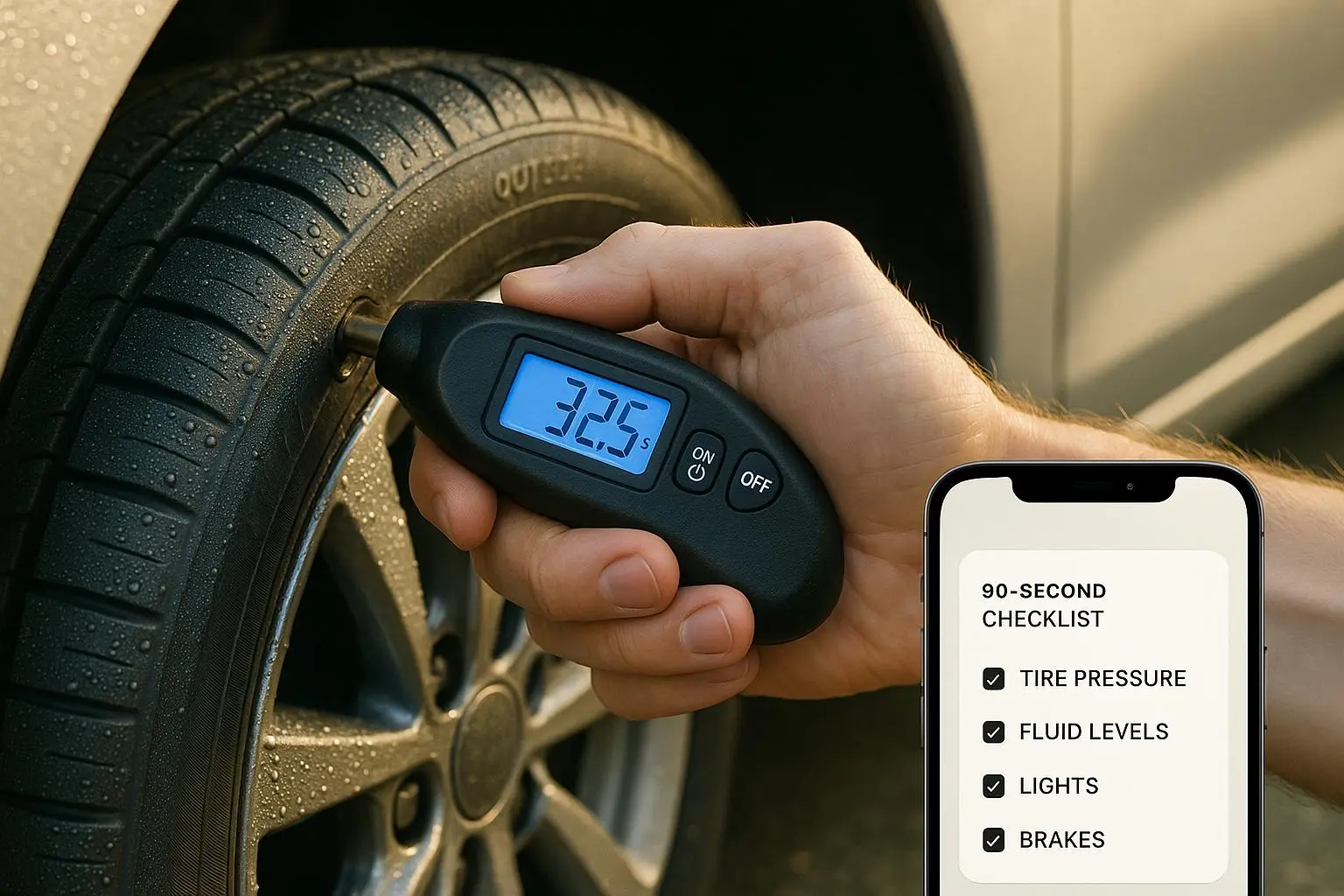
- Remove the valve cap, place the gauge on the valve stem, press firmly until the hiss stops and the reading appears.
- Write the number down and compare with the recommended PSI.
- Adjust as needed, in short bursts.
- If too low: add air in small bursts and recheck after each burst.
- If too high: bleed air in small increments and recheck.
- Cap it and move on.
- Replace the valve caps to keep dirt and moisture out.
- Do a final check to confirm you’re within the target range across all four tires.
- If you drive often in extreme heat or cold, consider rechecking later in the week when the tires have cooled again.
That’s the routine. It’s not a priest ritual or a high-tech process. It’s a few minutes, a consistent method, and a gauge you trust.
Here’s a concrete, real-world iteration I use when a quick check is needed after fueling or at a roadside stop.
- Step 1: I pull into a shade spot or a garage. I set my timer for two minutes—yes, I actually time it.
- Step 2: I locate the door placard for the official PSI, then I verify that against the gauge reading. If there’s a discrepancy, I don’t guess; I re-check.
- Step 3: I adjust only to the target PSI. If it’s close enough, I leave it; I don’t over-tune the tires because the difference tends to close as the tires sit.
- Step 4: I make a quick note in my maintenance log: date, tire PSI, and any adjustments. The habit is tiny, but over weeks it compounds into reliability.
The thing I like about this routine is that it doesn’t require fancy tools. A good gauge and a short note are enough to keep you honest. If you want to get fancy, you can use a digital gauge for faster readings and a phone app to log readings. I’ve found a simple digital gauge to be more precise for inconsistent readers, but the core habit remains unchanged.
Common Pitfalls You Might Be Falling Into
Nobody’s perfect, and tire pressure is one of those things that quietly slips away if you let it.
- Reading hot tires and trying to roughly “reproduce” the cold PSI. It’s not a good idea. If you’ve accidentally read a hot tire, write down that reading and recheck after the tire cools, then adjust based on the cold value.
- Using a cheap, unreliable gauge. If you’ve had a gauge that reads consistently differently each time, it’s time to swap. The right tool matters.
- Forgetting the spare. A spare tire is the emergency hero you hope to never use in a pinch. Check it sometimes to avoid a rude awakening.
- Not checking regularly. Once a month is a good target, and more often if you live in a climate with dramatic temperature swings or you do a lot of highway miles.
Now, I know you’re busy. So if you’re thinking, “This is extra work,” I get it. But think of it as a weekly gut check for your car. You’re not just checking air; you’re checking the health of your wheels, your braking, and your fuel economy. A 1 PSI change across all four tires can translate into a measurable difference in gas mileage, and over a year that adds up to real money. And more importantly, it protects you and your passengers on every trip.
Hot vs Cold Readings: The Real Story
Heat is the arch-nemesis of precise tire pressure. Air expands when it warms, so the pressure climbs as you drive. That means a tire checked after a highway stint could read 3-5 PSI higher than its cold pressure. If you then adjust the tire to that hot value, you’ll end up underinflated when the tire returns to its cooler state. The safest move is to read cold, then adjust to the cold target.
If you must check a hot tire, treat the reading as a potential indicator of what you’ll need when the tire cools. In most cases, you’ll need to fill to the cold PSI, not the hot reading. And if your weather involves extreme temperature swings, plan to check more often, perhaps between long trips.
This is where a lot of people push back, or they rationalize: “I’ll just do it later.” But later is where I’ve seen people forget, and that’s when you end up dealing with underinflated tires after a long drive or a cold morning with a flat-spot temper around the corner.
In-Garage vs Roadside: A Quick Cheat-Sheet
You’ll be in one of two places when you check: a comfortable garage in your driveway, or a curbside stop on the side of the road. The two scenarios produce different realities, but you can navigate them with one-page clarity.
In-Garage (Cold) Check
- Tire temperature: Cold
- Accuracy: High
- Adjustment advice: Inflate/deflate to the manufacturer’s recommended PSI
- Convenience: Best for your regular monthly routine
Roadside (Possibly Hot) Check
- Tire temperature: Hot
- Accuracy: Lower; numbers skew high
- Adjustment advice: Do not reduce pressure to cold PSI while hot; wait until cold to adjust
- Convenience: Practical in a pinch, but less precise
The goal isn’t to turn every roadside stop into a science lab. It’s to develop a repeatable habit that you can rely on at home and then translate to the road when you must. If you carry a spare, give it a quick check every couple of months; you don’t want a surprise to greet you when you really need it.
A Printable, Lock-Screen-Ready Checklist
If you want to reduce friction to near-zero, print this compact checklist and save it to your phone’s lock screen. It’s your “pause-and-do” moment when you’re rushing out the door.
- Check tires when they’re cold (parked for 3+ hours or driven less than 1 mile)
- Use a reliable tire pressure gauge
- Look up the recommended PSI on the door placard (not the tire sidewall max)
- Check all four tires and the spare if you have one
- Adjust to the recommended cold PSI in small increments
- Replace valve caps securely
- Log the reading in your maintenance app or notebook
- Recheck mid-month or before long trips, especially during temperature swings
If you’d rather a digital version, I’ve used a clean, printable PDF in the past that fits neatly on a phone screen, but the core habit remains: cold tires, precise gauge, and a quick adjustment.
Why This Matters For Your Wallet and Your Safety
I know what you’re thinking: “This is just one more thing to remember.” Here’s the blunt truth: tire pressure is a tiny thing that has outsized impact. It influences:
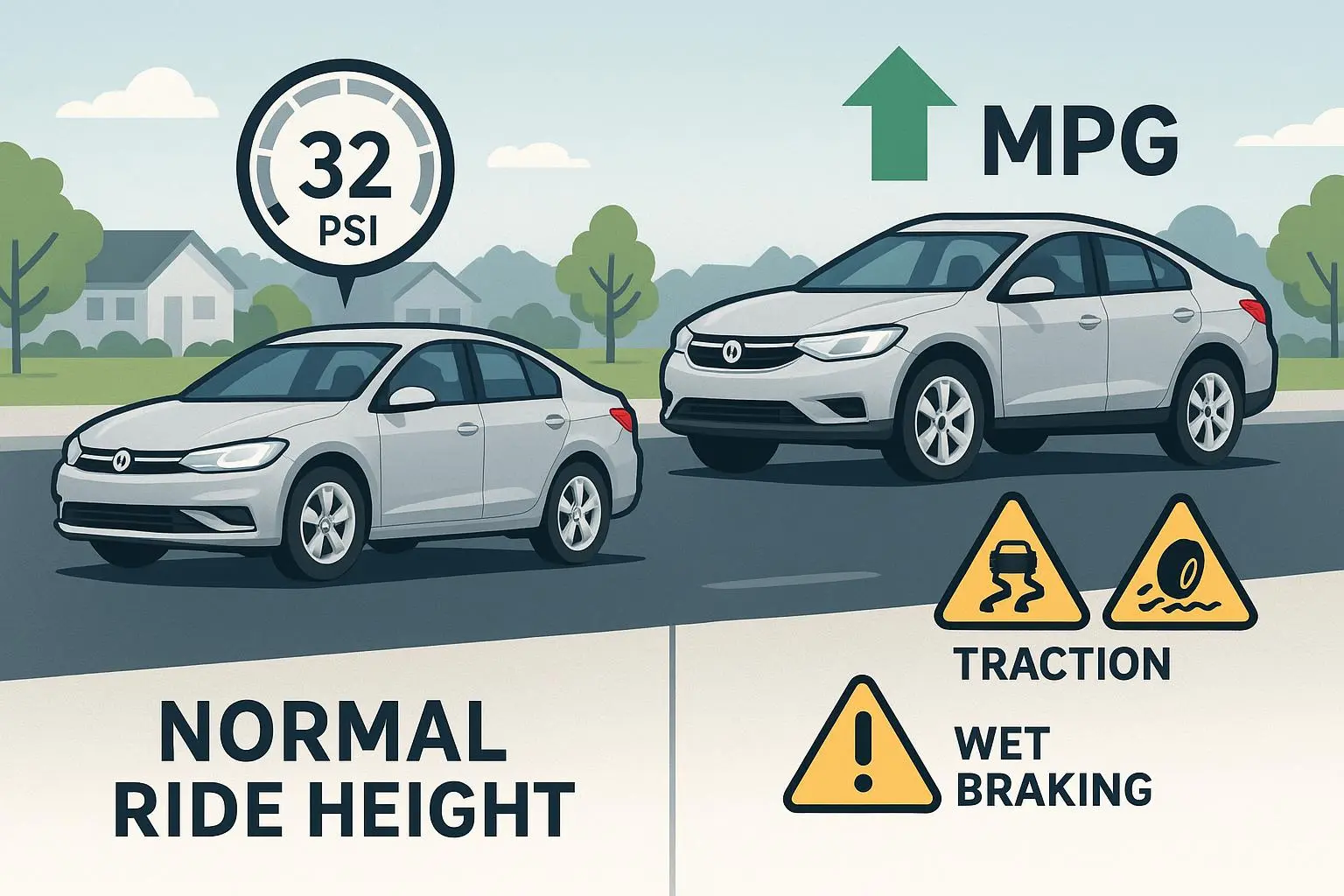
- Handling and braking performance. Underinflated tires flex more and heat up quicker, reducing grip, especially in wet or slippery conditions.
- Fuel economy. Each PSI under the ideal reduces fuel efficiency a measurable amount. AAA and DOE have echoed this, showing a drag in efficiency with underinflation.
- Tire life. Uneven wear and faster wear on the edges are the telltale signs of underinflation. Even inflation keeps the tread wearing evenly, extending the tire’s life and delaying replacements.
I once bought a set of new tires, expecting a quiet improvement in mileage. The thing that actually made the difference wasn’t the tires themselves but the habit around tire pressure. After I started maintaining a cold-tire routine, I saw a noticeable dip in fuel costs over six months and a more consistent braking feel in wet weather. It wasn’t a miracle, but it was a measurable improvement I could feel every day.
Real-World Outcomes: Numbers You Can Trust
- Monthly fuel savings: 0.2-0.4% per 1 PSI improvement spread across all four tires (typical range when moving from underinflation to manufacturer-recommended cold PSI) [^doe2023].
- Tire wear: More even wear across the tread, extending tire life by roughly 5-15% in typical driving conditions when inflation is kept within ±1 PSI of the recommended cold PSI [^aaa2022].
- Safety margin: Improved handling and braking response in wet or snowy conditions as tires maximize contact with the road when pressures are set correctly.
These aren’t grandiose claims. They’re small, repeatable gains that accumulate over a year. The stability you get from a reliable cold-tire routine is the quiet advantage that adds up—like consistently paying your credit card bill on time and watching your balance stay healthy without fanfare.
What I Recommend Now
- Do a cold-tire check at least once a month.
- Before long road trips, check your tires in a cold state—no driving within the last three hours if possible.
- Keep a spare tire check in your monthly cycle if you carry one.
- Invest in a reliable gauge and cross-check with a second device if you’re in doubt about readings.
- Create a simple log (digital or paper) so you can track trends and spot anomalies early.
If you want a more high-tech approach, consider pairing a tire-pressure-capable gauge with a maintenance app that prompts you on a schedule and logs PSI readings alongside mileage. Tools like Car Scanner ELM OBD2 or Fuelio can help you integrate tire checks into a broader maintenance plan. But even without digital help, a steady routine can deliver the same safety and cost benefits.
The 90-Second Routine, In Short
- Tires cold, parked 3+ hours (or driven under 1 mile)
- Find the recommended PSI on the door placard
- Use a reliable gauge to check all four tires and the spare
- Inflate or deflate to the cold PSI, in small increments
- Recheck after adjustments
- Replace valve caps
- Log the reading
That’s it. It’s not complicated, but it’s incredibly effective.
And if you want to make it stick, pair it with a simple reminder. A Sunday morning nudge or a quick post-fuel-stop check can prevent the drift from creeping in. Over time, it becomes second nature—like brushing your teeth after you’ve made it part of your morning routine.
A Quick Note On Sources
While the routine is practical, there’s real science behind it. The cold-tire rule and the relationship between temperature, air expansion, and PSI have been documented by major safety and automotive organizations. The practical steps align with guidance from NHTSA, AAA, and tire manufacturers who emphasize reading pressure on cold tires and following the vehicle’s recommended PSI.
- National Highway Traffic Safety Administration (NHTSA). Tire Safety: Everything You Need to Know.
- American Automobile Association (AAA). Tire Maintenance Tips for Safety and Longevity.
- U.S. Department of Energy. Fuel Economy Guide: Tire Pressure.
- Goodyear. Understanding Tire Pressure: PSI, TPMS, and More.
- Michelin. Tire Pressure: Why It Matters.
If you want more reading, I’ve included a compact reference list at the end of this piece with quick citations you can consult later.
Final Thoughts
The best habits aren’t flashy. They’re repeatable, reliable, and they save you money and risk you didn’t even realize you were taking on. The cold-tire rule plus a 90-second routine is exactly that kind of habit: small, practical, and powerful.
If you’re starting from scratch, pick a morning, head to your driveway, and commit to this routine for a month. You’ll likely notice two things: fewer frantic checks before trips, and steadier fuel costs over time. The payoff isn’t just in the numbers; it’s in the confidence you gain knowing your car’s first line of defense—its tires—are well cared for.