How to Jump-Start Safely — Including Hybrids & Modern Cars
Dec 17, 2025 • 7 min
The click-click-click of a dead battery is one of those small disasters that always feels worse than it is—until you make a mistake.
Modern cars, hybrids, and EVs aren’t the same as the old-school sedan you learned on. They have multiple batteries, electronic brains, and manufacturer rules that, if ignored, can fry a module or leave you paying a mechanic more than the battery costs.
This guide walks you through a safety-first way to jump-start any 12V system: the right clamp order, what’s different about hybrids and EVs, how to use portable jump packs, and what to do when a jump won’t bring a car back to life. I’ll also share a couple of real-world moments where I learned the hard way—and how you can avoid those mistakes.
Why the 12V still matters on hybrids and EVs
You might assume a hybrid or EV would run off its big traction battery if the small 12V dies. That’s not how most of them are wired.
The 12V runs the computers, door locks, lights, and the safety systems that let the car “wake up.” If that 12V is dead, the car can be completely unresponsive—even if the propulsion battery is full. So when we talk about jump-starting, we’re almost always talking about rescuing that 12V subsystem.
Quick fact: most portable jump packs are designed for the 12V rail. Never, ever hook jumper cables to a high-voltage pack on an EV.
Safety first—simple rules that matter
- Turn everything off: lights, radio, climate, and both vehicles' ignitions.
- Park vehicles about 18 inches apart—close enough for cables, not touching.
- Engage parking brakes and put autos in Park (or neutral for manuals).
- Wear safety glasses and gloves if you have them.
- Read the owner’s manual for vehicle-specific jump points and warnings.
If the manual says “call a dealer,” that’s not fearmongering. Some hybrids and EVs have manufacturer steps that reduce risk to electronics—follow them.
Micro-moment: I always keep one pair of nitrile gloves in my glovebox. They’re cheap and weirdly calming when you’re fiddling around an engine bay at 7 a.m. in the rain.
The clamp order that actually prevents sparks (and fried electronics)
This is the single most important sequence. Do it out of order and you can cause a dangerous spark or a damaging surge.
- Red to dead battery positive (+).
- Red to donor battery positive (+).
- Black to donor battery negative (-).
- Black to a clean, unpainted metal ground on the dead car—engine block, chassis bracket, or a bolt away from the battery.
Why that last ground? Batteries can emit hydrogen. Connecting the final negative directly to the dead battery terminal can create a spark over the battery where hydrogen may be venting. Grounding to the chassis reduces that risk and helps avoid surges into sensitive electronics.
When disconnecting, reverse the order: negative ground off first, then negative donor, then positive donor, and finally positive on the dead battery.
Tip: cheap clamps that wobble or don’t bite metal are a waste. Good clamps give firm contact and make the whole process quicker.
Hybrids and EVs: the special cases
Hybrids (Prius, Accord Hybrid, etc.) typically have a small 12V battery separate from the traction pack. Sometimes it’s under the hood, sometimes in the trunk, and sometimes under a seat.
- Consult the manual for the exact jump points. Many models provide designated positive and ground points under a fuse box cover or inside the engine bay.
- Do NOT attach cables to high-voltage components or battery terminals.
- EVs will usually have an accessible 12V point for emergency power—often under a panel or behind a tow-eye cover. Manuals will show this. Use a portable jump pack rated for automotive 12V use.
Practical note: some manufacturers caution against using a high-amperage donor (like a big diesel truck) on certain EV 12V systems because of potential voltage spikes. When in doubt, use a dedicated lithium jump pack with safety features or call roadside help.
Portable jump packs: why I prefer them (and what to buy)
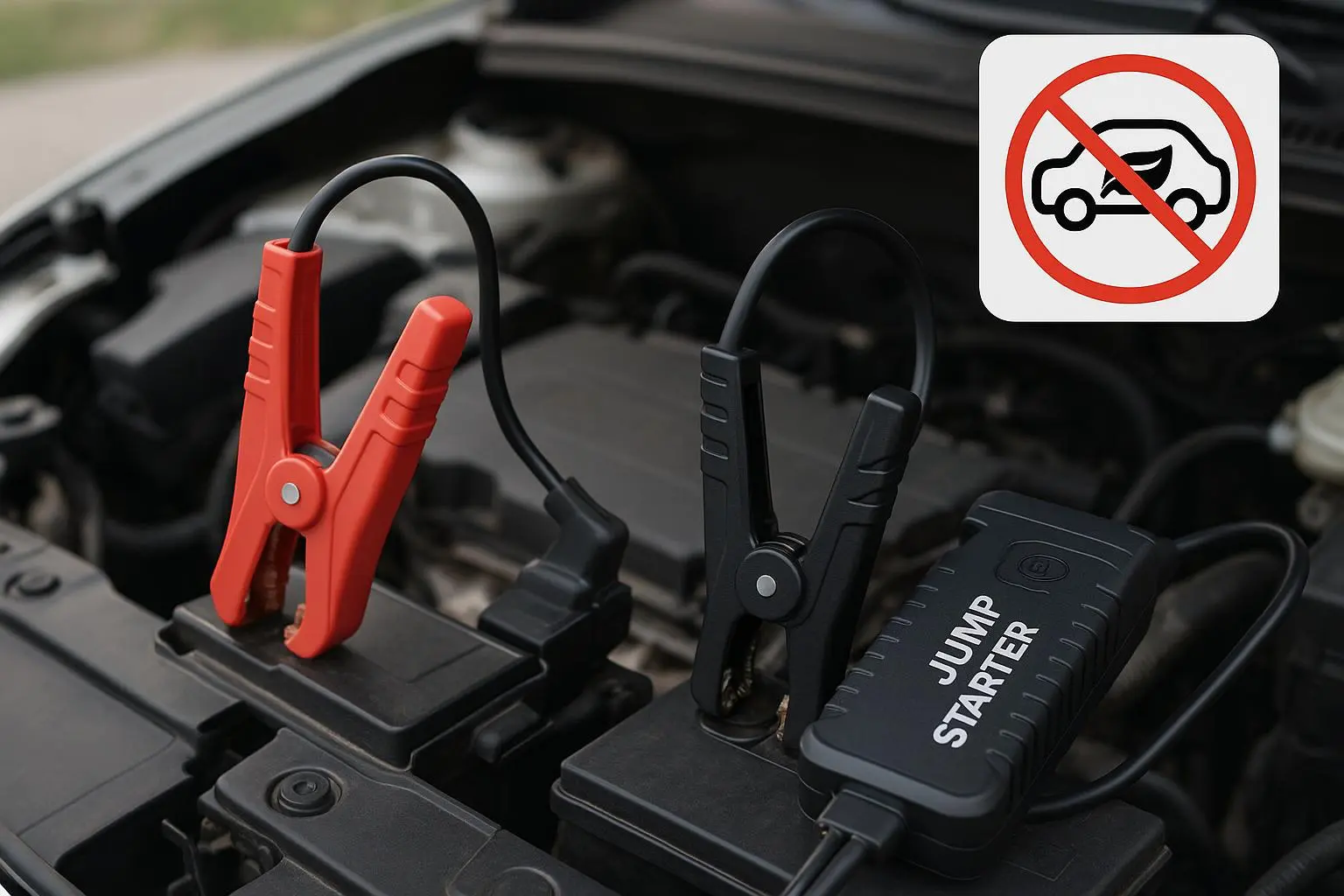
Portable packs have two big advantages: they don’t stress a donor car’s alternator, and many include reverse-polarity and spark protection.
But not all packs are equal. For a combustion engine or large vehicle in cold weather, aim for at least 600 Crank Amps (CA). For smaller cars or mild climates, 300–500 CA can work.
Buy a reputable brand (NOCO, Clore, DBPOWER) and check:
- Reverse polarity protection
- Short-circuit protection
- Peak amp rating (not just advertised “portable” claims)
- Manufacturer guidance for hybrid/EV use
How to use one: connect positive to positive, negative to chassis ground on the dead car, turn the pack on, wait 30 seconds, then try to start. If it works, disconnect ground first and power down the pack.
A real story: what I learned the hard way (150 words)
A few winters ago my neighbor’s Civic died in my driveway. I’d grabbed my old heavy cables, hooked up the donor truck—and forgot to ground away from the battery. There was a loud pop and a smear of corrosion on the dead battery's vent. The Civic started, but the dash lit up with error codes later that day. Long story short: a $20 mistake led to a $200 diagnostic and a replaced battery sensor. I switched to a small NOCO pack after that. It’s saved me twice since, and once I used it on a hybrid Prius where the manual told me to use the engine bay jump points—those pins are not where the battery lives. The NOCO’s protections kept everything calm. Lesson: good tools and grounding away from the battery are worth the price.
Troubleshooting when a jump doesn’t work
If it still won’t start after a proper jump:
- Re-check clamp contacts. Corrosion or paint prevents good contact.
- Let the donor run for a few minutes to charge the 12V. Some cars need 5–10 minutes.
- If it starts and dies when you remove cables, suspect the alternator. The jump only got you past the initial crank.
- If you get clicking but no crank, the battery may be sulfated or below recovery. Replacement is likely.
- If the car attempts to start but electronics act weird afterward, a fuse or ECU may have been damaged—professional diagnosis required.
When to call roadside assistance: if the car is an EV/hybrid and the manual warns against DIY jumps, or if you’re unsure about ground points. For many, the $50–$100 tow or service call is cheaper than a wrong move.
What to say to roadside assistance (short script)
If you're calling for help, have this ready:
- “My [make, model, year] has a dead 12V battery and won’t start.”
- “It’s a [ICE/hybrid/EV].” (If hybrid/EV, mention that explicitly.)
- “I’d like a jump-start or battery service—are you able to jump hybrids/EVs?”
- Provide location, color/plate if needed, and whether the car is blocking traffic.
This saves time and ensures the technician brings the right gear.
Preventive moves that save you time later
- Replace batteries older than 4–6 years proactively.
- Keep a quality portable jump pack in your trunk.
- Clean battery terminals annually—corrosion resists current flow.
- If you have a hybrid or EV, download and keep the owner’s manual PDF accessible on your phone.
- Join a roadside membership if you value peace of mind.
Quick checklist (if you only remember five things)
- Read the manual for model-specific jump points.
- Red to + on dead, red to + on donor.
- Black to - on donor, black to chassis ground on dead.
- Use a portable pack when possible; buy a reputable brand.
- If it starts then dies, check the alternator.
Final thought
Jump-starting is a small skill that becomes a lot more useful when paired with the right tools and a healthy dose of patience. Modern cars add complexity, but they also add safeguards—use them, and you’ll minimize risk to both yourself and your car.
If you drive a hybrid or EV, take five minutes today to find the designated 12V jump points and tuck that page of the manual into your glovebox or phone. The time you spend now will probably save you a smelly, spark-filled afternoon later.