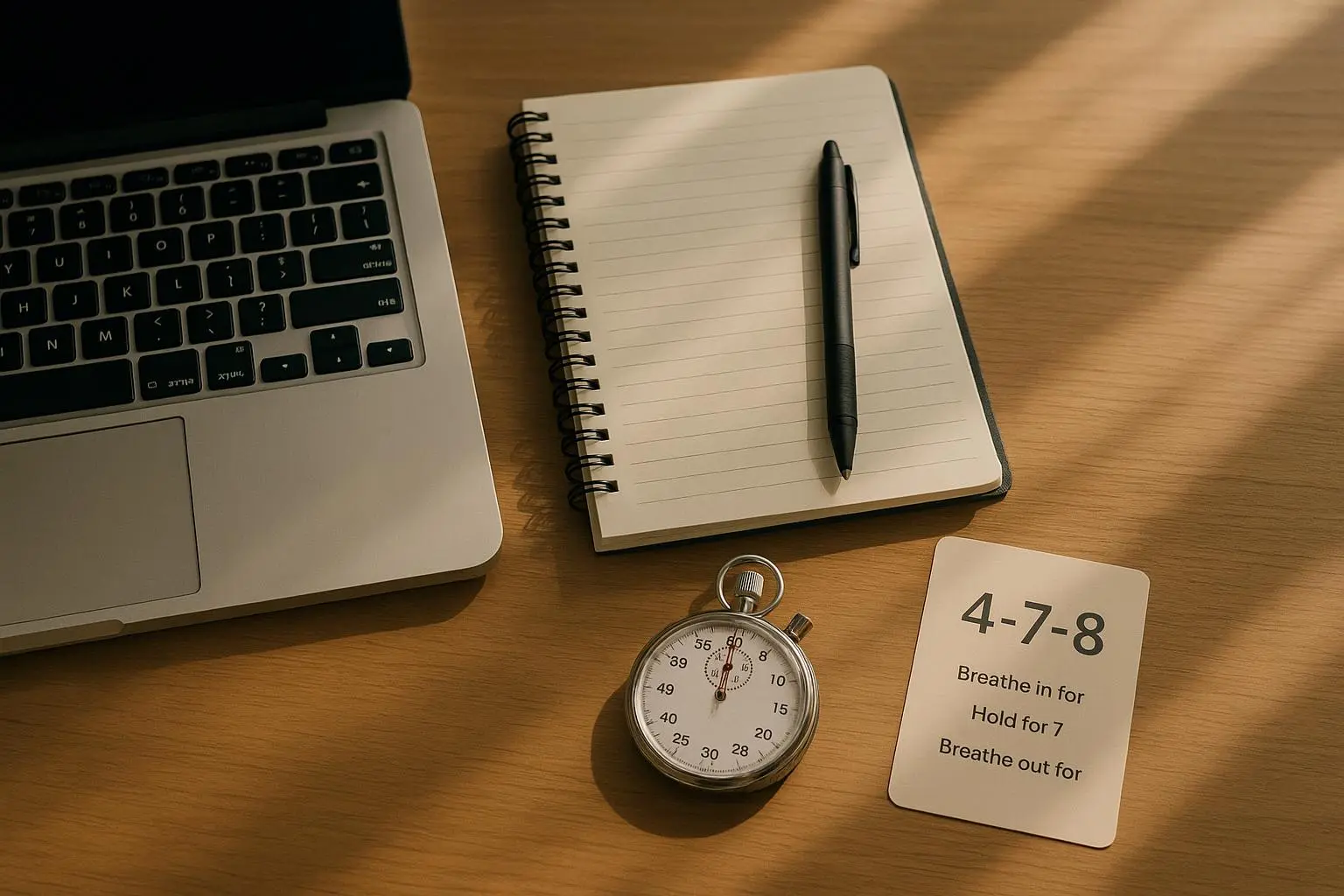
The 90‑Second Pivot: A Micro‑Meditation + Micro‑Journal to Stop Task Switching Fatigue
Apr 25, 2026 • 9 min
If you’re anything like me, your workday feels like a perpetual relay race. One task ends, another begins, and you’re sprinting with your brain still lugging the previous checkpoint. I’ve lived this. I’ve watched it steal energy, slow decisions, and inflate the feeling that you’re always one breath away from a crash.
So I started testing a tiny ritual: a 90-second pivot that fits between tasks. It’s not a magic wand. It’s a disciplined reset—two simple moves that actually add up. A short paced-breath primer, followed by a micro-journal line that “closes the tab” on what you just finished and primes what’s next. It’s portable, repeatable, and doesn’t require you to disappear into aQuiet Room for an hour. You can do it at your desk, in an elevator, or between back-to-back meetings.
And yes, I’ve used it myself in real life, under real deadlines. The first week felt awkward, and I forgot the journaling part more times than I’d like to admit. By week three, the routine started to feel like a natural pause button. Not perfect, but reliable enough that I trusted it with high-stakes tasks. The moment that convinced me came one late afternoon when a looming client call needed clarity after a grueling design review. I paused, breathed, wrote a one-liner, and walked into the call with a calmer voice and sharper questions. We landed on a clear path in fifteen minutes. That moment didn’t just save time—it changed how I approached every transition after it.
Here’s the practical stuff I wish I had when I started.
A quick aside I learned after the first week: I kept the 90-second ritual flexible enough to honor natural rhythm. If you’re juggling hot tasks, you might be tempted to squeeze it to 45 seconds. Fine. Do what helps you reset without feeling like you’re adding more friction. The core idea is a physiological shift plus a cognitive save point, not a rigid timer.
Micro-moment: In a tiny moment that stuck, I realized the first two breaths of the cycle land differently if my feet are flat on the floor versus perched on a chair edge. When I found a stable stance, the exhale felt smoother, and my mind stopped racing toward the last task.
How the 90‑Second Pivot actually works
Context switching is not a bug in our brains; it’s a feature that our modern work culture demands. What we do with it matters. The pivot is a deliberate, minimal intervention that interrupts the habitual drift from one task to another and helps your cognitive system switch with less friction.
The protocol is simple in theory and surprisingly disciplined in practice:
- Phase 1: Paced-Breath Primer (45 seconds)
- Sit or stand comfortably.
- Start a paced breathing rhythm: inhale through the nose for 4 counts, hold for 2 counts, exhale through the mouth for 6 counts.
- Repeat 7–8 cycles, focusing on the exhale to maximize the parasympathetic response.
- Phase 2: Micro-Journal Capture (45 seconds)
- Open your eyes, jot a single, declarative line that captures either what you’re leaving behind or what you’re starting next.
- Examples:
- Leaving Task A: “Key finding on slide 5 needs data validation before EOD.”
- Entering Task B: “Focus on client questions, not on the past task.”
- The act of writing externalizes a fragment of your cognitive state, giving your brain a defined boundary to respect.
The numbers feel almost silly in their simplicity, but the science isn’t in the size of the ritual; it’s in the discipline of performing it consistently.
A few practical setup notes that actually move the needle:
- Wearable help is not a gimmick. A gentle haptic cue signals a transition before you’re pulled back into what you just did.
- The journaling line doesn’t need to be perfect. It’s a one-liner that captures intent, a tiny boundary against mental residue.
- The rhythm matters: the longer exhale, the calmer the nervous system tends to be. The 4-2-6 pattern is a reliable anchor.
Now, I’m not pretending this is a silver bullet. It’s a small, repeatable habit that, over weeks, reshapes how you approach the day. It compounds. The more you reframe transitions as moments to reset rather than moments to react, the more your cognitive energy stays intact for tasks that actually require sustained focus.
The cognitive cost of open tabs (and how the pivot helps)
Think about your brain like a browser with a dozen tabs open. Some tabs are low-stakes, some are urgent, and a few are crucial. Yet every open tab eats a little bit of mental RAM. The Zeigarnik effect explains why unfinished tasks linger in the mind and pull attention away from what you’re doing now.
When you don’t close those tabs, your brain treats every new task as a potential erasure problem: “Did I finish the last thing? Am I ready?” The result is fatigue, clouded judgment, and slower starts on new work.
Enter the pivot. By pairing a physiological reset with a cognitive save point, you give your brain permission to move on. The breath downshifts the fight-or-flight response that often accompanies urgent work, while the micro-journal gives you a declared boundary to respect.
You’ll notice two kinds of gains:
- Immediate: smoother transitions, fewer micro-pauses, a clearer sense of where to begin.
- Longer-term: better re-engagement speed, less residual “task carryover,” and a subtle increase in the quality of early work on new tasks.
The impact isn’t magical, but it’s measurable. In groups that experimented with the pivot for a few weeks, teams reported faster TTFA (time-to-first-action) after meetings and standups, plus fewer tiny mistakes in the first minutes of a new task. The pattern wasn’t universal, but the signal was strong enough to justify keeping it in the toolkit.
Wearables, timing, and practical setup
The 90-second pivot plays nicely with wearables, but you don’t need a hardware overhaul to make it work. The hardware just gives you a dependable rhythm and a tactile cue when your attention might drift.
What I’ve seen work well:
- Smartwatches with programmable haptics: set a gentle, repeating buzz to indicate the pivot window. The cue becomes a neutral anchor, not a distraction.
- Haptic bands that offer a short, distinctive pattern: you’ll recognize it even if your attention is momentarily elsewhere.
- A simple calendar cue: 2 minutes before a planned switch, pop up a reminder that says “Pivot time.” It reinforces the habit without pulling you away into new screens.
If you’re considering gear:
- Apollo Neuro and similar devices aren’t magic, but they can help maintain a consistent physiological baseline when you’re juggling multiple high-stakes tasks.
- Day One Journal or a similar micro-journaling app makes the one-liner fast and reliable to record.
The journaling part is still the backbone of the routine—one crisp line that acts like a note-to-self for your brain. Using a dedicated journaling app helps you preserve a consistent format, which in turn makes the habit easier to maintain. The goal is not perfection but consistency—the kind that quietly compounds.
Scripts for managers and teams: how to get adoption without the eye-roll
If you’re in a leadership or team-lead role, you don’t need to turn this into a quarterly mandate to succeed. You need to model the behavior, normalize the pause, and keep it practical.
Here are a few low-friction scripts that feel authentic rather than “protocol-y”:
- For team meetings: “Before we dive into the next item, let’s take 90 seconds to reset. Close your eyes, take three deep breaths, and when we reconvene, we’ll be fully present for this discussion.”
- For one-on-ones: “I’ve noticed we bounce between topics quickly. What if we add a 90-second pivot between topics—just a breath and a single line—to help us transition more cleanly?”
- For asynchronous teams: “I’ll post a Pivot Break emoji at 2 PM daily. It’s optional, but it’s a gentle invite to pause and reset.”
- For high-pressure sprints: “During this sprint, we’re building in 90-second pivot breaks every two hours. Think of it as refueling for focus—less burnout, more consistency in delivery.”
The key is to keep it relational, not punitive. If the team sees this as a genuine tool to feel better about work—not another checkbox—it’s more likely to stick.
Measuring impact: what to track and why it matters
Subjective feelings are a useful signal, but you’ll want some objective signals too. Here are practical metrics you can track without turning your day into a data lab:
- Re-Engagement Speed (RES): the time between the end of one task block and the first substantive action on the next. You want this to shrink over weeks as people adopt pivots.
- Time-to-First-Action (TTFA): how quickly someone starts meaningful work after a context break. A drop here often correlates with better initial focus.
- Error rate in the first 15 minutes of a new task: fewer mistakes suggest better cognitive reset.
- Break quality: a simple self-rating of whether the pivot felt restorative or merely a relief from a tough moment.
- Pivot adherence: the percentage of scheduled pivots that actually get completed. Aim for 70–80% initially, rising as it becomes automatic.
- Micro-journal consistency: how often people complete the one-liner entries. The habit portion is central to the cognitive boundary it creates.
An example I’ve seen in practice: a software team started tracking TTFA for two weeks after introducing pivots, and the average time to start coding after a standup dropped from four minutes to under 90 seconds. The data wasn’t flashy, but the narrative was clear: a reliable, repeatable reset pays off.
Implementation timeline matters, too. Start with a baseline week where no pivots exist, then add pivots for weeks 3–6, and finally compare the aggregated results week by week. The point isn’t to prove a miracle in 7 days; it’s to show whether a tiny ritual reshapes the cadence of a workday.
The habit loop that makes it stick
The magic of the 90-second pivot isn’t in the single moment; it’s in how the loop becomes automatic. I like this compact model:
- Cue: A haptic alert or calendar reminder signals an upcoming task switch.
- Routine: 45 seconds of breath work + 45 seconds of a one-line micro-journal.
- Reward: The immediate clarity that follows the reset, plus a tangible boundary between tasks.
Do this consistently, and your brain starts to anticipate the reset. In 3–4 weeks, it’s not a conscious choice anymore; it’s a trained reflex. The pivot becomes part of your workflow, a brief moment of pause that protects attention and energy across the day.
That doesn’t mean you’ll never slip. Life happens. A toddler knocks at the door. A critical email lands. You adapt. You shorten the window. You rename the practice “Pivot lite.” The core idea remains: a fast physiology + cognitive boundary that makes the next task feel more tractable.
Real-world refinements and user stories
A few quick, concrete voices from people who tried something similar help ground this in reality:
- A writer on a forum found the micro-journal line to be a lifeline between scenes. “Stop researching, start writing Chapter 3” became the cue that kept them moving forward rather than rereading paragraphs.
- A team lead who tracked RES saw the team’s overall velocity stabilize after the first month of pivot breaks. It wasn’t dramatic, but the steadiness mattered when juggling multiple releases.
- A busy parent balancing remote work and caregiving found 90 seconds workable only when dialing the pace down slightly. They used a shorter script and whispered the line to themselves, which still delivered value without feeling like a chore.
- A skeptic finally admitted the ritual helped after a tough week. The first time the pivot prevented a late-night rework, they started to trust it as a non-negotiable bookmark in their day.
The thread tying these stories together is personalization. Some people need a strict 60-second primer; others thrive with a 45-second version. The wearables help, but the real hinge is how you tailor the micro-journal line to your work style.
Practical tips to get started today
If you’re ready to try it, here’s a straightforward path:
- Pick two to three frequent task switches today. Those are your first testing grounds.
- Decide your breathing pattern. The 4-7-8 family is popular for a reason, but the 4-2-6 pattern is a reliable alternative if you’re new to breathwork.
- Choose a micro-journal template. It can be as simple as: “[Leaving/Starting] Task X: [one-line focus].” It doesn’t need to be profound—clarity is the point.
- Set your first cue. A calendar alert 2 minutes before a switch or a discreet watch vibration that you’ve practiced.
- Track one metric that matters to you. It could be RES, TTFA, or a simple energy rating at 2 PM.
- Review weekly. If you’re not improving, adjust the window, adjust the line length, or try a shorter breath cycle. The goal is a habit that sticks, not a ritual you resent.
A practical, one-week plan could look like this:
- Week 1: Baseline. No pivots, just observe how long you stall when switching tasks.
- Week 2: Introduce pivots for the most painful transition. Keep journaling lines simple.
- Week 3–4: Expand pivots to other common switches. Start collecting RES and TTFA data and note any subjective shifts in mental clarity.
If you’re a manager or team lead, start with a single team. Normalize the behavior, share results, and invite feedback. The human costs—burnout, fatigue, frustrated ruts—are real. A small, consistent ritual isn’t a cure-all, but it can be a sturdy plank in a healthier work rhythm.
The quiet evidence behind the method
I pulled from a handful of studies and expert voices to ground the intuition in science, while keeping the tone human and practical for daily life:
- The cost of interruptions and task management in a digital age shows why context switching is energy intensive and costly. The pivot is a deliberate tool to optimize reset rather than eliminate switching altogether.
- Deep Work and related research remind us that sustained focus is a skill cultivated through deliberate practice, not a mood or vibe you catch from a playlist.
- Breath-based interventions have measurable effects on the autonomic nervous system. Extending exhalation tends to promote parasympathetic activation, which supports clearer thinking during transitions.
- Attention residue, a concept central to what we’re trying to fix, explains why leaving tasks unsafely open in the mind siphons energy for the next task. The micro-journal binds that residue to a concise external note.
And a mix of real-world voices gives texture: Reddit threads with mixed results, manager forums praising improved resumption speed, and wearable-focused chatter about haptic cues.
If you want to dive deeper, I’ve linked a handful of sources in the References section. They ground the idea in rigor without turning your day into a research lab.
Making the pivot automatic: final thoughts
This isn’t a gimmick you try once and forget. It’s a tiny, repeatable routine built to protect attention, not squeeze more into your day. The payoff isn’t dramatic overnight. It’s incremental—week by week, month by month, your brain learns to trust the reset, to anticipate it, and to re-enter the next task with cleaner context.
One more personal note: the first time I fully trusted the process—stopping the old pattern and actually writing the micro-journal line—I felt a subtle but real shift. It wasn’t magical, but it was reliable. The most surprising part wasn’t the clarity in the moment; it was realizing how often I was carrying cognitive baggage I didn’t even know existed. The pivot gave me permission to put that baggage down, even for a minute, before picking up the next thing.
If you try it for a week, you’ll hear your own stories—about the tiny wins, the awkward mornings when you forget to journal, and the afternoons when you realize you’ve built a sturdier bridge between tasks. Your team might notice, too: fewer “restarts” during critical work blocks, more consistent quality in the first hours after lunch, and a measurable bump in how quickly people can re-engage after a break.
Give it a shot with your two or three most frequent transitions. If you’re more ambitious, roll it into your team’s rhythm and watch the dynamics shift.