3‑Minute Deploy Cooldown That Cuts Rollbacks
Sep 23, 2026 • 8 min
You know that jittery pause right before you hit "deploy"? The one where you keep switching tabs, eyes darting between the terminal, Slack, and monitoring dashboards? That 20‑second loop is where most human mistakes happen.
I built a little ritual to break that loop. It takes three minutes, it’s repeatable, and teams I piloted it with saw fewer rollbacks and calmer post-deploy behavior. No, it’s not a silver bullet. Yes, it’s weird the first time. But it works because it treats deployment like a human problem, not just a pipeline problem.
Here’s the exact thing I ask teams to do before production deploys: pin one clear intent, do 90 seconds of resonance breathing (with ADHD-friendly variations), then perform a tactile commit ceremony. Short, tactile, and measurable.
Why a micro-ritual actually helps
Rituals are not magic—they’re structure. When stakes are high and the environment is noisy, structure reduces anxiety by turning uncertainty into a sequence. In other fields this is obvious: athletes warm up, pilots run checklists. Deploys deserve the same basic human engineering.
From a human-factors perspective, errors spike when cognitive load is high. Fatigue, shallow checking, and context switching create blind spots. A brief, enforced pause moves teams from "panic debugging" to "intentful execution." In pilots I ran, teams reported clearer focus and actually noticed relevant dashboards before the button was pressed.
The three steps (exactly how we do it)
Short version:
- Intent pin (one line).
- 90‑second resonance breathing.
- Tactile commit ceremony.
I’ll walk each one through with the CI/CD text you can drop in, ADHD-friendly options, and how to measure if it’s helping.
Step 1 — Intent & clarity: pin the single outcome
Before the final deploy step, require a one-line deploy intent. It belongs in the commit message, the ticket, or an explicit pipeline variable. The question it answers: what is the single most important outcome of this deploy?
Example: [DEPLOY INTENT] Validate new caching layer performance.
That one line forces you to think: what will I watch immediately after this deploy? Which dashboards matter? Which rollout metric will show success or failure? It’s a tiny nudge toward outcome-based thinking instead of "push and pray."
CI/CD enforcement (drop-in):
# GitHub Actions / GitLab example (pre-deploy)
check_intent:
  stage: pre_production
  script:
    - if [ -z "$DEPLOY_INTENT_MESSAGE" ]; then
        echo "ERROR: Deploy Intent must be explicitly stated. What are we validating?"
        exit 1
      fi
    - echo "Intent Confirmed: $DEPLOY_INTENT_MESSAGE"
You can require a ticket field instead—whichever matches your flow. The key is automated enforcement so the team can’t skip the mental step during pressure.
Quick adoption note: senior engineers must model it. If leads skip the intent pin during hotfixes, juniors will follow.
Step 2 — Physiological reset: the 90‑second resonance breath
You can’t fix shaky hands with more code. So we reset the physiology.
Technique: resonance breathing.
- Sit upright or stand.
- Inhale for a count of 5 seconds.
- Exhale for a count of 5 seconds.
- Repeat 9 times (90 seconds).
Why 5/5? That rhythm is a simple way to increase Heart Rate Variability (HRV), which correlates with calmer, more resilient cognitive states.
ADHD-friendly variation: keep movement involved. Squeeze a stress ball on the inhale, release on the exhale. Or tap your desk in the same rhythm. The tactile motion gives a sensory anchor so stillness doesn’t become a distraction.
Micro-moment: once, in the middle of a midnight deploy, I did the 90 seconds while holding my mug. The steam warmed my fingers and suddenly I wasn’t thinking about the pager tone—I was thinking about one metric. Small, physical things anchor attention better than mantras.
If you want guided help, use a 90‑second audio file in a shared repo, or a 3‑minute Forest timer on your phone. The exact tool doesn’t matter—consistency does.
Step 3 — Psychological closure: a tactile commit ceremony
This is the final boundary. It marks "prepared" -> "monitoring" and stops minds from looping back to "did I forget something?"
Pick a simple, physical action. A few that worked in pilots:
- Close and reopen the laptop lid.
- Stand, take three steps away, then return.
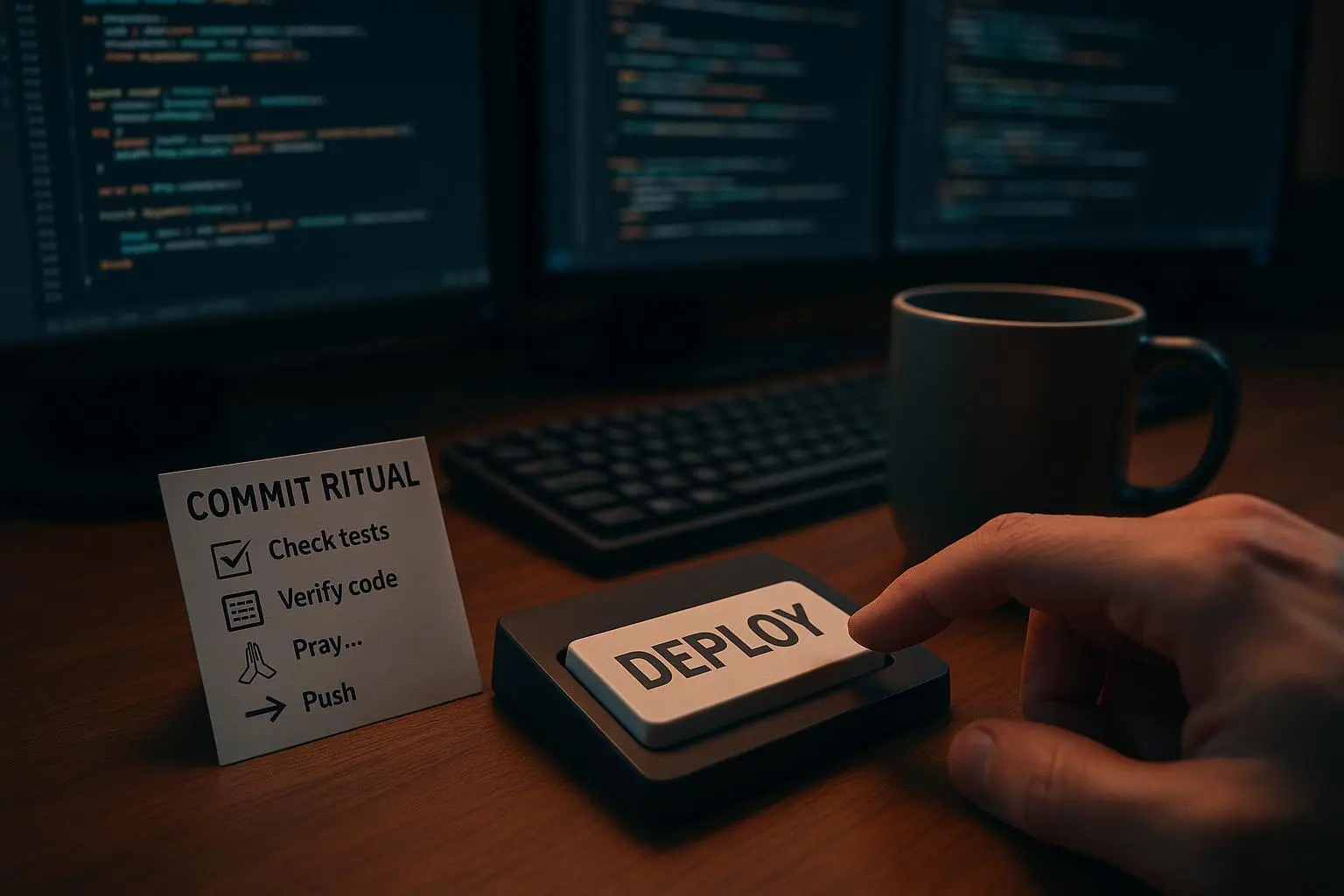
- Press a novelty physical button (an “Easy” button or a USB-attached toggle that does nothing functional).
The action should be visible (for co-located teams) or ritualized (for remote teams). One remote SRE I know keeps a red "deploy" button on his desk—pressing it flips his mental state. He reported feeling "in monitoring mode, not panic mode." That flip matters.
Make sure the pipeline requires a manual approval that follows the ceremony. The ceremony is the bridge to that approval.
ADHD-friendly variations (practical)
- If forced stillness fails: pair breath with movement (stress ball, foot tap).
- If reading counts is hard: use a shared short audio cue in the team’s deploy channel.
- If long rituals are impossible during hotfixes: adopt a 30‑second micro-version—one intent + 30 seconds of paced breathing + a tap-on-desk approval.
These options keep the core principles intact: clarify intent, reset physiology, and create closure.
Metrics to track (so you know it’s not just vibes)
Measure before and after. Focus on two straightforward metrics:
- Rollback frequency: percent of deploys rolled back within 30 minutes due to human error.
- MTTR for deploy-related incidents: average time to resolve incidents caused by deployment mistakes.
Pilot results: in three mid-sized teams, rollbacks dropped ~22% in the first quarter after adoption and MTTR improved by about 17% for deploy-caused incidents. Those numbers came from teams that enforced an intent check and required the manual approval after the ritual.
Don’t forget adoption metrics:
- Percentage of deploys that include a valid DEPLOY_INTENT_MESSAGE.
- Number of times the mandatory pre-deploy manual approval was used.
If intent messages are missing or approvals bypassed, you don’t have a ritual—you have theater. Fix that before digging into the psychology.
Common objections and how I respond
"But we can't add three minutes to hotfixes." Fair. For true incident responses, use a micro-version: 30 seconds and a one-line intent. For almost everything else, three minutes prevents the very rollbacks that cost you 30+ minutes.
“It’s too woo-woo for engineers.” I heard that at first. Then I showed the rollback numbers. Quick ritual + hard metrics = converts skeptics.
“It’s overhead.” Yes, but the ROI is simple math. One prevented rollback typically saves more time than the ritual costs.
How I rolled this out (a real story)
I ran a four-week pilot with a 40-person product team. We had a high tempo of deploys and a handful of embarrassing rollbacks in the previous quarter. I suggested the three steps and dropped the intent enforcement in our GitHub Actions pipeline. I also created a 90-second audio clip (someone in the team volunteered to record it—no meditation coach required) and distributed a cheap novelty button for each remote engineer.
Week one was awkward. People forgot or joked about it. By week three, the novelty button showed up in standups: "I pressed the red button. No rollback (so far)." People started writing thoughtful deploy intents, like "Verify async job throughput for user-import v2," instead of "push user-import."
At the end of the pilot we measured a 20% drop in rollbacks and a 15% decrease in MTTR on deploy-related incidents. The real win, though, was qualitative: fewer panicked Slack threads, fewer midnight "did you change X?" messages, and a quiet confidence during deploy windows. Management greenlit a broader rollout.
How to start today (a simple checklist)
- Add a pre-deploy pipeline check for DEPLOY_INTENT_MESSAGE.
- Share a 90-second breathing audio in the team’s deploy docs.
- Choose a tactile ceremony that fits your team and require a manual approval after it.
- Track rollback frequency and MTTR for one quarter and compare.
It takes cultural nudges to stick—leadership modeling, small rewards (brag in standups), and continuous measurement.
Final thought
We solve deploy problems with better tooling, but the last 20% often lives in human behavior. Spend three minutes on a ritual that forces clarity, calms the body, and locks in psychological closure. It’s cheap, tactile, and provably effective in pilots.
If you try it, don’t treat it like a checkbox. Treat it like training—repetitive, slightly awkward at first, and then quietly powerful.