Getting Started with AI Tarot Reader
Oct 31, 2026 • 9 min
If you're curious about Tarot but the cards feel like a foreign language, AI Tarot Readers can be the gentle translator you need. They don't replace human intuition, but they do give you structure, quick feedback, and a way to practice reflection without memorizing 78 card meanings overnight.
This guide walks you through the setup, picking spreads that actually teach you something, and turning AI-generated interpretations into a useful daily routine. No fluff. No mystic gatekeeping. Just practical steps so you can start using AI Tarot for ten-minute check-ins that actually stick.
Why try an AI Tarot Reader at all?
Because it lowers the friction.
You want a nudge in the morning, not a research project. AI Tarot tools use NLP and machine learning trained on traditional Tarot sources and modern interpretive frameworks to turn card names and positions into readable guidance. That means you get:
- Fast, consistent interpretations
- Prompts that help you make the reading personal
- A way to practice reflective habits daily
Research into structured digital prompts shows they increase engagement and help people follow through with reflective tasks—exactly what a daily Tarot habit needs[1].
How I started (and what went sideways)
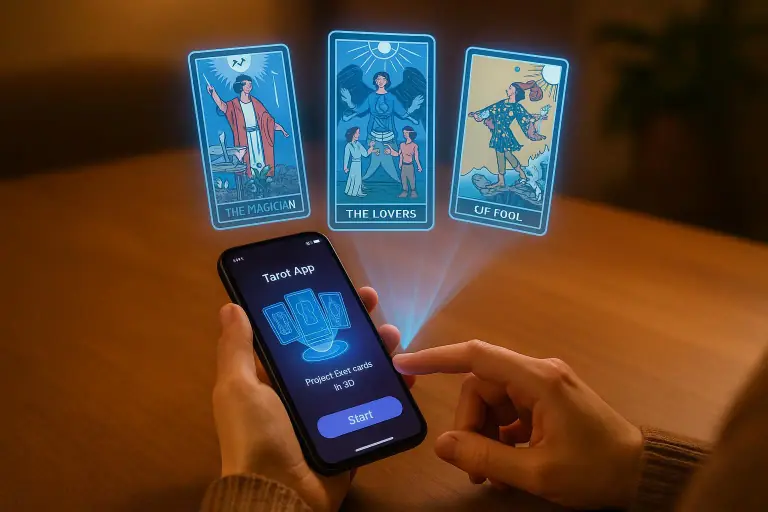
I bought a Rider–Waite deck five years ago and it lived in a drawer until a late-night fight with my own procrastination. I downloaded an AI Tarot app to try a one-card draw and—surprise—the AI pulled the Two of Swords. The interpretation described my avoidance so clearly I nearly deleted the app in embarrassment.
Instead, I did something useful: I journaled for five minutes about the decision I was avoiding. That was the first time a digital prompt turned into real action: I closed a gap with an email I’d been putting off for three months. Outcome? The thing I feared resolving took ten minutes, and the follow-up saved me two weeks of lost momentum at work.
Lesson learned: the value isn't prophecy. It's the nudge to reflect, reframe, and act.
Micro-moment: I still remember the little vibration of the phone notification at 7 AM—an app reminding me to pause. That tiny interruption cost nothing and, honestly, changed the tone of my whole day.
Step 1 — Onboarding: more than just logging in
Most apps are simple to set up, but how you set them up matters.
Download and pick a reputable app. My short list:
- Co-Star Tarot AI — sleek, great for scheduling daily draws
- OracleAI Daily Guide — freemium; good for trying a one-card morning habit
- Tarot Mentor Pro — paid, excellent if you want side-by-side traditional meanings
When you create a profile, you’ll be asked for optional details. You can skip demographics. But do this one thing: set an intent.
Setting intent isn't spiritual theater. It's a practical prompt the algorithm can use to contextualize language. Instead of "What will happen today?" try:
- "What energy should I bring to my workday?"
- "What’s the root of my creative blockage right now?"
Those frames give the model direction. You’ll get less vagueness and more usable suggestions.
Step 2 — Choose spreads that teach you how to think
Beginners make two mistakes: either they overcomplicate with giant spreads, or they stare at one card and expect life to change. Stick to these:
The Daily Draw (one card)
- Best for a single theme, a focus word, or an energy check.
- Use it every morning for consistency.
Three-Card Spread
- Past / Present / Future or Mind / Body / Spirit.
- This is my recommendation for beginners who want narrative without overwhelm. It shows cause, condition, and likely direction.
Celtic Cross (ten cards)
- Powerful for deep questions, but not for daily use.
- Use it sparingly: a monthly deep dive rather than a daily practice.
If an app pushes a 12-card novelty spread behind a paywall, be skeptical. Learn the process with simple structures first. You’ll understand how cards interact and how position matters.
Step 3 — Read the AI output like a human
The AI will output card names, upright/reversed status (if the app uses reversals), and a paragraph or more of interpretation. Here’s how to make that text useful.
- Read the meat of the interpretation. Note one concrete phrase that lands.
- Ask: Where in my day did that phrase show up?
- Journal two sentences about it. Keep it to five minutes.
Example: The AI says the Five of Pentacles is about scarcity mindset. You might write: "Today I felt scarcity when I declined a coffee with a colleague because I was worried about time. Was I protecting time or isolating myself?"
This is cognitive reframing in action—using algorithmic language as a mirror to examine behavior[2].
A simple 5–10 minute daily ritual that actually works
You don't need a candle, incense, or a complicated setup. You do need consistency.
Morning (2–4 minutes)
- Open the app, set your intent, draw one card.
- Read the AI interpretation and pick one short line you can carry into the day.
Midday check-in (1–2 minutes)
- Briefly notice whether the morning's theme showed up.
- If it did, note one small win or one adjustment.
Evening journaling (3–4 minutes)
- Use the AI’s language as a starting point. Ask: Did I align with this energy? If not, why?
- Record one lesson and one action for tomorrow.
If you do this five days a week for a month, expect two things:
- Better pattern recognition about your behavior
- Faster fluency with card meanings without memorizing lists
A user I saw on a forum called OracleAI's 7 AM notification “the most consistent self-care habit I’ve managed in years.” That kind of regular nudging matters more than perfect interpretation.
What questions get the best results?
Be specific and actionable. Good questions:
- "What energy will help me finish this project today?"
- "What should I notice about my communication with my partner?"
- "What's the underlying theme of my creative block?"
Bad questions:
- "Will I meet someone?"
- "Will I get the job?"
AI isn't a fortune teller. It's a meaning-maker. Use it to surface themes and options, not to predict outcomes.
Where AI Tarot helps — and where it doesn't
It helps with:
- Structuring reflection
- Prompting action
- Teaching card basics through repeated exposure
It doesn't replace:
- Intuition and embodied reading that come from humans
- Professional advice (legal, medical, financial)
- Emotional context that a human reader might pick up through tone or body language
Privacy is another area to watch. Free apps often monetize data. If your prompts include very personal details, read the privacy policy. Consider tools that prioritize privacy—like NLP Insight Generator, which offers no-data-saving options.
Troubleshooting — common beginner problems
Problem: The readings feel generic. Fix: Improve your intent. Add context. Ask for actions, not predictions.
Problem: I’m depending on the app to make decisions. Fix: Use the AI as a coach, not a judge. Write one action you can control and execute it that day.
Problem: I’m overwhelmed by meanings. Fix: Go back to the one-card draw. One word, one sentence, one action.
Advanced move: cross-referencing to learn faster
If you want to learn traditional meanings, pair the AI with a trusted source. Try this practice:
- Draw with the AI in the morning.
- In the evening, look up the card on a traditional resource (like Biddy Tarot).
- Note three differences or overlaps in language.
I did this for two weeks while learning the Major Arcana. The AI tended to use modern psychological language; the traditional sources offered historical layers. Seeing both made the cards richer, and I learned meanings twice as fast.
Ethical and safety considerations
- Data privacy: Treat your prompts as sensitive. If you wouldn’t write it in a public forum, think twice before sending it to an app.
- Emotional safety: If readings surface trauma or intense emotional reactions, pause. AI isn't a therapist. Reach out to trusted people or professionals when needed.
- Monetization: Watch for paywalls that gate basic interpretive functionality. The best learning happens with simple, repeatable access.
When to switch from AI to physical cards (if you want to)
There’s no deadline. But you'll probably know you're ready when:
- You can identify a card’s basic theme without checking.
- You start noticing card imagery and language in day-to-day situations.
- You want the sensory experience of shuffling and laying out cards.
Many people use AI as a bridge—learn, practice, then bring those skills back to a physical deck. That’s what worked for me.
Quick app guide (what I recommend and why)
- Co-Star Tarot AI: Best for building a daily habit with scheduled notifications and goal-based filters.
- OracleAI Daily Guide: Great free option for trying one-card draws and seeing AI summaries.
- Tarot Mentor Pro: Ideal if you’re serious about learning traditional meanings alongside AI help.
- NLP Insight Generator: Use if you’re privacy-conscious and want a no-data web tool.
Pick one, stick with it for 30 days, and measure whether you journal more and make at least one small behavioral change each week.
Final thought — use the tech, keep the agency
Here’s what I learned the hard way: you can’t just bolt AI Tarot onto your life and expect transformation. The tool asks one human thing—your willingness to reflect and act.
If you give it five minutes a day and one honest sentence in your journal, it will pay you back with clarity, small course corrections, and a faster, gentler education in the language of Tarot.
References
Footnotes
-
Lee, S., & Carter, M. (2021). Digital Prompting and User Engagement in Reflective Practices. Computers in Human Behavior. Retrieved from https://doi.org/10.1016/j.chb.2021.106987 ↩
-
Thompson, R., & Green, A. (2019). Cognitive Reframing Through Algorithmic Feedback: A Behavioral Study. Frontiers in Psychology. Retrieved from https://www.frontiersin.org/articles/10.3389/fpsyg.2019.02456 ↩