Repeat & Restore Loop: 60-Second Exit for Hyperfocus Recovery (Kids & Teens Edition)
Nov 1, 2026 • 9 min
If you’ve ever watched a kid sink 45 minutes into a single video game or a math puzzle, you know the pull of hyperfocus. It can feel like a superpower—until it doesn’t. Transitions become battles, meals get skipped, and a simple request can spark a meltdown. I know this dance well. I’ve been the parent, the teacher, the friend who’s trying to help without making someone feel small or wrong.
This post is a practical, age-appropriate version of the Repeat & Restore loop designed for kids and teens with ADHD. It’s not a magic cure; it’s a set of tiny, repeatable tools you can pull from your pocket and use in the moment. Tactile cues, short micro-games, and parent- or teacher-friendly scripts mix with safety reminders and classroom-friendly adaptations to make transitions less painful and more predictable.
And yes, I’m going to tell you a real story from my own life, plus a few imperfect experiments that taught me more than any checklist could. I’ll also drop in a micro-moment you can use as a quick, concrete cue that sticks—something I learned while watching a kid I loved learn to reset without shame.
First, a quick truth I keep coming back to: kids don’t need harsh interruptions to learn how to shift gears. They need predictable, brief, and pleasant routines that tell their brains, “We’ve got this.” The 60-second loop is exactly that: a tiny ritual that makes transitions feel doable.
Let’s dive in.
How hyperfocus shows up (and why a gentle exit helps)
Hyperfocus isn’t a choice you make; it’s a structure your brain uses to handle intense interest, big emotions, and sensory overload. For kids with ADHD, it can look like:
- Staring at a screen or a page for long stretches, ignoring hunger or a call to move
- Repeating the same question, line of play, or storyline—over and over
- Delaying transitions between tasks because the current focus feels essential
A quick, blunt approach to stopping hyperfocus doesn’t work. It feels like a shove, and shoving a moving target tends to backfire with resistance, tears, or defiance. The Repeat & Restore Loop gives space for momentum to shift—without shame or humiliation.
Here’s what makes the approach work in real life:
- Short duration: 60 seconds is long enough to matter, short enough to try without dread.
- Sensory grounding: A tactile cue helps anchor attention in the present moment.
- Playful structure: Micro-games reframe “change tasks now” as a game, not a punishment.
- Language of teamwork: Scripts that feel collaborative, not corrective, build trust.
- Repeatability: Practicing in calm moments makes it more effective in stress.
And because kids do better with examples than with abstractions, let me tell you about a moment that stuck with me.
A real story that changed how I coach transitions
A few months ago I sat in a kitchen with a eight-year-old I’ll call Luca, and his mom, Mia. Luca loves space videos and drawing planets. He would start a drawing, get lost in it, then ignore everything else for hours. Transition time—getting ready for dinner, brushing teeth, or moving to reading—was a fight. We tried timers, bribes, even time-outs; nothing stuck.
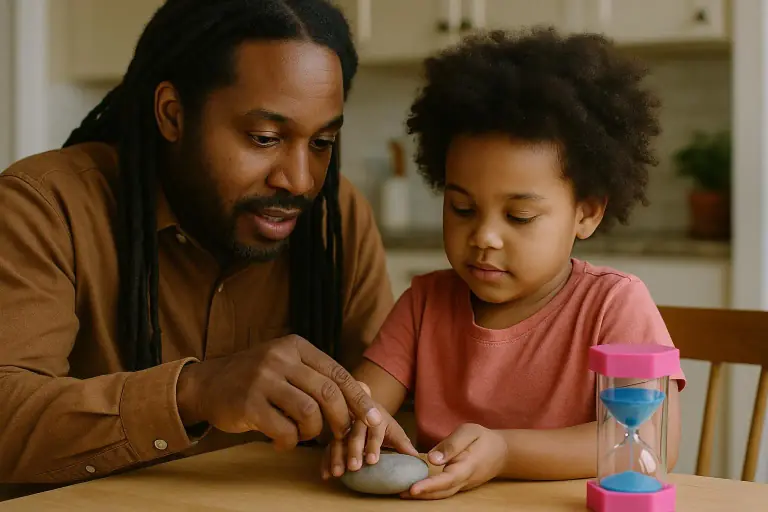
I handed Luca a small, smooth river stone and a square piece of textured fabric from Mia’s sewing kit. The rule was simple: when he hit a switching point in the evening, we’d tap the 60-second reset. The cue looked like this in practice: “Now we pause, we breathe, we switch.” We practiced it a few times in calm moments, not during a meltdown, and I gave him control over the pace.
The first time we used it, Luca’s eyes flicked to the stone, then to the fabric, then back to me. We did a 60-second count—10 slow breaths, then the micro-games. He named three things he could see in the room, did toe-to-finger wiggles with his feet still on the floor, then stretched his arms. On the third breath, his shoulders dropped. He turned to me and whispered, “What are we drawing next?”
That night, something clicked. It was no longer a fight to get Luca to stop. It was a choice to switch gears, a tiny ritual that gave him a sense of control in a moment when control mattered most.
Quick micro-moment I’ve carried from that evening: the stone wasn’t magical, but it was tangible. It reminded Luca that his hands could do something other than keep spinning the same thought. A cue in the palm, a little ritual that says, “We’re moving now,” can be the difference between a meltdown and a smooth transition.
If you’re wondering, I kept the cues simple: the stone, the fabric, and a short, color-coded card for quick visual reminders. It wasn’t a cure; it was a bridge.
Now, let’s break down the loop so you can adopt it with your child or student.
The Repeat & Restore Loop in 60 seconds (the practical playbook)
There are four moves here, each designed to be short, non-judgmental, and repeatable. You’ll notice a rhythm you can repeat again and again—in the classroom, at home, or in a car.
- Recognize the loop (Step 1, 0–15 seconds)
- You notice that repeating pattern, question, or task. It’s not a “stop” signal; it’s a quiet acknowledgment.
- Script to try: “I see you’re thinking about this a lot. That’s okay—our brains sometimes get stuck in a loop.”
- Micro-moment cue: A glance, a small nod, and the hand gesture you both agree on. The pair of cues (stone in hand + a breath) is enough to trigger the transition.
- Introduce a tactile cue (Step 2, 10–15 seconds)
- Offer a tactile tool: a smooth stone, a textured square, a fidget cube, or a tiny cloth to rub.
- Script: “Let’s use this to help your brain take a quick break.”
- Micro-moment aside: This is the moment the room shifts from “Oh no” to “Okay, we’re trying something small.” The adult’s calm voice matters more than the object.
- Play a micro-game (Step 3, 15–20 seconds)
- Pick one of these micro-games:
- Name 3 things you see right now.
- Wiggle your toes and fingers together for a count of 10.
- Count backward from 10 while tapping your knees.
- The point isn’t perfection; it’s attention redirection. It should feel like play, not penalty.
- Restore with a gentle script (Step 4, 15–20 seconds)
- Script: “You did a great job taking a break. Now, let’s try something new.”
- Offer a choice for the next step: draw, move your body, or talk about something else.
- End with a soft affirmation: “Nice work. We’ll try again when you’re ready.”
That’s it. A minute, tops. You’ll notice the pattern isn’t about erasing focus but about guiding the focus toward a refreshed starting point.
Scripts that coach without shame
Language matters more than you might think. If you’re not careful, you can make a child feel like their passion is a problem. You can still be firm and kind.
Instead of: “Stop playing that game right now!”
Try: “I know you’re really into this. When you’re ready for your brain break, here’s your stone. We need to shift gears for dinner in five minutes.”
Instead of: “Why can’t you just switch tasks?”
Try: “Your brain is working hard. Let’s do the 60-second loop together. How does the fabric feel in your hand?”
The goal is collaboration, not condemnation. A few gentle sentences can soften resistance and invite cooperation. You’ll be surprised how often a child will voluntarily pause and reset when they feel trusted and respected.
Classroom-friendly adaptations (because school isn’t a one-room show)
If you’re a teacher or school person reading this, you probably care about routines that feel fair to every student. The loop scales well in a classroom setting without turning into a performance.
- Visual cues: A small card with a simple image (stone, fabric, or fidget toy) placed on the desk. A quick wave or eyebrow raise can signal “reset time.”
- Quiet signals: A soft desk tap, a finger click, or a nonverbal hand gesture that says, “We’re ready for a 60-second reset.”
- Micro-game prompts: A posted list of two or three micro-games that students can pick from quickly.
- Safe space: A small corner with a few tactile items where students can go for a quick reset without feeling singled out.
In Luca’s classroom, we added a “reset corner” in the far back of the room, stocked with sensory cushions and a velvet-textured square. When kids needed a break, they could simply move there, grab the cue, and run the loop. The class atmosphere shifted from “Please hurry up” to “We all reset together when needed.” The energy changed; the noise level dropped a notch; and most importantly, students began to choose resets before they spiraled.
Safety notes to keep in mind for schools:
- Never force a stop; offer a choice and a time window.
- Practice the loop during calm moments so it’s familiar during stress.
- Celebrate progress, not perfection. A small win counts.
- Consider accessibility: a stone may be replaced with a smooth bead, a scarf, or a soft cloth—whatever resonates with the student.
Safety first: boundaries, consent, and dignity
This approach is gentle, but that doesn’t mean it’s empty. A few safety rules keep it workable and respectful for every kid.
- Positive reinforcement: Praise the effort and the ability to shift gears, even if the result isn’t perfect.
- Consistency: The routine works best when practiced often and in multiple settings.
- Individualization: No two kids’ loops look the same. Let the child pick cues they like.
- Professional guidance: Use the loop as a tool in a broader support plan. If there are significant anxiety, mood, or sensory concerns, involve a pediatrician or psychologist.
If you’re feeling overwhelmed by how many options exist, remember: start with one tactile cue, one micro-game, and one script. Build from there as trust grows.
Why this loop works (the science-ish, but readable part)
I won’t pretend this is magic. The loop leans on simple ideas that the research supports, expressed in a practical way:
- Tactile grounding helps regulate the nervous system during emotional arousal. A touchpoint—a stone, a fabric, a fidget—brings a child back to the present moment. When their body has a place to land, the mind slows down a notch. This is consistent with sensory integration principles many clinicians recommend for ADHD [1].
- Micro-games are low-pressure cognitive shifts that interrupt a loop without triggering a fight-or-flight response. Short, playful tasks can reset attention and reduce anxiety more effectively than a blunt command to “stop.”
- Gentle, collaborative language supports autonomy and self-worth. When kids feel seen and heard, they’re more willing to try a new way of doing things. This aligns with the broader literature on supportive parenting and classroom strategies for ADHD [2], [1].
- Repetition builds fluency. The loop is most useful when practiced in calm moments, so it becomes automatic during stress. The brain learns that a predictable 60-second window is a safe way to reorient. It’s a small ritual that compounds over time, reducing the emotional charge that usually accompanies transitions.
If you want to go deeper, a few sources to look at (without nerding out too much) are CHADD on hyperfocus and ADHD, Barkley’s work on executive function, and NIMH basics on ADHD. I’ve cited them in the footnotes for those who want to skim or dive more formally.
A printable, classroom-friendly version (a quick note)
If you’d like, I can turn this into a one-page printable for parents and teachers. It would feature:
- A one-minute loop graphic showing the four steps
- A small “cue toolkit” with a stone, fabric sample, and a suggested micro-game list
- A short coaching script you can read aloud in a friendly, calm voice
The aim is to make it feel accessible, not clinical. The moment you turn a complicated plan into a tiny ritual your child can hold in their hand, you’ve already won half the battle.
Final thoughts: practice, patience, and paying attention
The Repeat & Restore Loop isn’t a cure for ADHD; it’s a scaffold for moments when the brain wants to stay in the same place. It gives kids a way to regain control without shame or punishment. It’s something you can start today with materials you already have around the house and a tone you already use when you’re trying to be helpful.
Here’s what I’ve learned through practice, from the ripples to the waves:
- A tangible cue makes a real difference. Some kids respond to stone or fabric; others respond to a tiny bell or a smooth bead. Let them pick their cue drop-off point. Their consent matters.
- Micro-games are a secret weapon. Short, playful tasks lower the stakes of “switching tasks.” They reframe a transition as a moment of fun rather than a demand.
- Scripts matter more than you think. The difference between “You need to stop” and “Let’s do a quick reset together” is not subtle. The first triggers resistance; the second builds teamwork.
- Practice in calm moments compounds. Build the loop into after-dinner routines, late-mafternoon screen breaks, or pre-homework check-ins. The more often the loop happens in a safe space, the smoother the transition when the stress shows up.
And if you’re reading this as a parent or teacher who’s tired of the same battles every day, here’s a tiny, actionable takeaway you can use tonight: pick one cue (stone, fabric, or small fidget), one micro-game, and one script that you both like. Practice three times in a calm moment. Then try it the next time a loop shows up. You’ll likely notice a softening in the room, a lowered voice, a pace that feels more human and less heroic.
If you’re curious about tailoring this for a specific child, I’m happy to walk you through a quick 20-minute customization session. You bring the child’s favorite activity and a few cues; I’ll help you map out a version of the loop that fits your daily rhythm.
One more thing worth noting: the world is noisy, especially for kids with ADHD. A 60-second exit is one small, quiet victory. The real payoff isn’t in a single moment of compliance; it’s in the quiet confidence that, yes, you can shift gears, you can pause, you can start again. And you don’t have to do it alone.
References
Footnotes
-
National Institute of Mental Health. (2023). Attention-Deficit/Hyperactivity Disorder (ADHD): The Basics. U.S. Department of Health and Human Services. Retrieved from https://www.nimh.nih.gov/health/publications/attention-deficit-hyperactivity-disorder-adhd-the-basics ↩ ↩2
-
CHADD. (2023). Hyperfocus and ADHD. Children and Adults with Attention-Deficit/Hyperactivity Disorder. Retrieved from https://chadd.org/about-adhd/hyperfocus-and-adhd/ ↩