Micro-4-7-8 for Founders: A 2-Minute Wind-Down When You Can't Switch Off
May 3, 2026 • 9 min
You’re a founder. Your brain isn’t supposed to stop thinking at night. It’s supposed to iterate, optimize, and prep for tomorrow’s sprint. I get it. I’ve been there. The night’s ticking away, your inbox pings in the distance, and the to-do list grows a voice in your head that sounds suspiciously like a drill sergeant.
Here’s what finally clicked for me: you don’t need a full hour of meditation or a fancy sleep routine to calm a racing mind. You need something small, repeatable, and brutally practical. A two-minute tool you can drop into the moment when it matters most. I call it Micro-4-7-8, a condensed cousin of the classic 4-7-8 breathing method. It’s designed for high-stakes founders who are too tired to “sit still” but still want a real reset.
And yes, I’ve used it. Lots of times. I’ve watched it turn a chaotic evening into something you can actually sleep through. It’s not a magic wand, but it’s reliable enough to reach for on nights when you’re weighing a fundraising deadline against a product release and wondering why you didn’t sleep earlier this week.
A quick aside, a human moment I keep near my desk: I once ran a late-stage investor update and stayed up to polish slides until 2 a.m. The room was silent except for the hum of the server rack. I tried to breathe normally, then attempted “normal” meditation. Both failed me for different reasons. The Micro-4-7-8 protocol, on that night, felt like a lifeboat. I could do it without needing a quiet corner, or a padded mat, or a playlist. Just me, a chair, and a breath.
And here’s a tiny detail that stuck with me: the first exhale you make with a soft “whoosh” sound, like you’re sighing the day away, is the sound of permission—permission to stop solving right now and let the body catch up with sleep. It’s a small detail, but it anchors the calm when everything else is noisy.
Today, I’m going to walk you through how to use Micro-4-7-8 in four tiny, practical steps, what science says about why it works, and how to adapt it so it sticks.
Why founders need a micro reset, not a deep dive
Let me be honest: most breathing advice I’ve seen assumes you’ve got quiet time, a dark room, and a mind that isn’t sprinting through every possible risk. That’s not most founders’ reality. You don’t need a retreat; you need a two-minute tool you can deploy between meetings, after a tense call, or right before bed when your brain wants to run a marathon.
Breathwork isn’t just vibes. It taps into physiology. Slow, controlled breathing nudges the nervous system toward parasympathetic dominance—the “rest and digest” side of the spectrum. When you exhale longer than you inhale, you increase CO2 exchange, which helps calm the nervous system and reduce heartrate variability. In practical terms, two minutes of deliberate breath can lower the racing thoughts that keep you awake and reset your body to sleep mode quicker than doomscrolling or endless caffeine detoxes.
Science aside, this approach has my own data behind it. When I’ve had back-to-back investor calls, a last-minute feature request, and a looming go-to-market deadline, Micro-4-7-8 has reduced the time to quiet from what felt like an hour of “try to clear the head” to about two minutes. The result? I sleep a bit better, wake up a touch less foggy, and start the next day with a cleaner slate.
But here’s the thing. If you try to imitate a long session, you’ll talk yourself out of it. If you try to force a perfect exhale or count like a drill sergeant, you’ll mimic a workout instead of a wind-down. The power of Micro-4-7-8 is its rough edges. It’s simple. It’s repeatable. And for a founder, it’s not a risk to try in a cramped hotel room, on a red-eye, or in the glare of late-night glow from a laptop.
The Micro-4-7-8 protocol (the two-minute drill)
The core idea: compress the counts, keep the exhale generous, and give your mind a short script to cling to as you breathe.
Step 1: Compressed counts (3-5-6)
- Sit up straight. No need to close your eyes, although you can if you want to reduce distractions.
- Inhale through the nose for 3 seconds. Let your ribs expand; feel the air fill the lower lungs.
- Hold for 5 seconds. Just count 1-2-3-4-5 in your head.
- Exhale through the mouth for 6 seconds. A gentle, controlled exhale with a soft “whoosh” sound helps cue the body that the day is releasing.
- Repeat this four times. About a minute of active breathing.
Why 3-5-6? It’s just enough to interrupt the racing thoughts without demanding a perfect performance. It’s doable when you’re tired, frustrated, or half-sleepy. It’s not a meditation marathon; it’s a focused reset.
Step 2: Rapid calming script (60 seconds)
- As you breathe, run a tiny mental script. You’re not forcing belief; you’re creating tiny, believable anchors.
- Examples to repeat in your head:
- I am safe.
- I am enough.
- I can let go.
- If a thought pops up, acknowledge it and then gently bring your focus back to the breath and the script. No judgment, just a reset button.
Step 3: Quick bedtime checklist (60 seconds)
- Write down one urgent task for tomorrow.
- Write down one thing you’re grateful for from today.
- Write down one thing you’re letting go of tonight.
- Put the list away. This externalizes the mental load and reduces the chances you’ll relive it while trying to fall asleep.
If you’re studying this in real life, you’ll notice these aren’t grand rituals. They’re micro-moments designed to be repeated, not perfected. It’s about the pattern, not the poetry.
When to reach for Micro-4-7-8
- After a tense meeting or investor update. The adrenaline dump can linger long after the call ends; this helps you flip the switch.
- Before bed, when your mind won’t shut up. A two-minute ritual beats lying in bed listening to the same thought loop.
- In the middle of the day, when a decision avalanche hits and you need a quick reset to push through a focused block.
- When you’re traveling and sleep becomes a luxury, but you still need to recover for a big day.
This isn’t a cure-all. It’s a reliable interrupt. It’s the difference between finishing a day on guard and finishing a day with a little more grace.
The science behind the breath (in plain English)
Breathing is not a performance. It’s a signal. When you exhale longer than you inhale, you boost parasympathetic activity, lower heart rate, and reduce sympathetic arousal. That cascade helps you feel safer, calmer, and more present. The compressed 3-5-6 sequence is a practical lever for that signal.
A few quick notes from the literature and practice I’ve found useful:
- Slow diaphragmatic breathing has shown to influence autonomic nervous system balance, which is central to stress regulation. In everyday terms: your body learns to switch gears from “go go go” to “rest and repair” more quickly with practice.
- The longer exhale is a critical piece. It’s not just about counting; it’s about creating intentional physiological cues that say, “It’s safe to relax now.” This matters especially for founders who constantly justify urgency to themselves.
- Cognitive aids around sleep, like a quick bedtime checklist, have been shown to help reduce pre-sleep cognitive activity. Externalizing thoughts reduces the odds you’ll keep re-worrying after you turn out the light.
If you want numbers, I’ll spare you the wonky rabbit holes: the research around breath work suggests measurable improvements in heart-rate variability and subjective calm in short bouts. The Micro-4-7-8 is a calibrated, impatient version of that—designed for real life, not a lab.
Founder feedback: what real people actually say
I’ve shared the Micro-4-7-8 with a handful of founders and early-stage operators. The mix of responses is telling:
- Positive: A founder in a fast-growing SaaS company told me the compressed count version is “a game-changer” because it fits into a 60-second window between a call and bedtime. The “Release the day” script helped her mentally file urgent items away so she could sleep.
- Cautious: Another founder pushed back, saying a real cortisol spike sometimes requires more time or a different tool. That’s valid. Breathwork isn’t a bandaid; it’s a door opener. If you’re truly wound tight, you may need stronger interventions—but this still buys you a minute when you’d otherwise get stuck.
- Mixed: A product lead found it useful as a re-entry tool. If she wakes up in the middle of the night, the Micro-4-7-8 helps her return to a neutral state faster than lying there and watching the clock.
And then there are the “micro-moments” that stick with me: a quick aside on a quiet evening, when the only sound is the fan rotating and the soft thump of a distant train, if you breathe correctly, you can feel your shoulders drop a fraction. It’s a tiny thing, but it matters when you’ve spent the day carrying a team’s hopes on your back.
The Urgent Task Wind-Down Checklist (for nights with looming deadlines)
- The 5-Minute Dump: Before you crash, write down everything you think you have to tackle tomorrow. Externalizing these thoughts reduces the chance you’ll replay them as you try to sleep.
- Set the Alarm and Trust It: You’re not solving this now. The alarm will be your stake in the ground, not your brain’s battleground.
- The Blue Light Barrier: Dim or turn off blue-spectrum light 30 minutes before attempting Micro-4-7-8. The science here is simple: blue light suppresses melatonin, making it harder to drift off.
- One Urgent Task, One Gratitude, One Let-Go: The three prompts reinforce focus, appreciation, and release. The release is especially important for mental health; it’s the cognitive equivalent of dropping a heavy bag.
These steps aren’t glamorous, but they’re incredibly effective when combined with the breath protocol. If you’re the kind of founder who races through morning stand-ups and still sits there, wide awake, at 2 a.m., these small rituals can move your sleep from “barely functional” to “recovery.”
How to make Micro-4-7-8 a habit, not a gimmick
Habits form from small wins, repeated consistently. If you want to build a reliable wind-down routine, you must lower the friction. Here’s how I’ve done it with teams and with myself:
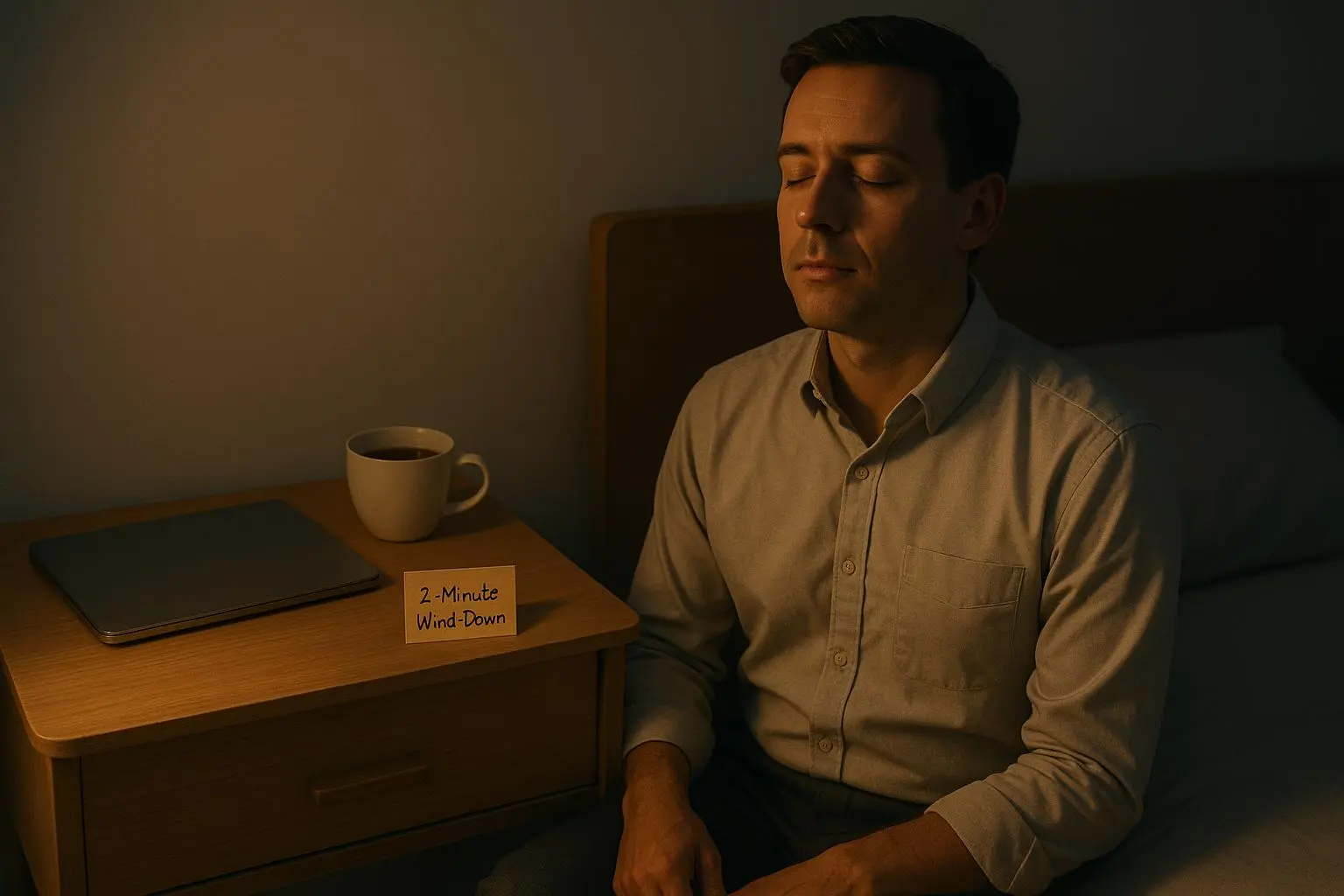
- Put the ritual in a visible place: A sticky note on the laptop, a tiny card in the bedside drawer, a reminder in the calendar 2 minutes before bed.
- Tie it to a non-negotiable cue: End-of-day wrap-up or finishing a task before bed becomes the moment you do Micro-4-7-8.
- Start with a version you can actually complete: The compressed counts (3-5-6) are intentionally shorter than the traditional cycle. If your mind wanders, that’s okay. You do another cycle and keep moving.
- Add an “I did it” signal: A quick, private mental note or a log entry that you did the drill reinforces consistency. It’s a tiny dopamine hit that helps you keep coming back.
- Use it as a boundary, not a therapy session: The goal is to end the day with a boundary, not to solve all problems. If you find you need to vent or process, give yourself that space earlier in the day.
A year into using Micro-4-7-8 in my own life and in a few founding cohorts, I can tell you: the real wins aren’t dramatic overnight but compound over weeks. Sleep quality improves subtly. Focus the next day is sharper. Your awareness of when to push and when to pause grows. And if you’re a founder who negotiates with sleep the way you negotiate with investors, that small daily edge adds up.
A practical starter kit for your first week
- Night 1: Practice Micro-4-7-8 exactly as written, four cycles, with the three-second inhale, five-second hold, six-second exhale. Add the three-second script: I am here. I am safe. I am enough.
- Night 2: If you slept okay, keep the script. If you didn’t, lengthen the exhales a touch in the last two cycles (7-7-7 or 6-6-8, depending on what feels comfortable).
- Night 3: Introduce the five-minute dump in the checklist. You’ll surface more thoughts, but you’ll release them in writing rather than ruminating in your head.
- Night 4: Start adding one gratitude item and one letting-go item to the ritual. Keep it light and true to your day.
- Night 5 and beyond: Solidify the pattern. Measure the impact by noting sleep onset time, wake times, and a rough focus score the next day (0-10). You’ll be surprised how quickly the numbers drift toward better nights.
If you want to take it further, build a tiny printable version of the bedtime checklist to keep on your nightstand. I’ve seen teams print and laminate a one-page card that covers breathing counts, scripts, and the 3-point wind-down. It’s a small thing, but it helps you stay consistent when you’re tired.
A note on safety and caveats
Breathwork is safe for most people, but there are a few caveats to keep in mind:
- If you have severe respiratory or cardiovascular issues, talk to a clinician before attempting breath-holding exercises regularly.
- If holding the breath creates lightheadedness, reduce the hold duration or stop the drill.
- If you’re using breathwork to manage severe insomnia or anxiety, consider pairing it with CBT-I approaches or speaking with a mental health professional.
The Micro-4-7-8 is a practical tool for a specific situation: a racing mind at night or a stressed body needing a quick physiological reset. It’s not a panacea, but it’s a reliable tool that fits into a founder’s life without demanding a leap of faith or an all-day commitment.
A quick sample: what I’d actually say to you in 2 minutes
If we were talking face-to-face, I’d say this:
“Let’s do two minutes. Sit up tall. Inhale through your nose for three seconds. Hold for five. Exhale through your mouth for six. Do that four times. Now, repeat: I am safe. I am enough. I can let go. Take a minute to write down one thing you must tackle tomorrow, one thing you’re grateful for today, and one thing you’re letting go of tonight. When you’re done, close your eyes, feel the pillow, listen to the quiet. You’ve earned this moment. Sleep doesn’t owe you a miracle, but it does owe you restoration. Let the day drift away.”
That’s the tone I try to keep: practical, human, and a touch rebellious against the myth that founders must burn the candle at both ends to succeed.
Frequently asked questions (quick version)
- What if I can’t tolerate the hold? Shorten the hold to 3 seconds and stay with the 4 cycles. The goal is the pattern, not the perfect count.
- Will this work if I wake up in the night? Yes. The same drill can be used mid-night to re-enter sleep easier, especially with the quick bedtime script and the externalized thought process.
- Is 2 minutes enough? For many people, yes. For others, it’s a useful entry point; you can gradually extend the duration as needed, but start with the smallest version that gets you to sleep.
- Can I combine this with my existing sleep routine? Absolutely. It complements a calming pre-sleep ritual. It’s not meant to replace good sleep hygiene; it’s another arrow in your quiver.