Master ADHD Task Switching with the Two-Minute Micro-Journal and Breath Bridge
Dec 9, 2025 • 8 min
You know that moment after a meeting where your brain keeps replaying a line you should have said, and you can't bring yourself to open the next file? For people with ADHD, those gaps — the stuck, blank, or panicked moments — are costly. They’re not just wasted minutes. They pile up into hours of lost momentum.
Here’s a two-minute routine I’ve been using for years (and tweaking) that turns those pauses into tiny, reliable bridges. It’s simple: 90 seconds of breathwork to calm the body, then a 30-second one-line micro-journal to clear the mind. That short sequence does three things: it signals safety, clears working memory, and hands your brain the very next action it should take.
If you hate long routines and love options that feel doable, this is for you.
Why transitions are so brutal (and not your fault)
When you switch tasks, your brain must shut down one neural pathway and start another. That switch isn’t seamless — it has a measurable cost. People with ADHD have extra trouble here because executive functions (working memory, inhibition, cognitive flexibility) are noisier and less reliable.
So you don’t fail at transitions because you’re lazy. Your brain literally needs help disengaging. That’s the opening problem the Breath Bridge and Micro-Journal solve: they give your nervous system and your prefrontal cortex a tiny, low-friction ritual to reboot.
The Two-Minute Bridge — the exact steps
Think of this as an on-ramp: physiological calm first, then a quick cognitive handoff.
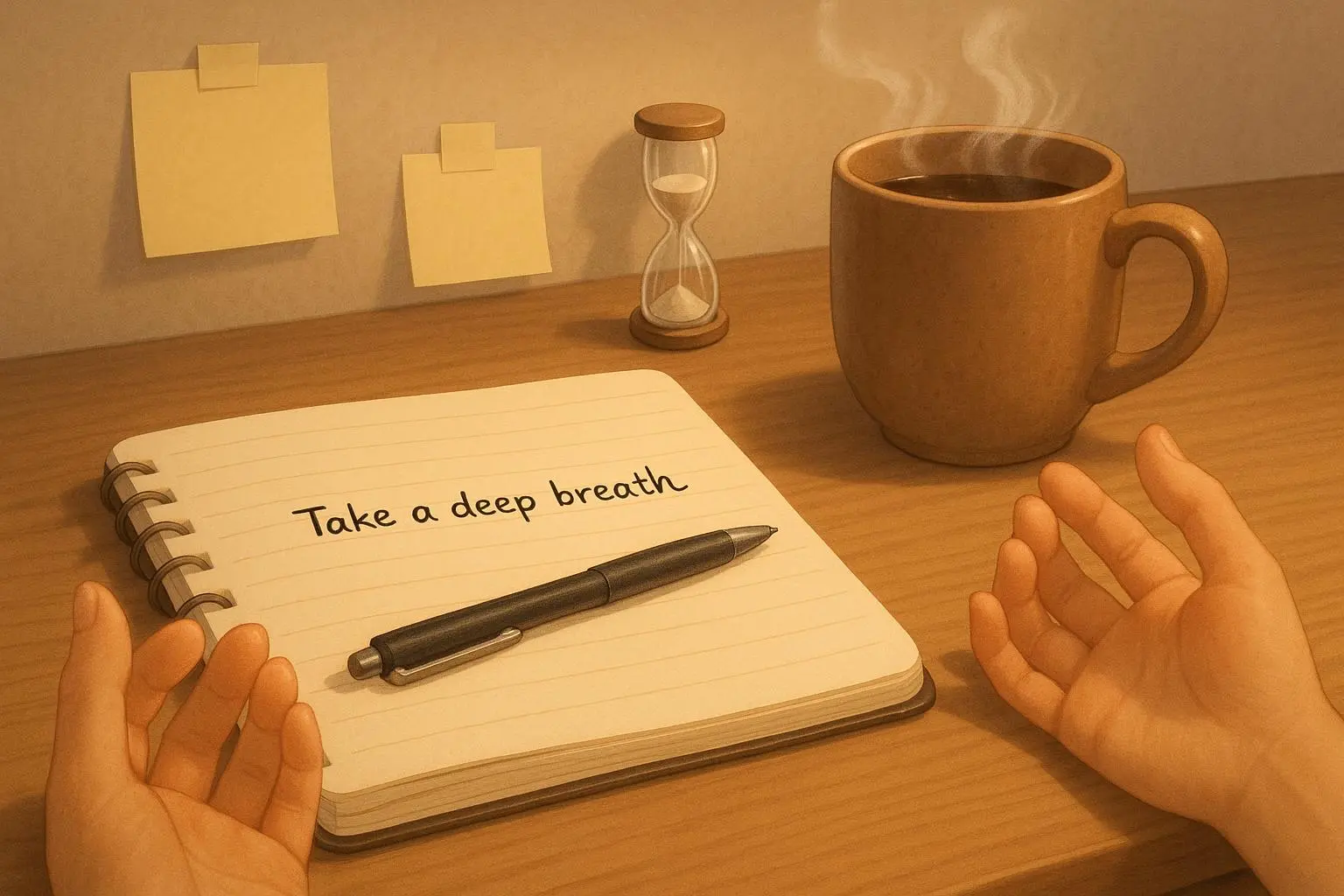
Phase 1 — 90-Second Breath Bridge
- Sit or stand comfortably.
- Inhale 4 seconds through the nose, belly-first.
- Hold 3 seconds.
- Exhale 6 seconds through pursed lips.
- Repeat for 5–7 cycles (about 90 seconds).
That extended exhale is not window dressing — it activates the vagus nerve and nudges your body out of “mild alarm” mode. It’s short enough to do between meetings and robust enough to stop that physical tension spike that makes starting the next thing feel impossible.
Phase 2 — 30-Second Micro-Journal (one line only) Use this template in a single line: DONE: X | NEXT: Y | BARRIER: Z
- DONE: one word or short phrase for what you just finished (e.g., DONE: Sprint Retro).
- NEXT: the smallest possible next action for the new task (e.g., NEXT: Open Budget Sheet).
- BARRIER: name the immediate mental or practical block (e.g., BARRIER: Need water).
That’s it. The goal is to externalize the residue of the past task and hand your brain a microscopic, actionable step for the next one. Writing the barrier down is crucial. By naming the distraction, you reduce its power to hijack attention.
How this actually helped me (a short story)
Last year I had a week of back-to-back coaching calls and writing blocks. I kept losing ten minutes after each call, staring at the next doc, trying to remember where I left off. On Tuesday I tried this exact routine out of frustration.
I did the breath sequence between a coaching call and a writing block. Then I wrote: DONE: Call—Jen | NEXT: Open Doc—Intro | BARRIER: Snack.
It took twelve seconds. But the effect was disproportionate. Because I’d acknowledged the snack barrier, I got up, grabbed a banana, and sat down. When I opened the doc, I didn’t waste time deciding what to do — I typed the first line. Across that day I estimated I saved roughly 45 minutes I’d normally have lost to blank-screen staring. Small action, big real-world time savings. The ritual felt embarrassingly simple — and then reliably effective.
Micro-moment: one sticky detail I keep — I use a blue sticky note for NEXT lines. Seeing blue on the corner of my laptop quickly reorients my eyes and my brain.
Why breath first? Because your body matters
If your body is tense, telling your brain to focus is like asking someone to think clearly while sprinting. Breathwork quiets the sympathetic flare-up (that little panicky spike), which buys the prefrontal cortex a more stable environment to accept direction.
Also: quick breathwork is portable. You can do the 90-second cycle while standing at your desk, leaning on a kitchen counter, or in a bathroom stall. It doesn’t require silence or special posture.
Variations that actually work (use what fits you)
Not everyone wants 4-3-6 every time. Here are practical, tested alternatives:
- The Box (4-4-4-4): inhale-hold-exhale-hold. Use when anxiety is high.
- The Quick Dump (10–15 seconds): skip the breath, write DONE + NEXT only. Use for transitions where you truly don’t have two minutes.
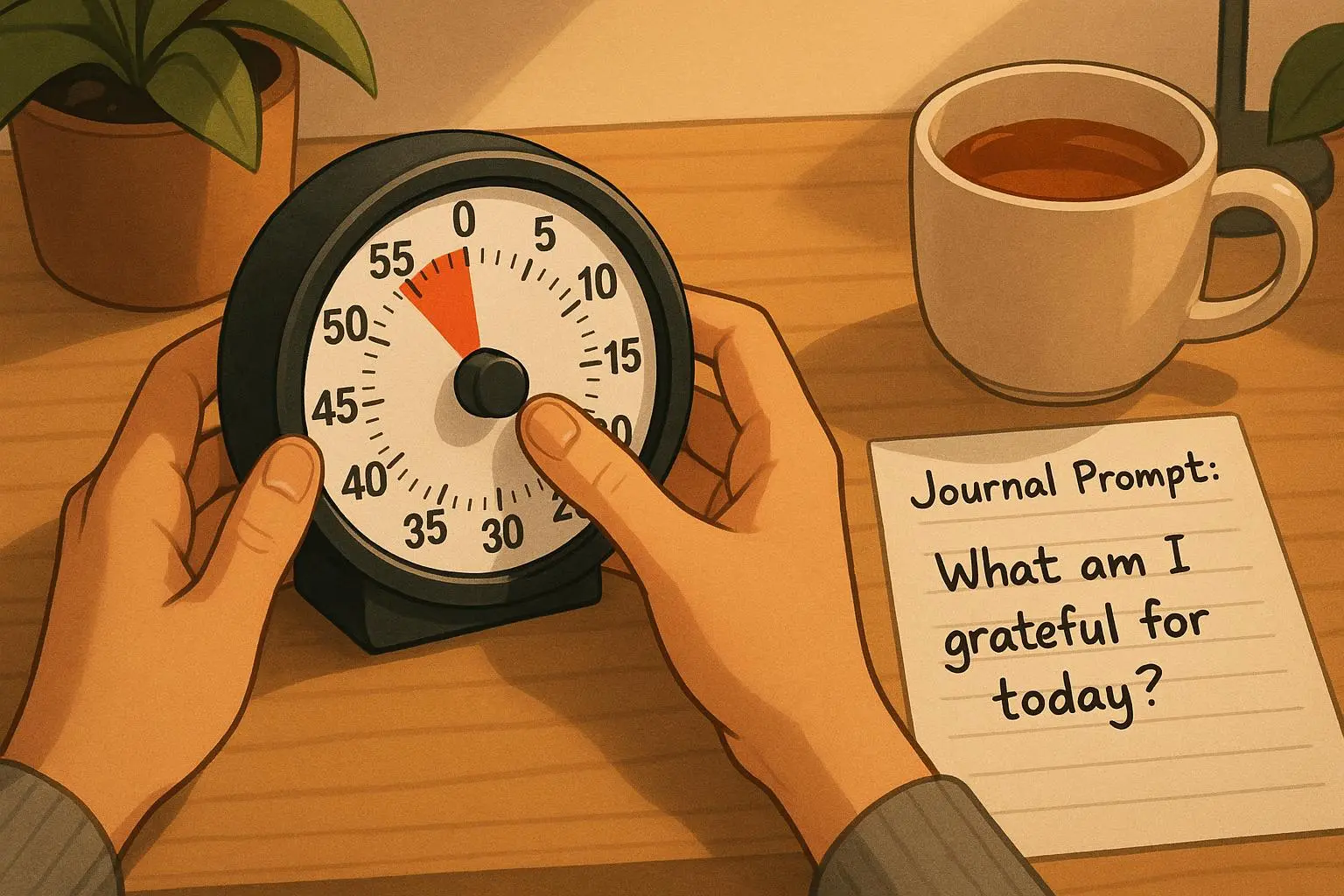
- The Visual Timer: use an app (Insight Timer or Calm) to guide exactly 90 seconds if you need structure.
- Parent mode: do the routine while you change a diaper or hand a kid a snack — you get the anchor and the transition without pretending you have extra time.
Pick one and stick to it for a week before changing. Consistency matters more than perfection.
Habit-stacking: make it automatic
The hardest part is remembering to do the thing. Habit stacking turns that memory burden into a cue.
Try these anchors:
- After I close my laptop for lunch, I will do the Breath Bridge.
- After I hang up a call, I will write the Micro-Journal before I check email.
- After I pour coffee, I will use breathwork to move from morning mode to work mode.
I recommend two anchors you already have. More than that becomes another to-do list.
What to expect in the first month
Week 1: It’s awkward. You’ll forget. You’ll sometimes cheat and jump straight in. Track the misses; they’re data.
Week 2: You’ll remember more often. The micro-journals will feel faster. You’ll notice fewer blank stares between tasks.
Week 3–4: The ritual short-circuits the “should I start?” loop more reliably. You may find yourself needing the breath less as a whole-body panic reducer, and more as a ritual cue.
Longer term: users report the routine gets shorter — you’ll inhale and know the NEXT step without writing it. That’s the habit working: the external structure becomes internalized support.
Common objections, and how I answer them
“This is just adding two steps.” True. It is two steps. But I’ve seen that two minutes of ritual prevents fifteen minutes of momentum loss. If you’re constantly paying the switching tax, those minutes compound.
“I’ll forget it when I’m hyperfocused.” That happens. The fix is anchoring to something non-negotiable — like hanging up calls or closing a laptop lid. The external cue does the remembering for you.
“What about long work blocks — shouldn’t I batch tasks instead?” Batching is great for deep work. But life isn’t perfectly batchable. Meetings, parenting, and interruptions happen. This method isn’t advocating for constant switching; it’s a low-cost tool when you must switch.
Tools and small hacks that make it stick
- Notion: create a tiny database for your one-line micro-journals so you can quickly pull previous NEXT actions.
- Insight Timer / Calm: set a 90-second guided breath session with a bell.
- Physical index cards: keep a stack by your keyboard. Writing physically can be faster than the mental “I should do this” loop.
- Toggl: if you’re skeptical, time how long you actually spend stuck between tasks for a week. Data is a great motivator.
Quick troubleshooting (if it stops working)
- You forget when hyperfocused: choose a more salient anchor (end of call, laptop lid).
- The breath feels weird: shorten cycles (3-2-4) or use the Quick Dump until you’re ready to expand.
- It feels slow: measure — are you saving time overall? Often the perceived delay is smaller than the time previously lost staring.
Two downloadable templates (one-line ready)
- Work Transition: DONE: [Meeting/Task] | NEXT: [Smallest Step] | BARRIER: [Distraction]
- Parent Transition: DONE: [Kid Task] | NEXT: [Work Micro-Step] | BARRIER: [Kid Snack/Interrupt]
Print them as tiny cards and keep one on your desk. I have four in a small jar and pull one when I switch contexts.
Final thought: build a bridge, not a wall
Task switching with ADHD isn’t about brute forcing willpower. It’s about building simple, external scaffolding that your brain can rely on. Two minutes is cheap insurance against the friction that chews up focus.
Try it once today. Close a meeting, do the breath, write one line. If it works, great. If not, tweak the anchor and try again. Over time the little ritual becomes less an added chore and more a quiet permission slip to move on.