Legal Risks of Impersonation & Defamation: Plain-English Guide for Dating AI Users
Nov 1, 2026 • 9 min
AI can help with the awkward first message, the nerve-calming reply, or the sentence you swear you would have typed if only your hands weren’t trembling.
But there’s a difference between “helping you say it better” and “saying it for you.” The law cares about that difference. So do real people.
This guide explains, in plain language, the legal traps when you use AI on dating apps: impersonation, defamation, and data misuse. I’ll show practical red lines, offer disclosure scripts you can copy, and give a step-by-step remediation playbook if something goes wrong.
Read it like you would a friend’s warning: useful, specific, and not judgmental.
Why this matters — short version
- If you send AI-generated lies about someone, you can be sued for defamation.
- If you let AI pretend you’re someone you’re not, platforms and people can treat that as impersonation—sometimes criminal, sometimes civil.
- If you feed other people’s private details into a public LLM, you could violate privacy rules and train the next generation of chatbots with someone else’s secrets.
Simple rule: you’re responsible for what you send. Tools don’t take the fall for you.
How I learned this the hard way (a real story)
A few years ago I helped a friend craft messages after a rough breakup. They were anxious and wanted to warn a new match about their ex. We used a “summarize and soften” prompt in a public LLM to turn a messy vent into something readable.
The model invented a detail: it said the ex "stole money" — something neither of us had evidence for. My friend copied that output into a group chat by mistake. Within 24 hours they received a hostile lawyerly message from the other person's counsel.
We deleted the chat, tried to apologize, and—critically—saved the original prompt and the LLM output. That evidence showed it was generated and not a malicious personal claim, which helped calm the situation. We still hired a lawyer for a quick consult. The cost and stress were real: $1,200 for legal fees and two sleepless nights that could have been avoided by a simple rule—don’t put allegations about real people into a third-party model.
That taught me two things: (1) AI can invent plausible-sounding falsehoods, and (2) you are the one who clicked “send.”
Micro-moment
I still remember the tiny timestamp on that screenshot—11:07 p.m. The hour we thought “one more edit” wouldn’t matter. It did.
The legal basics—what could go wrong
I’ll keep this short and practical.
Impersonation: when AI pretends to be someone else
- What crosses the line: using AI to present credentials, identity, or a life you don’t have (e.g., “I’m a surgeon,” when you aren’t).
- Why it matters: impersonation can lead to fraud claims, harassment charges, or platform bans. Worse, if someone is emotionally or financially harmed, criminal liability is possible in some places.
- Practical red line: don’t let the AI create new facts about who you are.
Defamation: when AI says something false and harmful
- What crosses the line: publishing untrue statements about a real person that harm their reputation (accusing someone of a crime, theft, cheating with fabricated specifics).
- Why it matters: courts generally treat the person who publishes the statement as responsible. “The AI wrote it” is not a legal shield.
- Practical red line: never ask the AI to make or embellish allegations about identifiable people.
Data misuse and privacy
- What crosses the line: pasting private conversations, personal identifiers, or sensitive details about others into a public model that may retain or use your input for training.
- Why it matters: privacy laws (GDPR, CCPA in certain cases), platform policies, and common-sense decency can all be violated. You may expose the other person’s sexual orientation, health data, or location.
- Practical red line: don’t feed other people’s personal data into consumer AI tools.
Real-world examples that matter
- Scenario A: You ask an LLM to “write a message warning my friend that Alex is violent” and include details that identify Alex. If those details are false, you can face a defamation claim.
- Scenario B: You use AI to create a dating profile that claims you graduated from a university you never attended. That’s misrepresentation—platforms will ban the account, and the targeted individual (if harmed) could pursue legal remedies if it leads to financial or reputational damage.
- Scenario C: You paste screenshots of a private conversation into ChatGPT. Without an enterprise or private setting, that content may be used to train the model and become discoverable indirectly later.
Practical red lines — what to never do
- Never use AI to invent or embellish someone’s criminal conduct, financial wrongdoing, or sexual impropriety.
- Never create a fake profile or use AI to impersonate a real person.
- Never paste other people’s private messages, photos, or identifying details into a public model.
- Don’t claim false professional credentials or achievements.
- Don’t use AI output verbatim to make legal conclusions or threats.
Say this out loud before you send: “Does this accuse a real person of something horrible?” If yes, stop.
Disclosure scripts — copyable and editable
Transparency is both ethical and smart. If AI shapes your messages significantly, say so.
Light use (tone edits only): “Quick note: I sometimes use a tool to check the tone of my messages. Everything here is my own and honest.”
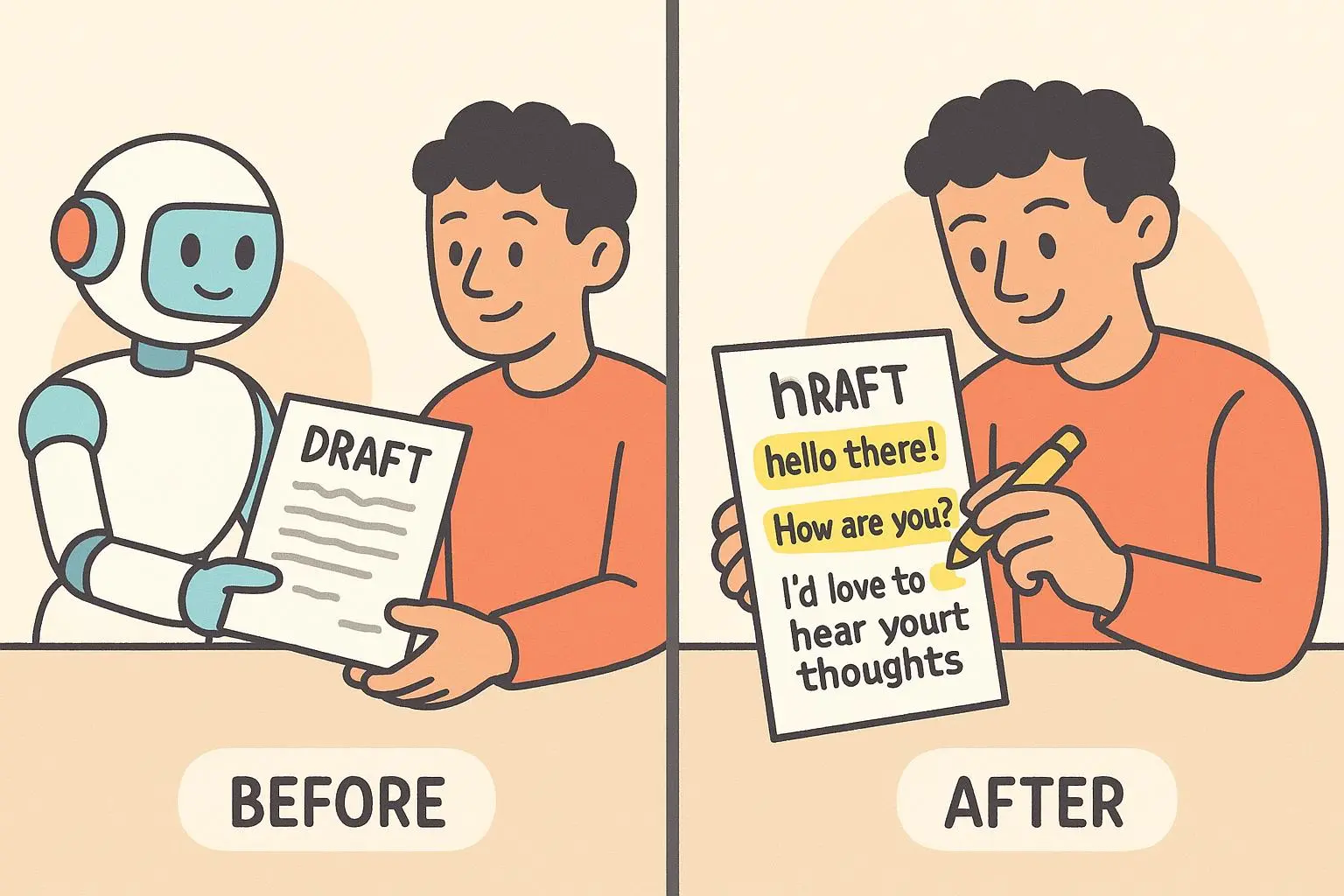
Moderate use (drafting help): “Full disclosure: I used an AI assistant to help draft my initial messages because writing short texts makes me anxious. The feelings are genuine—just the wording was assisted.”
Heavy use (profile or extensive drafting): “I want to be upfront: parts of my profile/messages were drafted with AI support. I’ll always be clear about what’s real and what was phrased by a tool—ask me anything.”
You can paste those into a dating app bio or send as a direct message. Short, human, and not legalese.
Documentation best practices — prove what you did
If the worst happens, records help.
- Keep a local log (Notion, encrypted notes, or a locked folder) of prompts and AI outputs you used for dating messages.
- Save screenshots of what was actually sent.
- If you received consent from someone to use AI content involving them, save that consent (a screenshot or short text is fine).
- Use tools with “no training” or “data opt-out” settings when possible.
- Time-stamp everything. The small detail of when something happened often matters.
Example workflow:
- Draft in a private editor (Notion template).
- Run LLM with minimal personal data and “no training” toggled if available.
- Edit until it sounds like you.
- Save prompt + final output as a dated entry.
- Send from the app and screenshot the sent message.
This habit protects you and shows good faith.
If something goes sideways — step-by-step remediation
Act fast. Apologies and corrections work best early.
- Stop the spread. Don’t forward or amplify the message.
- Document the chain: your prompt, AI output, and the message you actually sent.
- Remove the content if possible (delete the post/message).
- Apologize plainly and unambiguously. Don’t say “the AI made me do it.” Say: “I’m sorry. I sent an inappropriate and incorrect message. I take responsibility.”
- Offer correction or retraction where the harm occurred (publicly if posted publicly).
- Report to the platform (some platforms will assist if abuse or deepfakes are involved).
- If legal threats arrive or severe reputational/financial damage occurred, consult an attorney immediately and stop public back-and-forth.
- Consider a follow-up statement saying you used AI assistance and that you are retracting the specific claims.
A well-crafted apology is faster and cheaper than litigation. Use one. Be human.
Tools and settings that reduce risk
- Use enterprise or privacy-focused tiers that explicitly state input won’t be used for model training (ChatGPT Enterprise, some vendor privacy modes).
- Use secure email (ProtonMail) if communicating with lawyers or preserving sensitive records.
- Keep logs in a privacy-first workspace (Notion with encryption or local encrypted files).
- Avoid feeding PII into public models. Use placeholders—“Person A,” “Person B”—when you need to test tone or structure.
Platform policies — don’t forget the TOS
Dating apps differ. Some ban fake profiles, others have explicit language about AI. Read the terms before you use AI and follow community rules. A platform ban can be permanent; legal trouble can be worse.
If you want a quick check: search the app’s “safety” and “community guidelines” pages for “misinformation,” “impersonation,” and “automated assistance.”
FAQs — quick answers
Can I be sued for what my AI writes? Yes. The sender is usually treated as the publisher and liable for defamation or other harms.
Is it illegal to use AI to craft flirty messages? Not inherently. Be honest about any material fact you’re claiming, and don’t misrepresent identity or serious facts about others.
Can AI help people who struggle to write without putting them at risk? Yes. Many people with social anxiety use assistive tools ethically—just disclose when AI shaped the message substantially, and don’t invent facts.
Final checklist before you hit send
- Does the message make factual claims about a real person? If yes, verify them independently.
- Does it claim credentials or a life you don’t have? If yes, rewrite honestly.
- Does it include someone else’s private info (PII)? If yes, remove it.
- Did you keep a record of the prompt and final edit? If not, save one now.
- Can you own this message in court and to the person on the other side? If unsure, don’t send.
Treat your messages like they could be screenshotted and used in court. Because they can be.