How Long Until It Works? Expected Timelines & What Relief Really Looks Like
Mar 23, 2026 • 8 min
You try the 3-minute counted exhale because your chest feels tight and your brain is on repeat. You want to know one thing fast: does this actually calm you down, and will it stick?
Short answer: yes—usually fast for the immediate squeeze, and yes—slowly, with consistent practice for longer-term resilience. But "fast" and "slow" mean different things depending on whether you're asking about minutes or weeks. Here's what I tell people who ask me in the office, at workshops, or in late-night DMs.
What the 3-minute counted exhale actually does (in plain words)
The technique is simple: slow your breathing and make the exhale longer than the inhale. A common template is a 4-second inhale, 6-second exhale for about three minutes. That longer exhale nudges the vagus nerve, which helps your body downshift from fight-or-flight to rest-and-digest.
Think of the exhale as a brake. Hit it for a few minutes and the engine calms. Practice it often enough and the brake gets stronger—your nervous system learns the route.
Timeline 1: Immediate relief — seconds to minutes
What you’ll feel
- Within 60–180 seconds most people report a quieter mind, slower breathing, and looser shoulders.
- Subjective relief (SUDS) often drops by 1–3 points out of 10 during a single 3-minute session.
- Physiological signs: a noticeable slowing of breathing and often a small heart-rate deceleration.
Why this happens
- Prolonged exhalation increases vagal activity and respiratory sinus arrhythmia (RSA), which tells your heart to relax a bit.
- It’s not magic; it’s a predictable reflex—if you slow your breathing and lengthen the exhale, your body responds.
Real user notes
- Some people feel it right away. Others, especially those who are tense about doing it "correctly," need the full three minutes to notice a change.
- A small group may feel lightheaded or more anxious at first—usually because they over-control the breath and inadvertently hyperventilate. Give it gentleness first.
Practical tip: If you feel dizzy, soften the effort—shallower breaths, or return to natural breathing for a minute—then try again without forcing length.
Timeline 2: Short-term measurable changes — days to a few weeks
What starts to shift
- With daily 5–10 minute practice, you may see objective signals move: HRV trends upward, resting breathing rate drops, and baseline SUDS slowly declines.
- In studies, slow breathing protocols at ~6 breaths per minute (the 4/6 pattern approximates this) increase high-frequency HRV power—an indicator of parasympathetic (vagal) engagement.
Typical progression
- Week 1: You’ll get better at initiating and staying with the exhale. Recovery from minor stressors feels faster.
- Weeks 2–3: Wearables and HRV apps sometimes show a small but meaningful gain. Subjective reactivity—how quickly you escalate in stressful moments—starts to soften.
How to measure it
- Track SUDS (0–10) before a daily session and two minutes after.
- Use an HRV app (Elite HRV, HeartMath, or a watch with reliable HRV) to log morning readings and watch the trend—not the day-to-day noise.
Timeline 3: Integration and resilience — ~4 weeks and beyond
What “working” looks like now
- The technique moves from a desperate tool to an autopilot habit. You use it in traffic, before a presentation, or when your partner drops a hot take—and it actually helps.
- Measurable vagal tone gains (sustained HRV improvement, lower baseline reactivity) typically show after consistent practice for ~4 weeks.
Why four weeks?
- Neurophysiological systems need repeated stimuli to change baseline behavior. Like strength training, you don’t get stronger after one set—you get stronger after consistent practice over weeks.
- Multiple clinical and lab studies show that autonomic markers shift with repeated paced-breathing practice over weeks rather than days.
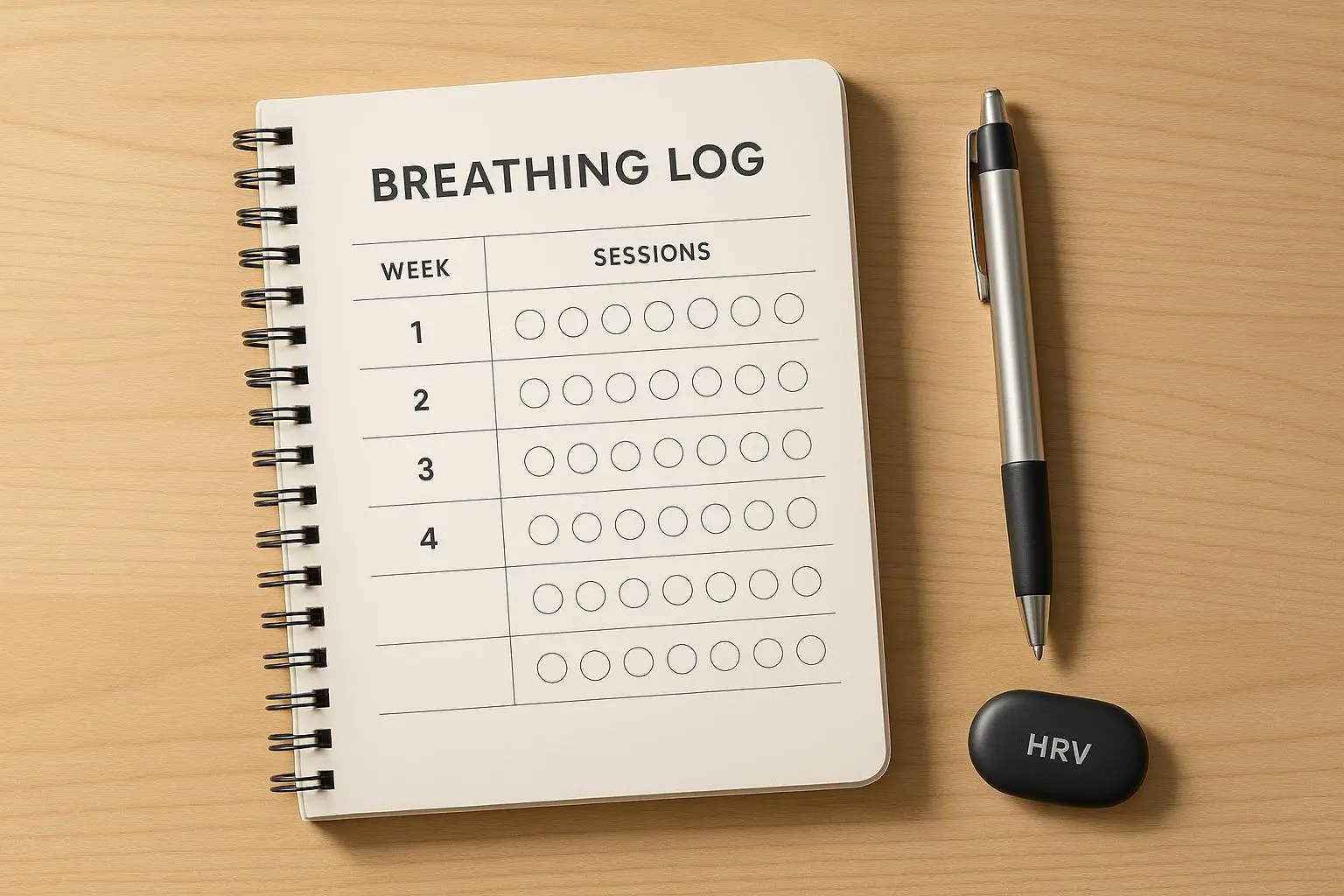
How to test it reliably: the 4-Week Practice Log
- Baseline (Day 1): Record SUDS, breaths per minute at rest, and a morning HRV reading if you use one.
- Daily: Do the 3-minute counted exhale once or twice. Note SUDS before and after, and log any subjective changes (sleep, headaches, reactivity).
- Weekly check-in (Day 7, 14, 21, 28): Re-measure baseline SUDS and resting breath rate. Look for:
- Decrease in baseline SUDS
- Faster time-to-2-point-drop in SUDS after a session
- Upward trend in average HRV (if available)
Practical expectation: If you practice daily, most people report a meaningful change in how reactive they feel by Week 3–4.
A personal story: what actually happened when I committed to 3 minutes a day
I was skeptical. In one clinic year I was juggling projects, sleep debt, and an inbox that felt like a live grenade. I promised myself three minutes of the 4/6 exhale twice a day for four weeks and logged it.
Week 1: I felt awkward. I counted, I rushed, and sometimes I forgot. SUDS dropped after sessions but my baseline still hovered around a 6.
Week 2: The counting got easier. I started doing a quick 3-minute set before meetings. My morning HRV (measured on a watch) nudged up by about 10ms—small but noticeable.
Week 3: A real moment came when I hit traffic on a bad day. Habit kicked in; I didn’t plan it, I just started the slow exhale. The usual climb to anger never arrived. That surprised me more than the HRV numbers.
Week 4: Baseline stress felt lighter. I still had bad days, but they were shorter. The three-minute habit didn’t remove stress—it shortened the time stress sat on me.
Outcome: Four weeks of short, consistent practice moved breathwork from a "tool I try" to a "thing I do." The measurable HRV gain and the subjective calm both mattered—together they made the practice feel worth it.
Micro-moment: the little detail that stuck with me When my shoulders dropped for real—after about two minutes during week two—I noticed the tiny click of a seatbelt settling differently. That small physical shift was the clearest piece of feedback: something in my body unclenched, and that told me the brain followed.
What can go wrong (and how to fix it)
If you feel worse at the start
- Cause: over-breathing or forcing long breaths.
- Fix: Slow your effort. Switch to diaphragmatic breathing practice (hands on belly) and reduce the counts. Try 3-second inhale / 4-5 second exhale, or simply aim to make the exhale gently longer than the inhale without rigid counting.
If counting feels counterproductive
- Some people (super-sensitive, anxious about “doing it right”) find counting adds pressure. Try focusing on the sensation of the exhale instead of seconds—make it about quality, not numbers.
If you get dizzy or lightheaded
- Pause. Return to natural breathing. Take a couple of gentle, normal breaths. Next time, reduce depth and effort. Breathwork should never force you into discomfort.
If you see no HRV change
- HRV is noisy. One-off readings can mislead. Look at weekly averages and trends over 3–4 weeks. Also check other markers: resting breath rate, sleep quality, and subjective reactivity.
Quick protocol you can steal right now
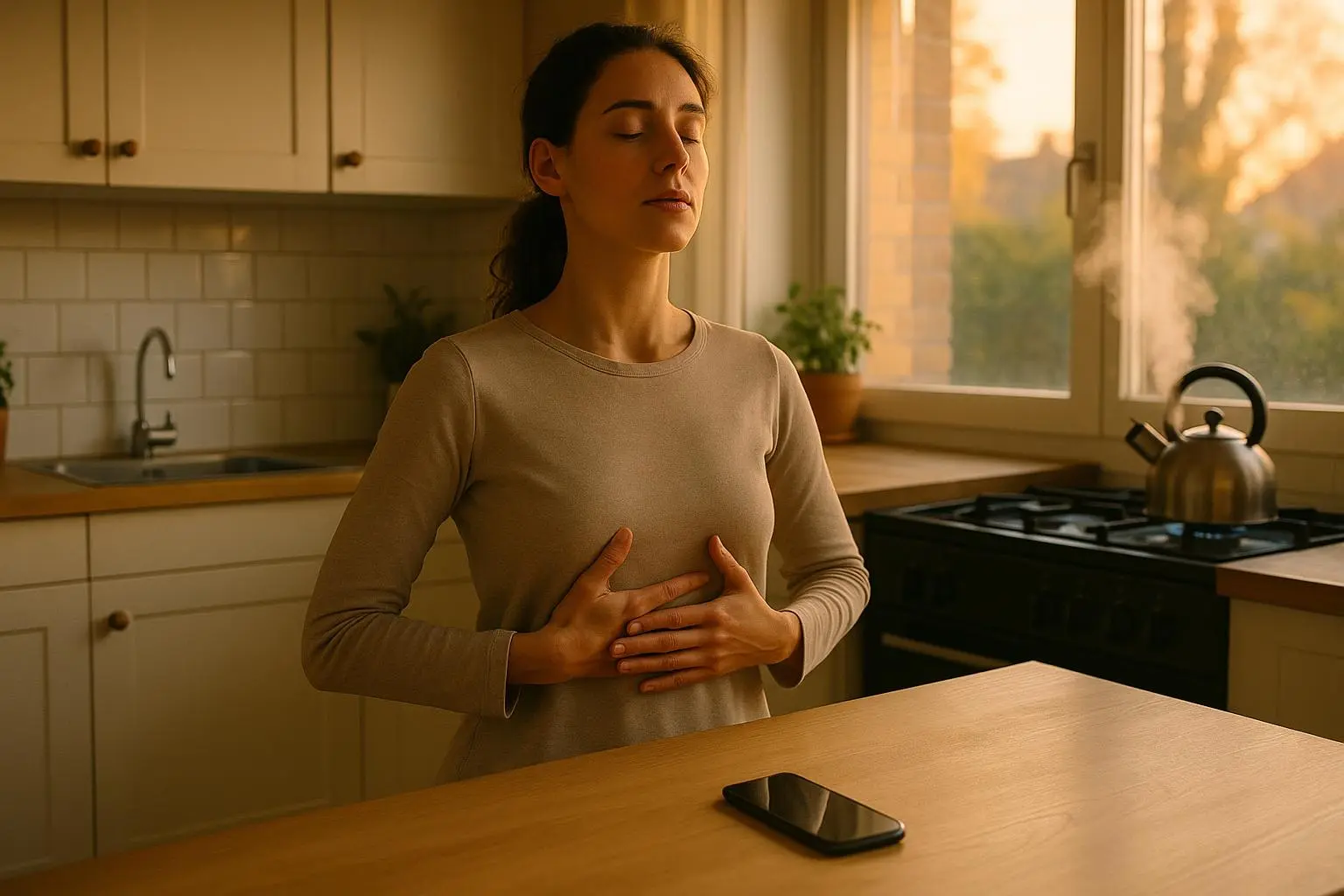
- Sit or stand comfortably. Place one hand on your belly if it helps.
- Inhale gently for 4 seconds (don’t gasp).
- Exhale smoothly for 6 seconds—long, soft, and relaxed.
- Repeat for 3 minutes. Do it once in the morning and once in the evening if you can.
- Log SUDS before and after. If you have an HRV app, take a morning reading daily.
If counting causes anxiety: forget the seconds. Make the exhale about twice as long as the inhale and keep it soft.
Measuring progress without a wearable
Not everyone wants a gadget. You can still track:
- Breath rate (count breaths for 30 seconds and double it).
- Baseline SUDS in the morning.
- The time it takes to drop 2 points in SUDS after a session.
- Subjective notes: fewer flare-ups, shorter angry episodes, better sleep.
These simple measures often correlate with physiological change and are enough to prove whether the practice is working for you.
The bottom line: when will you feel relief?
- Immediate (minutes): Most people feel calmer within 1–3 minutes. That’s the low-hanging fruit.
- Short-term (days–weeks): Daily practice starts to shift objective markers like HRV in 2–3 weeks for many people.
- Integration (around 4 weeks): With consistent practice the technique becomes automatic and resilience improves—your baseline stress drops and reactivity shrinks.
This isn’t a cure-all. It’s a reliable regulation skill that, when practiced consistently, pays back in faster recovery and greater day-to-day calm.
If you want to test it properly, give the 4-week log a try. Track SUDS and breath rate, be patient, and treat the practice like brushing your teeth—small investment, consistent payoff.