Getting Started: A Beginner's Roadmap to Validating Your Micro-Niche Podcast
May 18, 2026 • 9 min
You have an idea. It feels specific, maybe even exciting. But how do you know someone else will press play?
Here’s a short, no-fluff roadmap to answer that question before you sink months into recording: define your micro-niche, research the space, ask the right people the right questions, launch small pilots, and use honest feedback to decide whether to go full-time or pivot.
I’m walking you through what to do, why each step matters, and exactly how I’d do it if I were starting from scratch today.
Why validate at all?
Because enthusiasm isn’t an audience.
Validation stops you from guessing. It gives you data: who cares, what they want, and whether your format actually fits their listening habits. It doesn’t guarantee success. It reduces the risk that you’ll waste time on a show that no one wants.
Here’s the practical playbook.
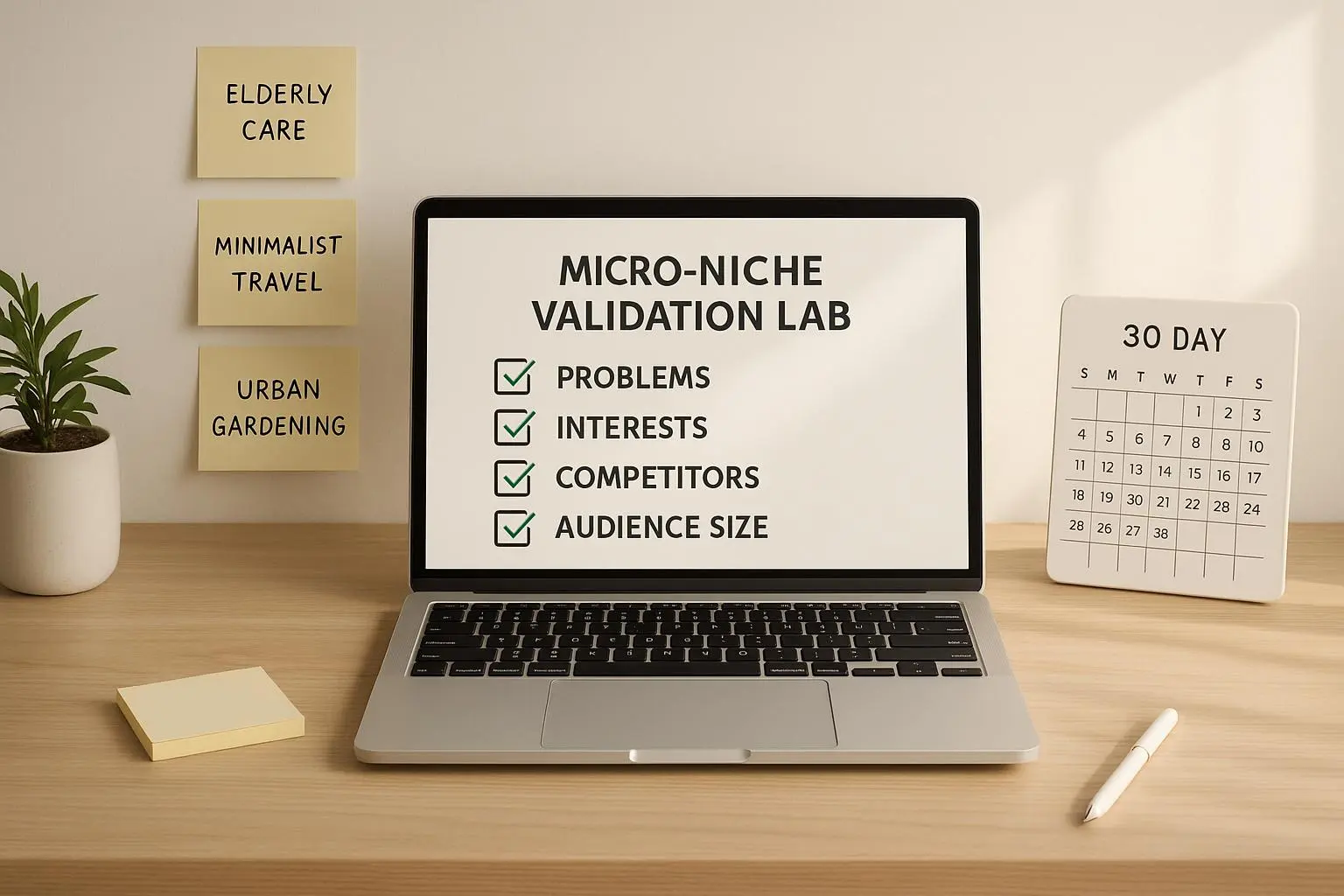
Step 1 — Define your micro-niche (don’t be vague)
“Business podcast” = invisible. “Business podcast for solopreneurs in sustainable fashion” = targetable.
A quick checklist to narrow down your niche:
- Pick an industry or lifestyle slice (e.g., “sustainable fashion”).
- Add a role or life stage (e.g., “solopreneurs,” “early-stage founders,” “parents returning to work”).
- Add a clear problem you’ll solve (e.g., “sourcing ethical suppliers on a budget”).
Example formula: [industry] + [audience] + [primary problem]. Aim for something that fits on one line.
Why this matters: the more specific you are, the easier it is to find communities, craft survey questions, and design pilot episodes that feel relevant.
Step 2 — Research the niche (do this for 1–2 hours)
You don’t need exhaustive market research. You need three things:
- Who’s already making audio for this audience?
- What topics get covered well?
- Where are the gaps?
What I do:
- Search Apple Podcasts and Spotify for 10 shows in your niche keyword.
- Open 3 recent episodes from each and note recurring topics, formats, and obvious weak spots (e.g., no practical case studies, weak guest diversity).
- Spend 30 minutes in two active online communities—Subreddits, Facebook groups, or LinkedIn groups—and read the last 20 posts to spot common questions people ask.
That’ll take 60–90 minutes and give you the market map you need.
Step 3 — Craft a short, unbiased survey (10–12 questions)
The goal: get actionable input, not compliments.
Keep it under 12 questions. Bias-free. Mix multiple choice for patterns and 2 open-ended prompts for qualitative gold.
Suggested structure:
- 1 question: Do you listen to podcasts? (Yes / No)
- 1 question: Which platforms do you use? (Spotify / Apple / YouTube / etc.)
- 2 questions: Top 3 topics you care about related to [your niche]
- 1 question: Biggest challenge right now (open-ended)
- 1 question: Preferred format (interview / solo / panel / documentary)
- 1 question: Preferred episode length (0–15 / 15–30 / 30–45 / 45+)
- 1 question: Would you listen to a podcast about [your niche]? (Definitely / Maybe / Not interested)
- 1 question: What would make you subscribe? (open-ended)
- 1 question: Would you be willing to listen to a pilot and give feedback? (Yes / No; optional email)
Quick tip: avoid leading language. Don’t ask “Would you love a podcast about X?” Ask about problems and listening habits.
Use Google Forms for a free start; SurveyMonkey if you want cleaner analytics.
Step 4 — Distribute the survey where listeners already are
You’re not begging strangers on the street. You’re using existing communities.
Three places that work best:
- Niche Facebook groups and Reddit communities
- Relevant LinkedIn groups (for B2B niches)
- Email lists or newsletters (even a small list of 100 engaged people beats blind social posts)
Concrete distribution plan (week 1):
- Post in 3 Reddit threads and 2 Facebook groups relevant to the niche.
- Tweet/post a short thread with a link and a single call-to-action.
- Send to any friends, collaborators, and small email list you have.
- Offer an incentive: 3 winners get a 30-minute consult, or promise early access to pilot episodes.
Aim for a baseline of 50–100 responses. Less than 30 and patterns will be fuzzy; 100+ gives you confidence.
Step 5 — Analyze responses (look for patterns, not perfection)
This is where you turn raw answers into direction.
What to look for:
- Platform bias: If 70% listen on Spotify, prioritize that for distribution and ads.
- Topic frequency: If “finding suppliers” is mentioned by 40% as a pain point, plan several episodes on that.
- Format preference: If solo episodes get zero votes but interviews get 65%, try an interview-heavy pilot.
- Openness to pilots: If many people volunteer to test, you’ve found a feedback cohort.
How I parse open-ends: copy responses into a single doc, highlight recurring phrases, and count those manually. Even a quick tally (e.g., “supplier” appears 22 times) tells you something.
Step 6 — Build 2–3 pilot episodes (don’t overproduce)
Think of pilots like prototypes. They prove the concept, not win awards.
What to include:
- Two different formats or tones (e.g., one interview, one solo deep-dive).
- Clear problem-focused content: each episode solves a real listener pain uncovered by the survey.
- A short 15–20 second hook for the start — you’ll learn fast whether listeners stick around.
Production budget: keep it minimal.
- Record on Anchor or Zoom for remote interviews.
- Edit with Audacity or simple paid tools.
- Use Otter.ai to transcribe for repurposing.
Time investment: 1–2 days per pilot for recording and rough editing if you’re doing it lean.
Micro-moment: the thing that stuck with me
I once launched a pilot with a 90-second intro because I thought it sounded “professional.” Everyone I asked skipped the first two minutes. I rewrote it to a 15-second hook—retention jumped noticeably. Small changes matter.
Step 7 — Share pilots and collect targeted feedback
This step separates “people liked it” from “people will listen regularly.”
Pick a feedback group:
- Use the emails gathered in the survey.
- Invite members of two active communities.
- Offer a 5–10 minute form and optional 15-minute interview.
Feedback questions to use:
- What did you like? (open-ended)
- What would you change? (open-ended)
- Was the episode too long/too short? (choice)
- Would you subscribe? (Yes/Maybe/No)
- Rate the episode’s value 1–5
Make it easy: one-click responses, a short form, or scheduled 15-minute calls. Expect blunt answers—those are the useful ones.
My real story: how one pilot saved me months
When I launched a small podcast project years ago, I skipped the survey and went straight to recording a “perfect” first episode. I spent two weekends editing, bought a theme, and posted it to a handful of friends.
The feedback? Crickets.
I then did the survey I should have started with. Within a week I had 84 responses. The biggest blind spot I’d missed: my target listeners wanted actionable checklists and real case studies, not long philosophical interviews. I recorded two short pilot episodes focused on case studies, shared them with the 30 people who volunteered to test, and got specific feedback: tighten the intros, add timestamps, and bring guests with concrete results.
Those changes turned a cold start into a 600-download first month and a steady group of early subscribers. Cost: a week of rework instead of two weekends of wasted polish. Lesson: validation saved time, not just money.
Step 8 — Decide: iterate or commit
Use simple thresholds to decide whether to proceed:
- If >60% of testers say they’d subscribe and open-ended feedback is actionable → proceed to a short season (6–8 episodes).
- If 30–60% say they’d subscribe with clear, fixable notes → iterate and run another pilot.
- If <30% express interest → pivot your niche or format before investing more.
Don’t be romantic about “maybe.” Data beats hope.
What to track when you do launch
If you move from pilots to a season, keep tracking:
- Downloads per episode (first 7 and first 30 days)
- Listener retention (where people drop off)
- Platform split (where people listen)
- Engagement (emails, DMs, social shares)
- Audience growth month-over-month
These numbers will show you what to double down on and what to drop.
Tools that make validation easy
- Google Forms: quick surveys
- Otter.ai: transcripts, repurposing
- Anchor / Buzzsprout: quick hosting and distribution
- Canva: episode art and promos
- Audacity: low-cost editing
Use the free tiers to validate. Upgrade only when you’ve proven demand.
Common mistakes I see (and how to avoid them)
- Mistake: Asking leading survey questions. Fix: ask about problems, not opinions.
- Mistake: Launching with high production and zero feedback. Fix: start lean.
- Mistake: Ignoring distribution. Fix: map where your audience already hangs out and promote there.
- Mistake: Measuring vanity metrics (likes) instead of retention and subscriptions. Fix: track the numbers that show repeat listening.
Iteration is the point, not failure
Validation isn’t a one-time test. It’s a loop: survey → pilot → feedback → iterate → repeat.
Most successful podcasts I follow tried at least one major pivot in their first year. That’s normal. Your goal is to learn fast with as little wasted effort as possible.
Quick checklist to follow this week
- Day 1: Define micro-niche with the formula (industry + audience + problem)
- Day 2: 90 minutes of competitive research (10 shows, 2 communities)
- Day 3: Build a 10-question survey in Google Forms
- Day 4–7: Distribute survey and gather 50+ responses
- Week 2: Produce 2 pilot episodes based on survey themes
- Week 3: Share pilots, collect targeted feedback, and decide next steps
Final note — validation saves time and sanity
You’ll want to believe your gut (and you should), but your gut partnered with data is powerful. Validation doesn’t remove creativity; it focuses it. It lets you spend energy on episodes people actually want to listen to.
If you do one thing from this post today: write the three-line niche sentence and share it in one community. The comments you get in 24 hours will tell you whether you’re onto something or whether your idea needs a sharper point.