From Match to Meetup: A Low-Pressure Escalation Map for Introverts
May 10, 2026 • 8 min
Dating apps often feel like fast food: loud, fast, and designed for volume. If you're introverted, that setup is exhausting. You don't need a script to "perform" — you need a map that respects your pace, energy, and need for quieter spaces.
This post is a practical, two-week escalation plan with exact message templates, pacing rules, low-stimulation date ideas, and a short script to ask permission before you use AI to help craft messages. Use it as a flexible guide, not a checklist you beat yourself up over.
Why introverts need a different map
Introverts tend to prefer depth to breadth. We recharge alone, we hate noisy crowds, and we think better with a minute of silence between messages.
Most dating advice pushes speed: get the number, meet fast, escalate. That works if you get energized by social friction. For quieter people, that pressure often causes burn-out, ghosts, or shutting the app down for weeks.
Here's the simple truth I learned: moving slowly doesn't mean you're boring. It means you're intentional. And people who match you on values will appreciate that.
Quick aside: One small detail that stuck with me — I once suggested a 45-minute coffee and my match replied, "Nice. I like timeboxes." That five-word answer felt like a handshake. Small boundaries can be a relief.
My real story (what actually worked)
A few years back I swiped on someone whose profile mentioned watercolor painting and terrible puns. I liked their prompt answer — "My emergency snack is pickles" — and messaged something tiny: "Pickles or pickle chips?" They replied. We traded three messages a day for a week. I used a short AI prompt to clarify a sentence once (I told them later), and they said they appreciated the honesty.
On day eight I asked for coffee at a quiet café, explicitly saying 45 minutes. They accepted. The café had booth seating and soft lighting. We spent most of the time talking about one book we both liked. When the 45 minutes ended, there was no awkward "what now?" We both smiled, and I suggested a longer, low-key museum visit next week. It turned out that time-limited first date removed all the pressure — we were there to test the chemistry, not audition. That date led to three months of gentle, steady dating where neither of us ever felt rushed.
What I learned: state your limit, pick a calm place, and treat the first meetup like a small experiment. People who want to connect will respond to that.
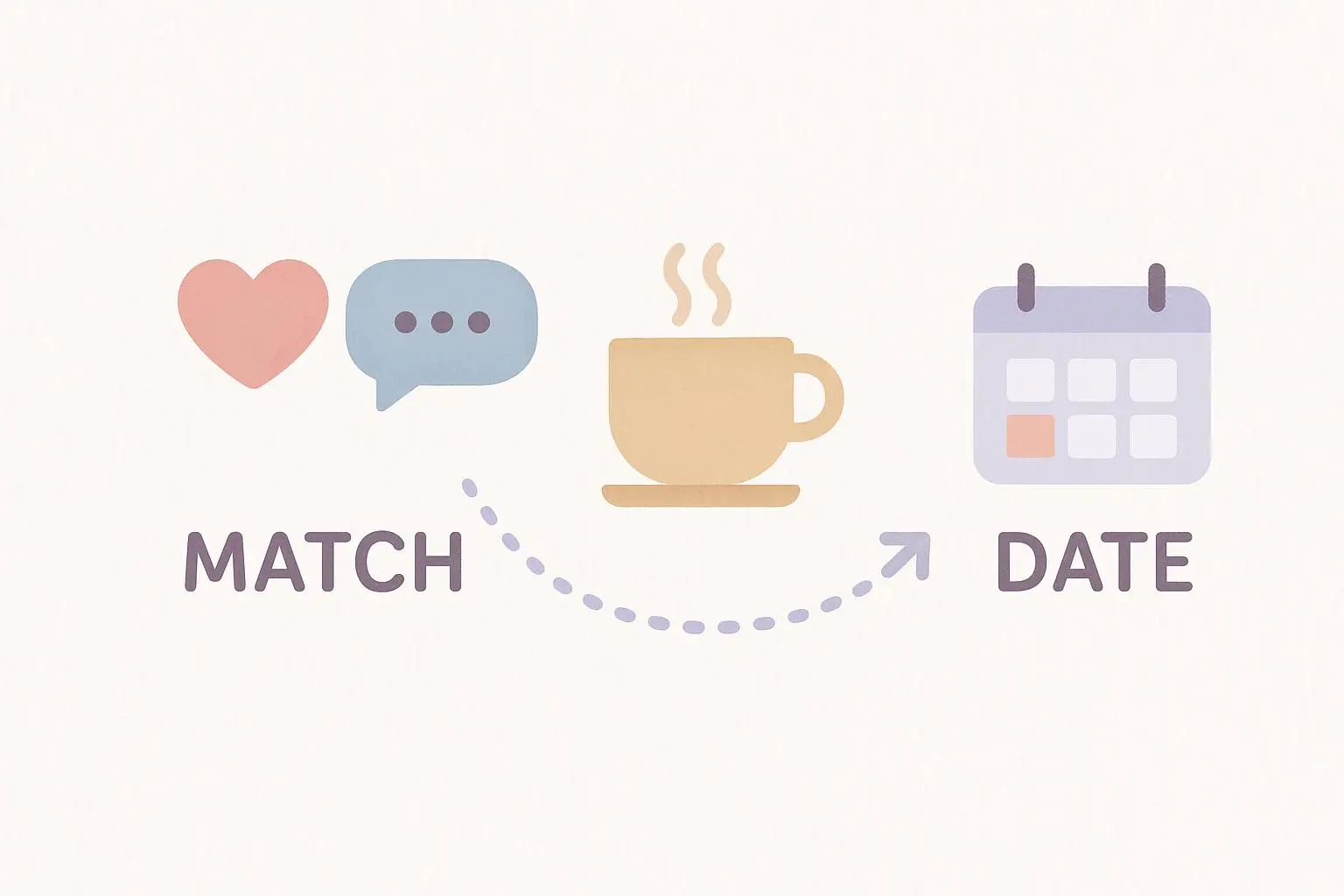
The two-week gentle escalation plan (overview)
This is a sample timeline you can copy and personalize.
- Days 1–3: Pacing — open, but slow. Quality > volume.
- Days 4–7: Deepening — share one personal detail, be transparent about communication style.
- Days 8–10: Low-pressure ask — propose a short, low-stimulation meetup with a clear timebox.
- Days 11–14: Meetup & follow-up — treat it as data gathering; follow up gently within 12 hours.
Below is the same plan in a tighter format:
| Days | Phase | Goal | Action |
|---|---|---|---|
| 1–3 | Pacing | Set rhythm | Send 1–3 thoughtful messages per day; avoid instant replies |
| 4–7 | Deepening | Build trust | Ask a curious question; disclose AI use if you do it |
| 8–10 | Ask | Propose meetup | Suggest short, specific, low-stim date (45–60 min) |
| 11–14 | Meetup | Gather data | Execute the date; follow up gently within 12 hours |
Pacing rules that actually help
Here's what I tell friends when they're overwhelmed:
- Wait a little. Don't feel obligated to reply immediately. Thoughtful beats speedy.
- Limit message bursts to 1–3 meaningful exchanges per day early on.
- Use profile prompts to guide questions (they’re free conversation scaffolding).
- Set small, clear limits: "I prefer meeting for 45 minutes the first time."
- If you need a recharge, say so: "I’m stepping away for a few hours to recharge — talk soon."
And this rule saved me more than once: let them initiate the next step when possible. It helps you avoid doing all the emotional heavy lifting.
Low-stimulation date ideas (what to suggest)
Avoid loud bars and crowded events. Pick something with natural pauses or shared focus.
- Quiet café (mid-afternoon) — 30–45 minutes
- Bookstore browse + compare finds — 30–60 minutes
- Museum or small gallery (off-peak) — 60–90 minutes
- Botanical garden walk — 30–60 minutes
- Library café meet — 30 minutes
- Casual cooking at home (if both comfortable) — short recipe, split tasks
- Board game cafe (choose a low-decibel game) — 45–90 minutes
Pro tip: pick a place you know is calm and has easy exit options (sits near a single cashier, short lines, or clear seating that isn't communal).
Exact scripts you can copy (use them verbatim if it helps)
First message (after match)
- "Hey [Name], I liked your profile—especially [specific detail]. I'm usually pretty quiet online, but I’d love to chat if you are."
Follow-up after a couple messages
- "I really enjoy our chat about [topic]. If you’re open to it, I’d love to meet for a quick coffee or a walk — somewhere chill, no pressure."
The low-pressure ask
- "Would you be up for coffee at [quiet café] this Saturday at 2 PM? I’m not great with big crowds — thinking 45 minutes to keep it low-key. Totally fine if that doesn’t work."
Setting a boundary (timebox)
- "I usually like first meetups to be 45–60 minutes. It makes things less intense and leaves room if we want to continue."
AI transparency script
- "Quick note: sometimes I use a writing tool to help me organize thoughts before I message — mostly to avoid typos and be clear. I want to be upfront about that. Is that okay?"
Follow-up after the meetup (within 12 hours)
- If you liked it: "I had a nice time today — loved talking about [specific thing]. Want to plan something slightly longer next week?"
- If you need time: "Thanks for meeting. I enjoyed it. I usually need a bit of time to process after meeting someone new — I’ll message in a couple days."
If they ghost or say no
- "No worries at all. Thanks for chatting — best of luck."
Small interpersonal rules that reduce panic
- Don’t over-explain yourself. A short boundary is enough.
- Use sensory language when scheduling: "quiet corner, mellow playlist" — it signals environment preferences.
- If a date goes long and you get drained, it's okay to say: "I’ve had a really nice time, but I need to head out to recharge. Can we pick this up later?"
- Let silence sit — you don't have to fill every pause.
How to ask someone out without sounding needy
Ask with a proposal, not a question mark forest:
Instead of: "Do you want to hang out sometime??" Say: "I’m free Saturday afternoon — would you like to meet at [place]? 45 minutes, low-key."
Give one clear option and a short timebox. People are more likely to say yes when the ask is specific and low-commitment.
What if they want something else (crowds, long date)?
Be honest and flexible within your limits.
- If they suggest a loud bar: "That sounds fun, but I get overstimulated in loud places. Could we try [alternative] instead?"
- If they want a longer first date: "I’m more comfortable with a short first meetup. Happy to do something longer if we both feel good after a first one."
Saying "no" to their suggestion isn't rejection — it's a boundary. A person who wants to meet you will pivot.
Handling rejection and investment
You can invest a lot into messages and still get a "no" or a ghost. It stings. Here’s a short recovery sequence that helps:
- Pause. Take 24 hours before reacting.
- Do a small ritual: make tea, go for ten minutes outside, delete the app notifications.
- Send one brief closure message if you need it: "Thanks for the chats — take care." Then let it go.
- Reframe: you tested for compatibility politely and clearly. That's progress, not failure.
Quick micro-moment (30–60 words)
That tiny line I keep in my phone notes: "45 min = permission to be human." It’s a reminder that timeboxing a first date is permission to be authentically yourself — not performative, not defensive. That tiny shift made asking people out feel less like an audition and more like scheduling a short experiment.
Tools that help (short list)
- Hinge or Coffee Meets Bagel: apps that encourage prompts and fewer matches.
- Grammarly or similar: for clarity and tone checks (remember to disclose if you use them).
- Doodle: propose times without lengthy back-and-forth.
- Calendar invite: send a simple invite once plans are set — it's low-pressure and practical.
Final thoughts: your map, your rules
This escalation map is a template — not a law. If two messages in a day feel right, do it. If you need a week to reply, say so. The goal is to remove pressure, not to create a new kind of performance.
Dating as an introvert is not about masking or rushing; it's about setting small experiments and honoring your energy. When you make that explicit, you attract people who value the same things: calm, curiosity, and connection.