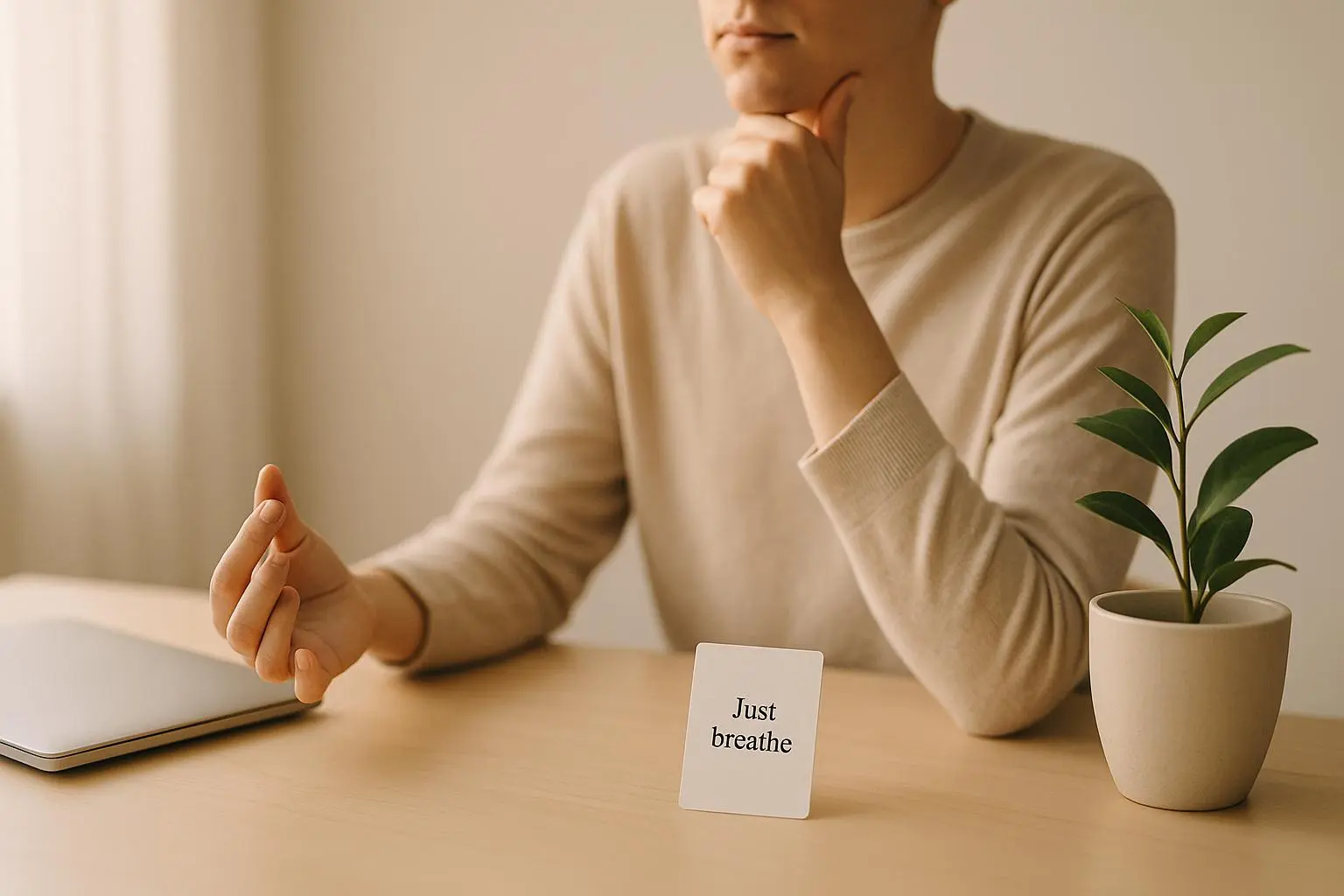
Desk‑Discreet TMJ Rescue: 3‑Minute Invisible Micro‑Scan to Stop Jaw Clenching
Oct 9, 2026 • 9 min
If your jaw tightens during Zoom calls and you only notice it when your face hurts at 4 p.m., this is for you.
This is a camera‑safe, office‑friendly, three‑minute routine that interrupts jaw clench and upper‑neck tension. No bulky tools, no dramatic stretches, no weird breathing noises. Just subtle mobility, a quick masseter massage, a one‑minute vagal‑boost breath (no holds), and simple behavior tweaks so you actually remember to do it between calls.
Why it matters: unresolved clenching turns into headaches, ear pain, and true TMJ problems. Do this a few times a day and you’ll stop paying for stress with your jaw.
Why jaw clenching happens at work (quick science)
When stress goes up, your sympathetic nervous system tenses the body. The jaw—specifically the masseter and temporalis—gets recruited for that tension. Add poor posture (head forward, shoulders up) and you’ve got a perfect storm: jaw muscles tighten, the TMJ gets strained, and neck muscles lock down.
Awareness helps. Most people don’t notice they’re clenching until symptoms show up: morning soreness, difficulty opening wide, or a tooth‑aching dullness by evening. That’s why the first win is catching it early—right at your desk.
How I actually made this work (a real story)
A few years ago I started getting evenings where my jaw felt like it had run a marathon. I blamed coffee and deadlines. Then I realized it happened most days I ran back‑to‑back virtual meetings. I began doing a single one‑minute check: tongue to the roof of my mouth, slow exhale, tiny jaw drop. It felt silly, but three things changed in two weeks: the evening ache eased, my lunchtime headaches stopped, and I stopped clenching unconsciously while drafting emails.
So I turned that one minute into a repeatable three‑minute sequence and added two habit hooks: after I hang up a call, and when I stand to refill my water. I tracked it for 30 days (yes, with an app). Outcomes: fewer pain days (down from 9 to 3 per month), less neck tension, and I actually remembered the routine because it was paired with things I already did.
That short, clumsy experiment became the Desk‑Discreet TMJ Rescue. It worked because it was small, private, and repeatable.
Micro-moment: one detail that stuck with me — the first week I kept my fingertip on my masseter while pretending to scroll on my phone, and a coworker asked if I was fine. I said yes. He never knew I’d just relieved a knot.
The 3‑Minute Invisible Micro‑Scan (doable between calls)
This is written so you can do it in your chair or standing, without drawing attention.
Phase timing:
- Phase 1 — Resting Jaw Reset: 45 seconds
- Phase 2 — Covert Mobility Moves: 45–60 seconds
- Phase 3 — Masseter Self‑Massage: 60 seconds
- Phase 4 — Vagal‑Boost Breath: 45 seconds
Total: ~3 minutes.
Phase 1 — Resting Jaw Reset (45 seconds)
Sit tall. Feet flat. Shoulders relaxed.
Find neutral: teeth slightly apart, lips lightly closed, tip of tongue resting just behind your upper front teeth on the roof of your mouth. This is the natural rest position most people lose when stressed.
Check for 15 seconds: are your teeth clenched? Jaw pushed forward? Observe. No judgment.
Then settle into the neutral position and breathe normally for 30 seconds. This primes your nervous system to notice tension sooner.
Why it works: simple proprioceptive awareness trains your brain to uncouple stress from jaw contraction.
Phase 2 — Covert Jaw Mobility Moves (45–60 seconds)
These moves are tiny—camera‑safe and silent.
- Gentle jaw drop (10–12 seconds): lips touching, lower jaw drops a millimeter or two—tiny, not theatrical. Hold 3–4 seconds, relax. Repeat twice.
- Side‑to‑side micro glides (15–20 seconds): with teeth slightly apart, glide the lower jaw a quarter‑inch left, return, then a quarter‑inch right. Smooth, controlled. Repeat 6–8 times.
- Tongue anchor (rest of the phase): keep the tongue on the roof of your mouth. It’s a simple cue that discourages clenching.
These restore joint mobility and are subtle enough to do while you scan notes or pretend to think.
Phase 3 — Masseter Self‑Massage (60 seconds)
The masseter is the big chewing muscle that balloons when you clench. Loosening it makes a pronounced difference.
How to do it without looking like you’re grooming your face:
- Place index and middle fingers at the angle of your jaw, just in front of the earlobe.
- Lightly clench once to locate the muscle, then relax.
- Make small circular motions for 20–30 seconds on one side, then switch.
- Keep pressure gentle. If it’s painful in a sharp way, back off.
Tip: tuck your chin slightly as you massage so the movement looks like a thinking pose. If you have a warm coffee or heat pack handy, a minute of warmth beforehand makes the massage more effective.
Phase 4 — Vagal‑Boost Breath (45 seconds)
This is silent, looks like a thoughtful pause, and calms your nervous system.
- Sit upright, hand on your belly.
- Inhale through your nose for a slow count of 4.
- Exhale slowly for a count of 6. No breath‑holding.
- Repeat 5–6 cycles.
The slightly longer exhale engages the parasympathetic system and reduces the fight‑or‑flight tone that drives clenching.
Why no holds: holding breath spikes tension. You want a smooth, unhurried exhale.
Ergonomics and small environment fixes that help
You can’t out‑massage bad posture. These quick wins reduce upstream causes of jaw tension.
- Monitor height: the top third of your screen should be at or slightly below eye level. If you look down, the head leans forward and the jaw compensates.
- Chair and torso: sit back against the chair so your shoulders aren’t rounded forward.
- Phone posture: avoid cradling your phone between shoulder and ear—use earbuds.
- Frequent micro‑breaks: stand and shake your shoulders for 30 seconds every 30–60 minutes. Movement resets muscle tone.
Even a 2–3 degree forward head tilt repeated all day adds up. Fix the alignment and the jaw tension often follows.
Behavior design so you actually do it
A 3‑minute routine only helps if you do it. Here’s what I use and what worked for others.
Tiny‑timer prompts
- Silent reminders at mid‑morning, after lunch, and mid‑afternoon.
- Label them “Jaw Check” so there’s no decision time.
Habit‑stack anchors
- After every video call ends: do the micro‑scan before switching tasks.
- While your coffee brews: do the masseter massage.
- Every time you stand to refill water: a quick jaw mobility set.
Apps worth trying
- Use a habit tracker (I used Streaks) to log completion and keep streaks going.
- Insight Timer or your phone’s timer can silently cue the breath phase.
Make it small. If three minutes feels like too much, do phase 1 only for a week. Increment slowly.
Red flags — when to stop and see a pro
This routine is great for everyday clench and mild TMJ discomfort. Stop and get evaluated if you have:
- Sharp, shooting pain in the joint
- Worsening clicking or popping sounds
- Jaw locking open or closed
- Trouble chewing or opening wide
- Pain radiating to ear, neck, or down the face
- No improvement after consistent practice for two weeks
Those signs suggest structural or dental issues that need a dentist, TMJ specialist, or physical therapist.
What to expect and realistic outcomes
Do this 2–4 times daily and you should see:
- Less evening jaw soreness within 1–2 weeks
- Fewer midday headaches
- Improved mouth opening and less “stiffness” mornings
- Reduced neck tightness (because the neck and jaw stop feeding tension to each other)
If you have chronic TMJ, these are maintenance tools—helpful, but not a replacement for professional treatment.
Quick FAQs (because people ask)
Q: Can breathing alone fix my clenching? A: Breathing helps, especially for stress‑driven clench, but the muscle and joint work matters too.
Q: Is massage safe if I have clicking? A: Gentle massage is usually safe; avoid deep pressure on the joint itself. If clicking worsens, stop and see a specialist.
Q: Can I do this on camera? A: Yes. The moves are designed to look like thinking poses or note‑scanning.
Q: How long until I stop involuntary clenching? A: It varies. Many people notice changes in 1–2 weeks. Habit change and posture correction compound over months.
Last practical tips (I still use these)
- Pair the routine with a visible anchor: a sticky note on your monitor that says “jaw check.” Oddly effective.
- Keep a small cushion or folded warm towel at your desk for pre‑massage warmth. Five minutes of heat amplifies results.
- Hydrate—dehydration increases muscle irritability. Simple, underused fix.
If you’re skeptical, start with one phase for a week. Track pain days. If it helps even a little, expand. Small, consistent changes beat rare heroics.