Blank Page Rescue: Two-Minute Rituals to Break Through Writer’s Block
Jul 12, 2026 • 9 min
You stare. The cursor blinks. You rehearse all the ways the paragraph will fail before you've written a single word.
Here’s a rule I use: when perfectionism shows up, shrink the task until it can’t refuse. Two minutes is small enough to be almost ridiculous—and that’s the point. These are not productivity hacks dressed as motivation. They’re tiny, repeatable rituals built to interrupt paralysis and produce actual words.
Below are six two-minute rituals I use and recommend. Each one includes a quick scaling path so those two minutes can naturally become twenty.
Why two minutes actually works
Perfectionism is a thinking problem, not a typing problem. The internal editor raises the bar to "publishable" before you even begin. That spike in cognitive load causes freeze.
Two minutes solves this in two ways: it reduces the decision overhead and it invites permission to be bad. Psychology and habit science back this up—small, easy starts build momentum, and momentum makes deeper work feel possible. Think of two minutes as a warm-up for the brain, not the workout.
Also: timers are magic. Set a timer, and a surprising thing happens—you stop arguing with yourself about whether to start.
How I actually made this work (a short story)
A few years ago I had a freelance deadline that felt impossible: a 1,500-word piece that mattered to me and to the client. I’d sit down, stare, and walk away—sometimes for hours. Finally, I tried something ridiculous: I promised myself two minutes of "awful writing" every morning for a week.
On day one I typed, "I don't know where to start. Maybe start with coffee." It was garbage. The bell buzzed. I stood up, made coffee, came back, and my brain had shifted. The second two-minute spill produced a sentence that tasted like a paragraph. By day four I was doing a two-minute ritual, then a 20-minute focused block. The piece that felt impossible on Monday was done and edited by Friday. The key wasn't that the ritual wrote the whole article—it was that the ritual removed the emotional bar that kept me from showing up.
That week taught me the simplest lesson: motion beats inertia. Two minutes is a tiny trick with outsized return.
Micro-moment: the sticky detail
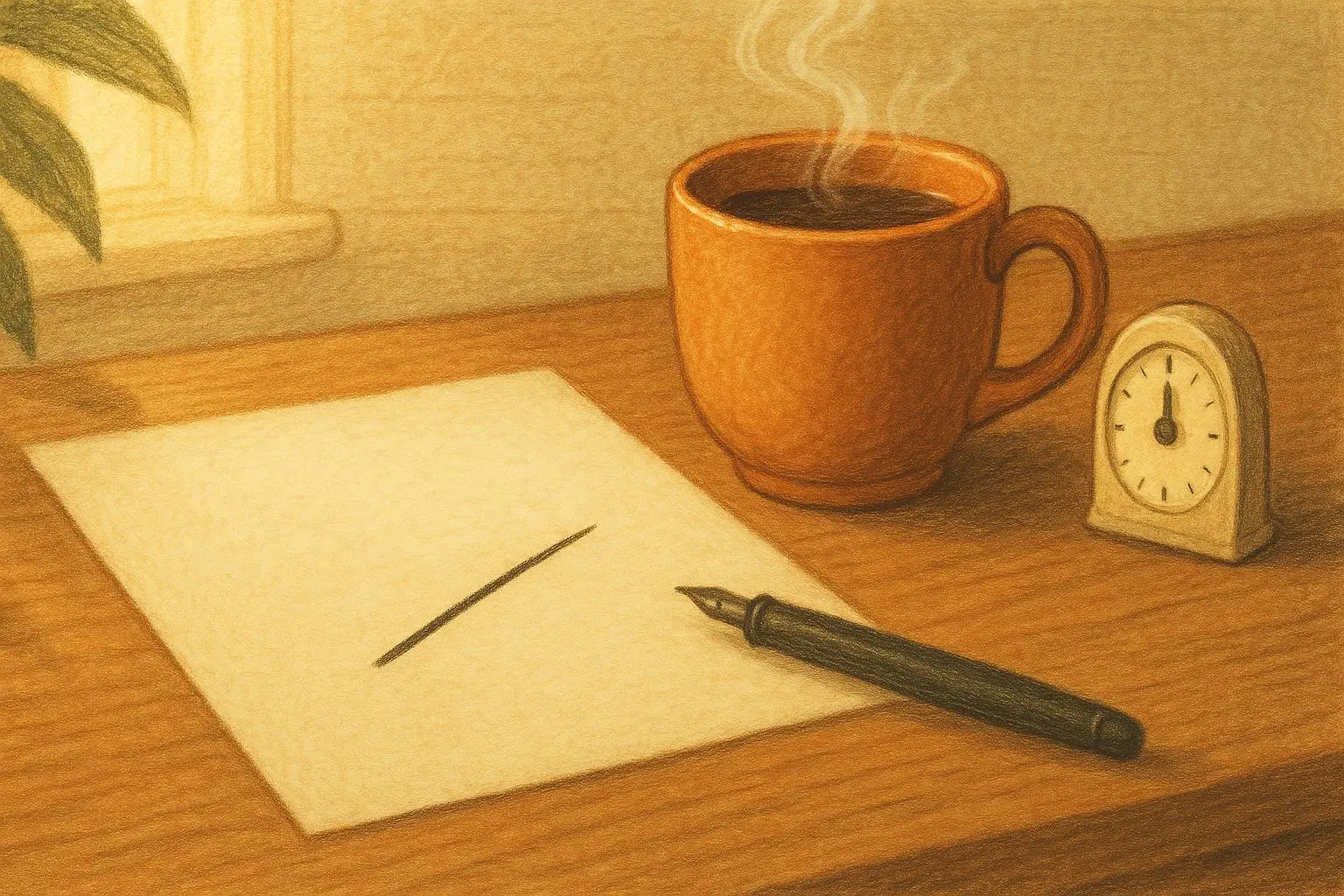
The small thing I still remember: the first awful line mentioned coffee. Later, when I smelled coffee during future sessions, my brain started to expect that "showing up" feeling. That smell became a mini sensory anchor—tiny and reliable.
The six two-minute rituals
Prep: pick a distraction-free app or a small notebook. Set a visible two-minute timer. Commit to no edits. Write until the timer buzzes.
1) The Sentence Starter
If you’re mid-project, locate the last complete sentence you wrote. Your two-minute job is to finish that sentence—literally. If you’re starting fresh, use a go-to prompt: “The most important thing I need to say today is…” or “What surprised me most about this topic is…”
Why it works: you eliminate the scary blank by continuing something already in motion.
Scaling path: when the two minutes end, read the line and set a five-minute timer to expand it into a short paragraph. Often that extension is enough to bootstrap a longer session.
2) Timed Micro-Freewrite
Two minutes. No stopping, no backspacing, no judging. Type or write whatever flows: fragments, complaints, grocery lists—anything.
Why it works: it forces output. Your fingers move; your inner critic loses its microphone.
Scaling path: highlight any phrase that feels “useful.” Paste it into your draft and spend ten focused minutes developing it.
3) Sensory Anchor Description
Describe your immediate environment using five senses. Smell the room. Feel the chair. Name the squeaks, the light, the texture of your mug.
Why it works: it pulls you out of your head and into observation, which loosens stuck thinking and often produces useful metaphors or fresh detail.
Scaling path: apply that sensory attention to a scene in your piece—spend five minutes describing the environment of your character, subject, or argument.
4) The Reverse Outline
Write the ending first. Draft a one- or two-sentence conclusion for the piece you want to write.
Why it works: clarity of destination reduces aimless pacing and gives your writing a destination to head toward.
Scaling path: use the conclusion as anchor, then spend fifteen minutes writing the introduction that logically leads there. Once you have intro and conclusion, middle sections feel like connectors rather than mysteries.
5) The "Bad Draft" Promise
For exactly two minutes, try to write the worst possible paragraph. Be cliché, clunky, melodramatic—everything your editor will hate.
Why it works: permission to fail is permission to start. It flips the fear on its head.
Scaling path: switch gears immediately after the buzz. Spend fifteen minutes editing the "bad" paragraph into something usable. Editing is almost always easier than conjuring perfect prose.
6) The Dialogue Dump
Write a two-minute conversation between two voices relevant to your topic: "Curiosity" arguing with "Fear," or "Product" debating "Customer." Let it be messy.
Why it works: it externalizes internal debates and surfaces useful tensions or lines you can quote.
Scaling path: pull the clearest three beats from the dialogue and turn them into bullet points. Spend ten minutes converting each beat into a short paragraph.
Common friction points and how to fix them
People hit the same snags. Here’s how I recommend handling them.
The timer buzzes and you stop—then check email: Make the first follow-up step predictable. My rule: buzzer → take one deep breath → set the next timer (5 or 10 minutes). Treat email as a later appointment, not a reward.
The ritual doesn't feel "productive": It isn't meant to produce finished work every time. Its job is to create motion. Track streaks, not word counts. If you do two minutes five days in a row, that's progress.
You can't get back to the project after the ritual: Use the scaling paths above. Rituals are ignition; scaling is the drive train. If you routinely stall, add a 5-minute buffer immediately after the two-minute ritual where you only read what you wrote and circle the most useful sentence.
Tools that make two minutes count
You don't need fancy gear, but a few tools make habit formation easier.
- A simple timer app (or your phone) is mandatory. I use Focus Keeper when I scale up.
- A distraction-free editor like Draftin or a plain notebook keeps the impulse to polish at bay.
- Forest (the little tree app) gamifies staying off your phone for two-minute stretches—yes, it helps.
Pick one tool and commit to it for a month. Habit formation likes consistency more than novelty.
When two minutes isn’t enough
Two minutes won't replace planning. If your piece has structural problems, rituals buy you breathing room but won't replace outlines or research. Use rituals to show up, then use structured sessions to build.
If distraction is your enemy, stack the two-minute ritual into a broader "habit stack." For example: make coffee → two-minute ritual → 25-minute Pomodoro. Habit stacks turn tiny starts into sustainable routines.
A realistic week-long plan
Try this seven-day sequence if you want a repeatable experiment.
Day 1: Sentence Starter (morning) + 5-minute expansion after buzzer. Day 2: Timed Micro-Freewrite (midday) + highlight one phrase for later. Day 3: Sensory Anchor (before work) + scene description for five minutes. Day 4: Reverse Outline (project planning) + 15-minute intro session. Day 5: Bad Draft (evening) + 15-minute edit sprint. Day 6: Dialogue Dump (creative day) + bullet-to-paragraph conversion. Day 7: Pick your favorite ritual and do a 30-minute sprint using it as warm-up.
At the end of the week, measure what changed: words produced, anxiety level, and how often you sat down without dread.
My final rule: ritual, not ritualism
These two-minute rituals are small because smallness makes them repeatable. If you ritualize the start—not the outcome—you end up writing more often and, over time, better. Perfectionism wants high stakes. Two minutes lowers them, and that’s where progress hides.
Start tomorrow. Set a timer to two minutes. Write a terrible sentence and be done with it. Tell me how it goes.