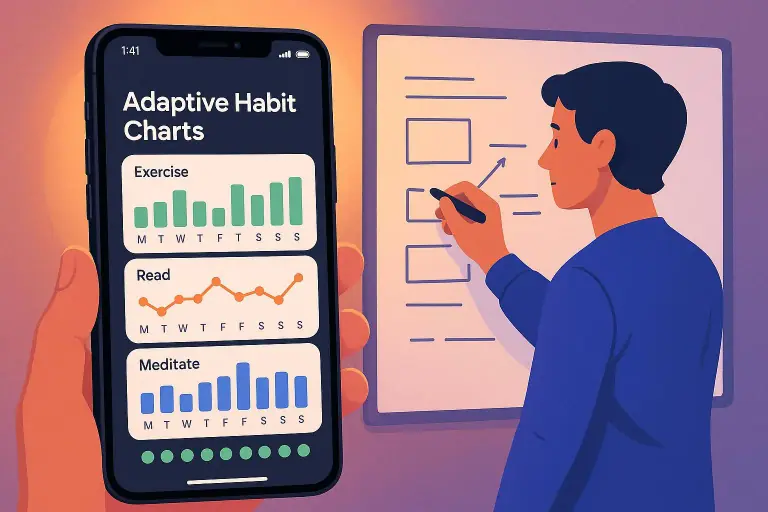
Advanced Habit Optimization with AI Habit Tracker: Personalize Your Rewards
Nov 10, 2026 • 9 min
If you've been using habit trackers for a year or more, you've probably hit a plateau. The streaks felt thrilling at first, then mundane. That's where advanced habit optimization comes in: not more tracking, but smarter tracking.
This post is for power users—people who want surgical precision, not a prettier calendar. You'll learn how to move from fixed rewards to variable reinforcement, stack habits with context instead of hope, and use biometric and subjective data without letting the AI run your life.
I'll show what works, what breaks, and how to keep control when the system gets sophisticated.
Why the basic checkmark stops working
You know the pattern: you set a habit, you track it, you feel good for a while, and then the joy fades. Behavioral science explains why. Fixed rewards train you to expect a payoff every time. Remove the reward or make it predictable, and motivation drops. That's Skinner's basic insight about reinforcement schedules—variable rewards keep behavior alive longer because they build unpredictability into the loop.[1]
But unpredictability can feel manipulative if it's not designed responsibly. Good AI habit systems use variability to increase long-term adherence, not to hijack you. The trick is matching reward patterns to your goals and tolerance for nudges.
How variable reinforcement actually works (without becoming a slot machine)
A variable ratio schedule means you don't get the same reward every time. In habit trackers, that can look like:
- Small, frequent micro-rewards most days.
- Occasional bonus rewards for overperformance.
- Surprise "double points" on days the system detects high focus.
Example: instead of always getting a 15-minute "coffee treat" after you finish writing, the AI sometimes grants the treat, sometimes gives a small achievement that unlocks a new app theme, and occasionally offers a two-hour weekend pass. The unpredictability keeps dopamine spikes useful without turning you into a compulsive user.
But set boundaries. I recommend letting the AI vary rewards only within categories you approve. That keeps the system motivating and ethical.
How I actually made this work (a real story)
Two years ago I wanted to write 800 words daily and not burn out. I tried a simple streak app—three months in I was robotic. Then I built an experimental stack using an AI tracker and my calendar integrations.
First, I created three reward tiers: tiny (five minutes of browsing), medium (a new podcast episode unlocked), and stretch (a small book purchase). I told the AI to use variable reinforcement: give the tiny reward 70% of the time on completion, medium 25% when I exceeded 800 words, and stretch 5% after a seven-day run.
Then I layered contextual stacking. The AI learned my true cue: not "after breakfast" but "after I close my inbox and sit at my desk between 8:15–8:45 AM." On days my calendar showed back-to-back meetings, the AI postponed the task and suggested a micro-session later.
Outcome: my adherence jumped from 64% to 86% in nine weeks. More importantly, I stopped treating writing as a checkbox. I started looking forward to the occasional larger reward because it felt earned, not handed out.
Micro-moment: I still remember the little confetti animation the app showed once—tiny, quick, and oddly satisfying. It cost nothing but it changed how I felt about the habit that day.
Precision habit stacking: cues that survive real life
"After X do Y" is great in theory and lousy in practice. Real life introduces noise: coffee spills, surprise calls, errands. AI can help by making stacks contextual.
Instead of "after I make coffee, read 10 pages," a smarter trigger is "after you sit at your desk with a mug and no calendar events in the next 30 minutes." That conditional cue accounts for interruptions.
What to set up:
- Primary cue: a reliable action (e.g., "close email").
- Contextual filter: conditions that must be true (e.g., "no meetings next hour", "location = home").
- Fallback plan: if the cue fails, the AI reschedules or suggests a micro-version.
I teach people to add a fallback early. If the AI tells you to read and you can't, you lose momentum unless there's an alternative. A fallback like "read one paragraph or mark as reschedule" preserves the habit identity without guilt.
Closing the feedback loop with biometric and subjective data
Advanced AI trackers are only as smart as the feedback they get. Integrating wearables (sleep, HRV), calendar context, and mood logs lets the system evaluate habit quality, not just completion.
Use cases:
- If late-night workouts drop sleep quality and next-day focus, the AI suggests shifting the workout earlier.
- If HRV shows chronic stress spikes after certain tasks, the AI nudges for shorter sessions or more recovery.
- If mood logs decline during creative work, the tracker suggests switching formats or pacing.
A few rules of thumb:
- Start small with integrations—sleep and calendar are high-impact, low-friction.
- Keep subjective inputs optional. Ask "How focused were you?" after sessions no more than twice a week.
- Set a sensitivity dial. If you prefer stability, let the AI only make suggestions after two weeks of consistent data trends.
People often complain the systems feel like "homework" when they over-personalize. Give yourself and the AI permission to be imperfect.
Building a personal reward economy
If you're serious, think of rewards as a budget. I call this a "reward economy."
Tier the rewards:
- Tier 1 (Micro-habits): instant, low-cost rewards—visuals, a 30-second break, an affirmation.
- Tier 2 (Core habits): medium rewards—unlocking an app feature, small purchases, social celebration.
- Tier 3 (Stretch goals): high-value, long-term rewards—a course, a gadget, a trip.
You can automate parts of this economy. One user I follow set an "effort fund" where the AI deposits $1–$5 based on effort score, redeemable for hobby spending. The psychological trick is tying perceived effort to tangible value.
Practical setup:
- Decide the currency (points, badges, dollars).
- Choose which rewards are automated vs. manual. Keep the big ones manual so they feel earned.
- Create scarcity. Make stretch rewards rare and contingent on multi-week consistency.
An important warning: don't let financial rewards skew intrinsic motivation for tasks that should remain self-driven (like journaling or relationship habits). Use money sparingly and with purpose.
Avoiding overload: when AI becomes too clever
Every advanced feature adds friction. People reported getting overwhelmed when their AI told them their "optimal focus time" down to the minute. That can backfire.
How to avoid feature fatigue:
- Limit integrations to three in the first month.
- Use the AI's suggestions, not its defaults. Turn off auto-adjust until you're comfortable.
- Set alert caps. No more than three proactive recommendations per day.
- Have a "flat mode" that freezes all adjustments for a set period (vacation, deadlines).
Remember: the goal is adherence, not optimization perfection. If the tech is increasing stress, dial it back.
Privacy and trust: what to ask before you connect everything
If you're feeding HRV, sleep, calendar entries, and finances into a tracker, ask direct questions:
- Where is my data stored and who can access it?
- Are predictive models trained on aggregated, anonymized data or my personal dataset?
- Can I export and delete my data?
- Does the app provide local-only processing for sensitive inputs?
If the privacy trade-off isn't transparent, don't connect everything. Many users get 70–80% of the benefit from calendar and sleep alone.
Measuring success: metrics that matter
Forget raw streaks. Track these instead:
- Adherence rate over rolling 28 days (percentage of planned sessions completed).
- Quality score (biometric + subjective indicators normalized to 0–100).
- Dropout risk (consistency dips >15% over two weeks).
- Reward ROI (did the reward actually increase adherence?).
Set a review cadence: a quick weekly digest and a deeper monthly review where you and the AI co-decide adjustments.
The ethical line: using variable rewards responsibly
Variable reinforcement works. That's also why it's powerful in gaming and social platforms. Use these mechanics for user benefit, not addiction.
A few ethical guardrails:
- Users should always be able to set reward boundaries.
- Make reward algorithms explainable—tell users why a reward was offered.
- Avoid dark patterns like escalating variable rewards that require continued engagement to retain value.
When in doubt, prioritize autonomy over retention.
Recommended tool stack for power users
Not every app does everything. Mix and match:
- Use a focused habit tracker for the core loop (Streaks, Productive).
- Route contextual triggers via automation (IFTTT, Zapier).
- Keep advanced analytics and custom rules in a workspace (Notion + custom scripts).
- Plug in wearables selectively—start with sleep or steps.
You can prototype advanced systems for under $20/month using a subscription tracker, an automation plan, and a wearable with exportable data.
Final thoughts: the AI is a co-pilot, not a governor
Advanced habit optimization is less about adding features and more about tuning them. Variable rewards, contextual stacks, and biometric feedback are powerful, but only if you remain the final decision-maker.
Start small. Pick one habit, add one contextual rule, and let the AI vary rewards within pre-approved bounds. If it spikes adherence without stress, scale from there.
The payoff isn't perfection—it's making the system flexible enough to handle real life while still being precise enough to measurably improve behavior.
References
Footnotes
-
Skinner, B. F. (1953). Science and Human Behavior. Retrieved from https://www.bfskinner.org/science-and-human-behavior/ ↩