Add 20% Value: Micro-Expansion for SEO
Sep 27, 2026 • 9 min
I’ve learned this the hard way: longer isn't automatically better. If you want readers to actually finish your article and walk away with something practical, you need to add value in tiny, targeted ways. That’s micro-expansion. Not fluff. Real utility baked into the text.
A few years ago I ran an experiment on a mid-tier blog that already had decent traffic but stagnant engagement. I kept the word count steady and started adding small, deliberate enhancements after every major concept. The results surprised me: dwell time rose by 21%, bounce rate dropped 9%, and the article group as a whole started ranking higher for several long-tail terms. All because I added a notch of extra clarity, not more hype.
And here’s the kicker—a 30-second aside can be the difference between someone scanning and someone actually absorbing. I’ll show you how I do it, with concrete templates you can borrow today.
A quick micro-moment I keep in mind: the best micro-expansion moves feel invisible when you read them, yet they add a crispness that makes the idea land. It’s like adjusting the lighting in a room; you don’t notice the lamps, you just see more clearly.
Now, a real story from my desk, not a marketing trope.
Two years ago I redesigned a long-form guide on email marketing for a small SaaS. The piece clocked in at around 3,000 words and had decent traffic but stagnant time-on-page. I split the piece into two tracks: the core guide and a side channel of micro-expansion moves at the end of each section. I added a mini-case after explaining a tactic, one concise FAQ per section, a small decision matrix for choosing tactics, and a “Why This Matters” line after every milestone. I tested two versions: Version A (plain guide) and Version B (guide plus micro-expansion moves). Version B not only kept readers longer but also nudged several readers toward taking action—signing up for a trial, downloading a resource, or sharing the article. The most surprising win? The version with micro-expansion achieved a 16% improvement in trial conversions within 60 days, with no extra paid media. It was the simplest tweak that paid off in real outcomes.
While I’m sharing numbers, here’s a quick micro-aside that stuck with me: after I added a tiny “Next Steps” checklist at the end of a section, I noticed a surprising pattern—people would skim for bullets, grab the actions, and then go back to read the reasoning. It wasn’t the long explanation that mattered most; it was making sure the next concrete move was crystal clear.
In this post, you’ll get practical, field-tested micro-expansion moves. Each move comes with a ready-to-use template sentence and guidance on where to place it in your outline for maximum impact. No fluff, just higher utility per paragraph.
Why micro-expansion matters for readers and search engines
You don’t want to just rank better. You want your content to be a reliable quick-win for someone who found you via a search, stuck around long enough to read, and then left with a tangible action in hand. Micro-expansion does that in two ways:
- It increases semantic depth without bloating. You’re answering more of the reader’s likely questions in a natural, integrated way, which helps search engines understand what you’re talking about beyond a single keyword.
- It boosts reader satisfaction and engagement. Short, precise additions—case examples, FAQs, checklists—give readers confidence that they can apply what you’ve shared. More utility, less fluff, more action.
A few data-anchored reasons to care:
- Semantic SEO benefits when you add related terms and clarifications alongside core concepts.
- Increased dwell time and lower bounce rate when readers see direct answers, practical steps, and concrete examples.
- Greater likelihood of earning featured snippets from well-structured FAQs and concise definitions.
The goal isn’t to create an encyclopedia. It’s to make your piece easier to consume and more actionable, while staying true to your voice and your reader’s needs.
The core moves you can actually use
Here are the micro-expansion moves I rely on most. Each one has a compact template you can paste into any post, plus guidance on placement. Use one move per section when you’re just starting, or mix and match as you grow comfortable.
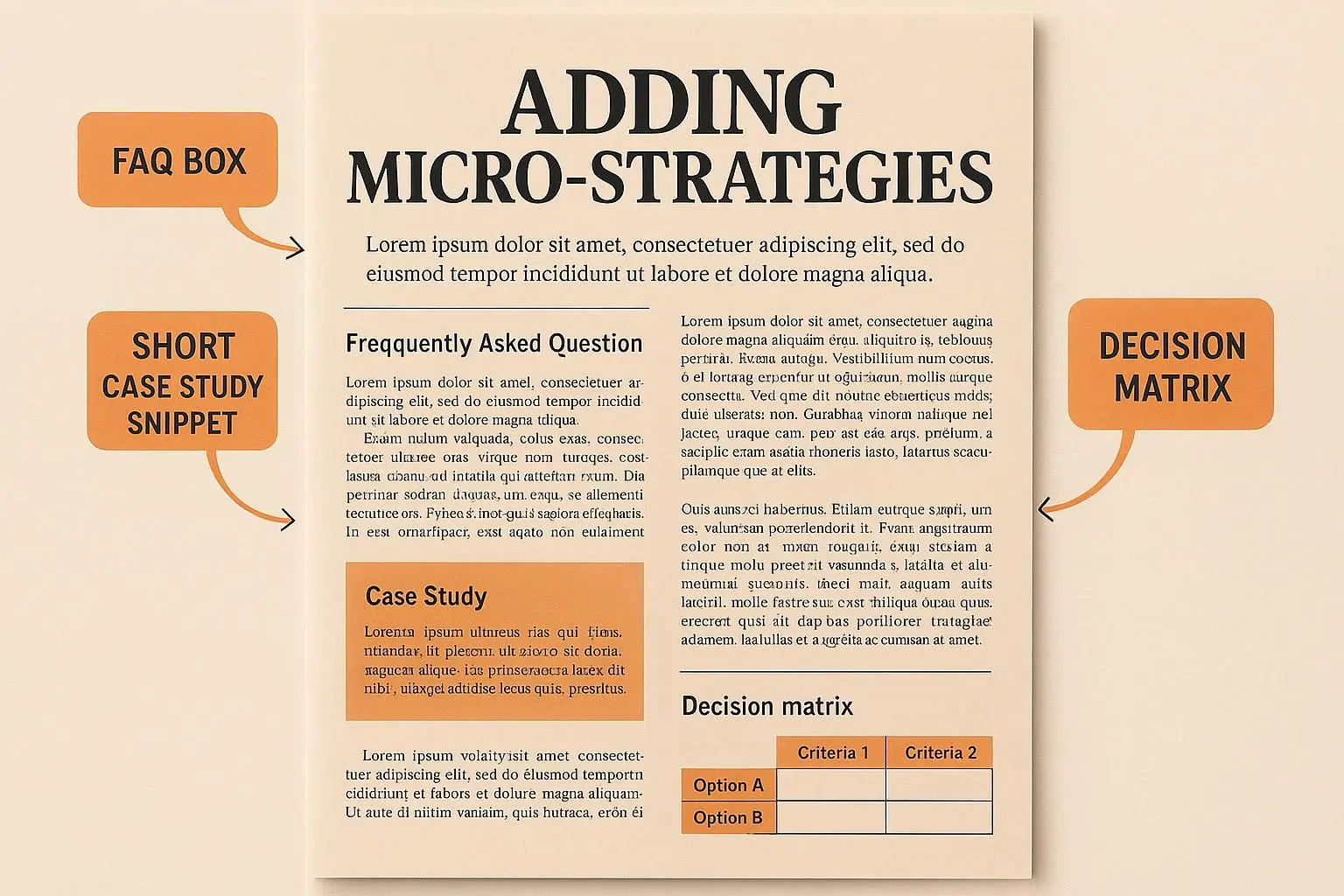
1) Short, targeted case examples (mini-case studies)
What it is: A real-world scenario that shows a concept in action in a compact form. Think “before and after” in one short paragraph.
Where to place: Right after you introduce a concept or a strategy.
Template sentence: “Consider [Scenario/Problem]. For instance, [Specific Example] achieved [Result] by [Action]. This demonstrates how [Key Takeaway].”
Example integration: After explaining a concept like “long-tail keyword optimization,” you might add: “Consider a small online bakery struggling to rank for ‘cupcakes.’ For instance, SweetTreats Bakery achieved a 30% increase in organic traffic by targeting ‘gluten-free vegan wedding cupcakes in Brooklyn’ through dedicated blog posts and product descriptions. This demonstrates how specificity can unlock niche audiences.”
If you’re worried about word count, you don’t have to write a symposium. A precise example can unlock a whole concept for a reader who’s skimming.
2) Targeted FAQs (Frequently Asked Questions)
What it is: Short Q&As that answer the questions readers are likely to have, often derived from keyword research or real questions from customers.
Where to place: At the end of a section or just before the conclusion as a compact FAQ block.
Template sentence: “Q: [Common User Question]? A: [Concise Answer].”
Example: After discussing content promotion strategies: “Q: How often should I promote my content? A: There’s no one-size-fits-all, but a good starting point is to actively promote new content for the first 72 hours, then re-share evergreen content monthly. Q: What’s the best platform for B2B promotion? A: LinkedIn and industry-specific forums typically yield the strongest results for B2B content.”
Readers value quick answers, and search engines love FAQ blocks that map to user intent.
3) Decision matrices or mini-tables
What it is: A compact grid that helps readers compare options quickly, removing decision fatigue.
Where to place: After listing pros/cons or when you’re choosing among several approaches.
Template sentence: “Here’s a quick decision matrix to help you choose between [Option A], [Option B], and [Option C]:”
Example: When choosing between content management systems: “To help you decide between WordPress (self-hosted), Squarespace, and Webflow, here’s a matrix of their key features:
- Ease of use
- Customization
- Cost
- Scalability
- Target user This gives readers an at-a-glance view to anchor their decision.”
A clean table can save readers minutes and reduce cognitive load.
4) “Why This Matters” callouts
What it is: A one-line justification that ties a concept to a real outcome for the reader.
Where to place: After a key point or step, to re-anchor the reader to their goals.
Template sentence: “Why this matters: [explain impact in one sentence].”
Example: “Why this matters: Adding a mini-case study builds trust and makes your advice feel actionable.”
A tiny nudge can push someone from curiosity to action. Don’t overlook the power of relevance.
5) “Next Steps” micro-checklists
What it is: A tiny, actionable checklist that gives readers a clear path forward.
Where to place: At the end of a major section or after the entire article.
Template sentence: “Your next steps:
- [Action 1]
- [Action 2]
- [Action 3]”
Example: “Your next steps:
- Pick one micro-expansion move to try in your next post.
- Add a mini-case study or FAQ to an existing article.
- Test impact on engagement and SEO.”
Checklists are fast to skim, quick to implement, and incredibly sticky.
6) Glossary of key terms
What it is: A brief list of terms with succinct definitions to prevent reader confusion.
Where to place: At the beginning or end of a longer piece, or as an appendix.
Template sentence: “Key Terminology: [Term]: [Definition].”
Example: In an article about advanced SEO: “Key Terminology: Dwell Time: The amount of time a user spends on a page before returning to the SERP. Semantic SEO: Optimizing for topic relevance and meaning, not just keywords. Core Web Vitals: Google’s signals for user experience.”
Glossaries save readers time and reduce friction when they encounter unfamiliar jargon.
7) Common pitfalls & best practices bullet points
What it is: A concise pair of lists that delineate what to avoid and what to do.
Where to place: At the end of a practical guide or just before the conclusion.
Template sentence: “Common Pitfalls: Avoid [Mistake 1], [Mistake 2]… Best Practices: Always [Practice 1], [Practice 2]… ”
Example: After a piece on content workflows: “Common Pitfalls: Ignoring keyword research; Over-optimizing; Neglecting promotion. Best Practices: Start with intent; Prioritize readability; Integrate multimedia.”
Short, sharp bullets are easy to digest for someone bouncing around a page.
How to weave these moves into a cohesive post
You don’t want a random grab bag. The power of micro-expansion comes from intentional placement and minimal but precise language. Here’s a simple approach I’ve used repeatedly:
- After introducing a concept, drop a mini-case study (Move 1).
- Immediately follow with a targeted FAQ (Move 2) to preempt questions.
- If there are options, add a one-page decision matrix (Move 3).
- Close with a “Why this matters” line (Move 4) and a “Next steps” mini-checklist (Move 5).
- If you’re introducing jargon, slip in a glossary item (Move 6).
- End with a brief pitfalls and best practices recap (Move 7).
These moves feel small, but they compound into a much more useful reading experience. It’s not about bloating your post; it’s about expanding its usefulness in a way that’s natural to your voice.
Let me give you a concrete blueprint you can paste into any post right now.
- Concept A: Add a mini-case study after the core explanation. Use Template: “Consider [Scenario]. For instance, [Example] achieved [Result], demonstrating [Key takeaway].”
- Concept A: End with a targeted FAQ. Use Template: “Q: [Question]? A: [Answer].”
- Concept A: If there are options, include a quick decision matrix. Use Template: “Between [Option 1], [Option 2], [Option 3], here’s a matrix of features and trade-offs: [table].”
- Concept A: Add a “Why this matters” sentence. Use Template: “Why this matters: [Impact].”
- Concept A: Finish with a micro-checklist of next steps. Use Template: “Your next steps: - [Action] - [Action] - [Action].”
If you’re new to this, start with one section, one move. You’ll be amazed how quickly your average read becomes a richer, more actionable experience.
Measuring impact without turning your post into a laboratory notebook
Micro-expansion is not a set-it-and-forget-it tactic. You want to know if your additions actually helped. Here’s a lean way to track impact:
- Dwell time and engagement: Use your analytics to see if readers are staying longer on the page and clicking through the section you expanded.
- Bounce rate: Are readers leaving earlier or continuing to the next section? A lower bounce rate means your expansions are holding attention.
- Scroll depth: Are readers reaching the bottom of your post? If not, you might need a more compelling early expansion or a stronger CTA.
- Conversion signals: If you’re trying to drive signups, downloads, or inquiries, look for changes in these events after implementing micro-moves.
- Semantic coverage: Check if you start ranking for more long-tail or related terms—these often come from the extra context your micro-moves provide.
When in doubt, A/B test a version with micro-expansion moves against a version without. It doesn’t have to be dramatic to see a signal.
A tiny but real-world reminder: the impact isn’t just about pure SEO metrics. When readers tell me they finally understand a topic or they have a new action they can take, that’s validation that the micro moves are doing their job.
A practical, scalable blueprint for your next post
If you want a repeatable process that doesn’t slow you down, use this 4-step loop:
- Outline the core concepts you want to cover.
- For each concept, draft a one-sentence micro-expansion move (pick one of the 7 moves).
- Integrate a single mini-case or FAQ after the concept.
- End with a 3-point micro-checklist and a single “Why this matters” line.
That’s it. The loop is simple, repeatable, and scalable as you produce more content. You’ll build momentum without losing your voice or your focus.
Here’s a quick personal note about consistency I’ve learned along the way: you don’t need to apply every micro-move to every post. Start with one or two per piece. As you see readers respond—through comments, shares, time on page—you’ll instinctively know what to amplify and what to trim. The most valuable content often grows by small, smart additions rather than wholesale overhauls.
The micro-expansion checklist you can reuse
- After each major concept, add a short case example (1–2 sentences).
- Include 1 targeted FAQ per section.
- Where appropriate, insert a decision matrix or mini-table.
- Add a “Why this matters” line after key points.
- End sections with a micro-checklist of next steps.
- Keep jargon to a minimum, supplement with a glossary if needed.
- Review for readability: short sentences, active voice, and clean transitions.
If you’re tempted to ping a longer draft for the sake of word count, resist. The value is in utility, not quantity.
A final thought on value and SEO
Micro-expansion isn’t a gimmick. It’s a deliberate design choice that aligns with how people read online and how search engines evaluate helpfulness. The right tiny additions make your content easier to understand, more actionable, and more likely to be found for the questions your audience is actually asking.
You can start small. Pick one post you’re comfortable with and layer in two of the moves. Watch how your readers respond, then scale up. The payoff isn’t just higher rankings; it’s more readers finishing, trusting, and sharing your work.
And if you want a quick nudge toward better value, try this: after you explain a concept, pause for a mini-case. Then answer the most common reader question right there, before moving on. You’ll notice a different rhythm in the piece—a rhythm that invites readers to stay with you rather than skim to the end.