A/B Night Routine: 3 Low-Energy Openers to Test for Faster Replies
Nov 27, 2025 • 8 min
Dating apps are supposed to be fun. Instead they're exhausting. If your brain checks out at 9pm but your matches pile up, you need a routine that conserves energy and still produces replies.
Here’s the thing I learned the hard way: perfectionism on a dating app is a burnout engine. Spend thirty thoughtful minutes on one message and you’ll get one reply or none. Spend ten minutes consistently every night, and you'll get a steady flow of responses you can actually follow up on.
This post gives you a sustainable nightly A/B testing routine for low-energy daters: three gentle openers to test, a strict 60-second personalization rule, and a tiny metrics sheet you can update in under two minutes. I’ll also show you how to interpret reply lift so you stop guessing and start improving.
Why A/B testing works for dating (and why it’s low-effort)
A/B testing isn’t new. Marketers use it to improve click-through rates. You can borrow the same idea for messages: hold everything else constant (your photos, prompts, profile), and test openers.
Why that helps low-energy people:
- You only change one variable at a time (the opener).
- Each message takes about 60 seconds to personalize.
- You build momentum: regular, repeatable actions beat sporadic masterpiece attempts.
Do this for a week. Ten sends per opener type (so 30 sends total) is a good minimum. That gives you enough data to see real differences without burning out.
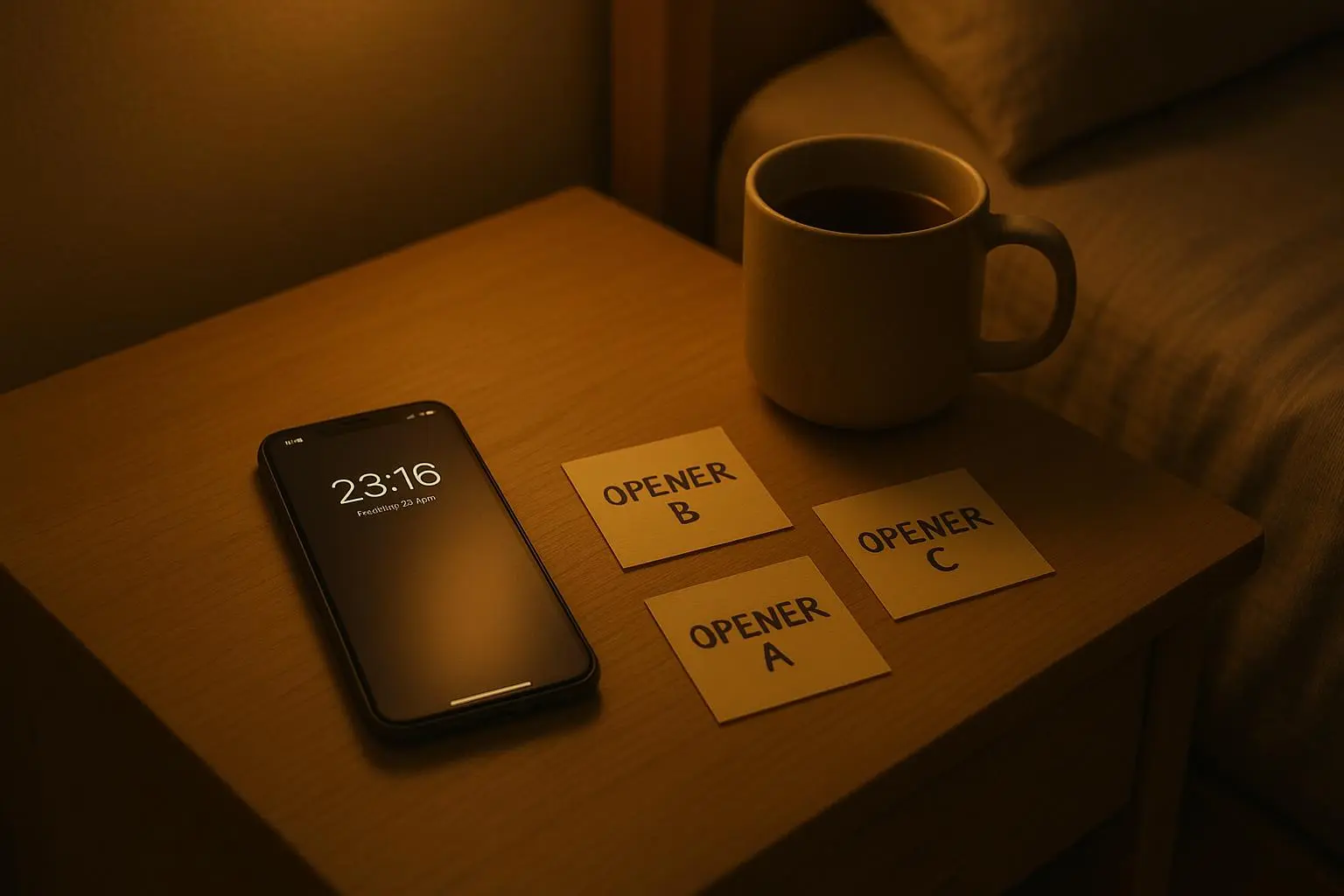
The three low-energy openers (A, B, C)
These are not witty monologues. They’re small, specific, and invite a quick reply.
Opener A — Specific Compliment Hook
- What it is: A short compliment about a non-physical detail, followed by one quick question.
- Template: “That photo of you [activity/place] is wild—what was the hardest part of it?”
- Why it works: It shows attention, not flattery, and asks a simple question.
- Personalization time: 60 seconds — pick one detail and ask one thing.
Opener B — Low‑Stakes Question (the fallback)
- What it is: A zero-pressure, easy-to-answer poll or preference question.
- Template: “Quick poll: coffee or tea to start the day? I’m a [coffee/tea] person.”
- Why it works: People love taking tiny stances. Low cognitive load = higher reply rate.
- Personalization time: 0–20 seconds. Use it when you can’t find a detail.
Opener C — Shared Experience Hook
- What it is: Find a shared location, hobby, or film reference and mention it.
- Template: “You’re in [neighborhood]? Have you tried [local spot]? I’m always looking for recs.”
- Why it works: Similarity builds rapport quickly and makes the reply obvious (yes/no + rec).
- Personalization time: 60 seconds — scan bios or photos for location/hobby cues.
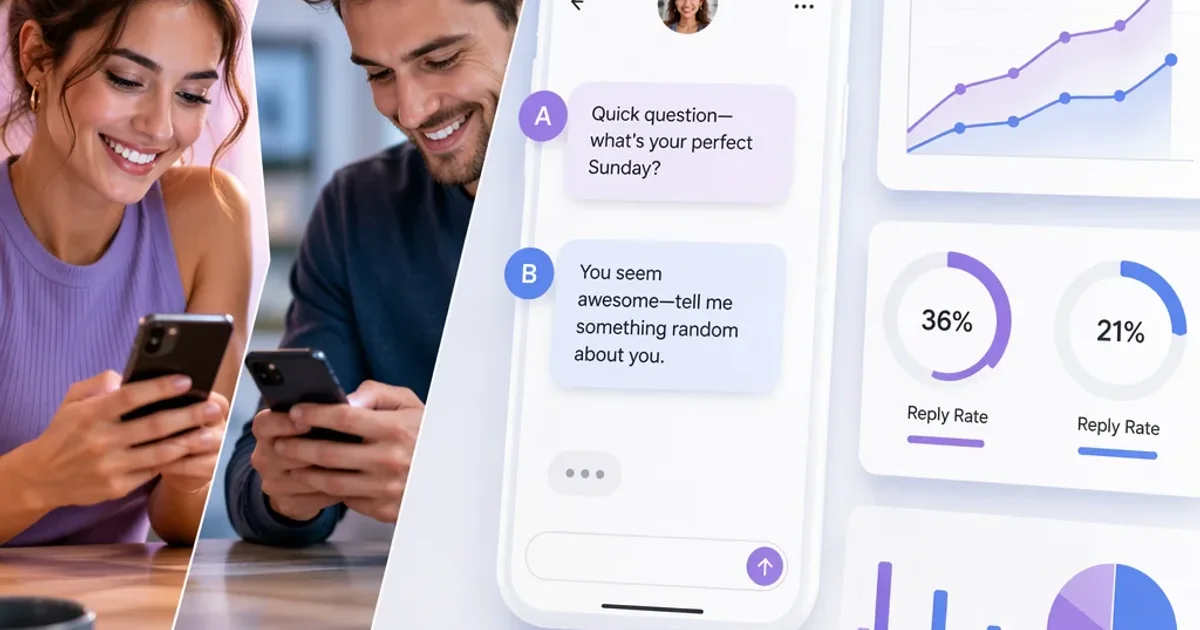
Do ten sends of each opener in a testing cycle. After that, compare reply rates. If Opener A has a 40% reply rate and Opener B has 20%, keep A and swap B for a new variant.
The 60-second personalization rule (and why it’s a life-saver)
Set a strict timer. Sixty seconds to find a detail and write the opener. If you haven’t found anything in that time, switch to the Low‑Stakes Question (Opener B) and move on.
Why this matters:
- It prevents analysis paralysis.
- It keeps your nightly routine under 10 minutes.
- It trains you to spot shallow-but-useful profile cues quickly.
I stole this idea from myself after a bad week. I remember one night—sore, tired, and cranky—where I stared at a match for five minutes, rewrote a joke three times, and sent it anyway. No reply. The next night I used the 60-second rule across 30 matches, and I got nine replies in three days. Same time invested; vastly different results.
That’s a 30% reply rate vs. near-zero. The math hits in ways optimism never will.
How to log results without becoming a spreadsheet hermit
You don’t need a fancy dashboard. Use a single row per message in Google Sheets, Notion, or even your phone’s notes app.
Minimum columns:
- Date
- Match name/initial (or app handle)
- Opener type (A/B/C)
- Sent (Y/N)
- Replied within 48 hours (Y/N)
- Quick note (tone, good reply? yes/no)
A tiny formula calculates reply rate: (Replies / Sent) * 100.
If you do 30 sends per week, you’ll have a clear picture in seven days. The metric I care about is Reply Lift: how much better one opener performs relative to the baseline. If Opener A is 40% and Opener B is 20%, Reply Lift = (40-20)/20 = 100% improvement over B.
Pro tip: label the week (Week 1, Week 2) so you track trends over time. Reply rates change with time of day, season, and app churn. A rolling 30-send window evens out noise.
How to run a simple weekly experiment (step-by-step)
- Pick your three openers. Save templates in your notes app.
- Set 10 minutes before bed. Open the app and a timer.
- For each match: use the 60-second rule, pick A/B/C, send, and log.
- After 30 sends (or one week), compute reply rates.
- Keep the winner as baseline. Replace the worst performer with a new opener to test.
Repeat monthly. Small, steady improvements compound quickly.
A story: how this routine saved my sanity (100–200 words)
I ran this exact routine for six weeks last spring after I hit the wall. I'd been patching together random lines, burning out, and getting two replies per week. I committed to the 60-second rule, used the three openers, and tracked every send in a Google Sheet.
Week 1: 30 sends, 6 replies (20%). Week 3: I had refined Opener A (the specific compliment) and got 13 replies from 30 sends (43%). By week 6: I’d swapped out a weak variant and kept iterating. I averaged 9–12 replies per 30 sends—enough to have several meaningful conversations without feeling overwhelmed.
The surprising bit: better consistency meant I actually followed up. Replies turned into dates because I wasn’t too tired to keep the conversation alive. The routine didn't make me more charming overnight—it made me reliable.
Micro-moment (30–60 words)
Quick detail that stuck: I keep a tiny “template” card in my phone with three saved openers and one-line tweaks. When tired, I pull it up, personalize for 30–60 seconds, and send. That small ritual stops the scroll-and-close reflex more often than you’d expect.
When to call a winner (and when to run again)
Don’t overinterpret early data. Use these rules:
- Minimum: 10 sends per opener before you decide.
- Strong winner: difference of 15+ percentage points with at least 10 sends each.
- If close (within 5–10 points), run another cycle with a fresh variant.
Once you have a clear winner, make that your baseline for the next month. Then test a new challenger against it. You’re doing controlled, manageable experiments — not rewriting your personality.
Common objections (and short answers)
“But won’t this feel fake?” No. These openers are short, personal, and easy to tweak. Think of the routine as a practice, not a script.
“What about photos and bios?” Openers can’t fix a weak profile. If your reply rates are abysmal across every opener (single digits), audit photos and prompts first.
“Does time of day matter?” Yes—reply likelihood changes. Track timestamps if you want to optimize for evenings vs. mornings. But for a low-energy routine, nightly testing is efficient and consistent.
Tools that make this painless
- Google Sheets: Simple tracking and quick formulas.
- Notes app: Store templates for fast copying.
- Rizzman or similar analytics tools: Optional. Useful if you want automated reply lift calculations.
- Trello or a tiny Kanban board: If you like visual organization, assign “sent,” “replied,” and “follow-up” lists.
You don’t need any paid tools to get meaningful results. I used one free Google Sheet and my phone’s Notes for two months and it was enough.
How to move from reply to a date (short roadmap)
A good opener gets you a reply. Don’t let it die there.
- Aim to exchange three substantive messages within 24–48 hours.
- Use a transitional question: pivot from the opener to a personal tidbit (travel, weekend plans).
- Propose a low-friction meet: “If you’re free this weekend, coffee at [local cafe]?” Concrete beats vague.
The goal is consistent small wins, not theatrical first messages.
The truth about testing: it’s boring and effective
A/B testing isn’t glamorous. It will feel mechanical at first. That’s the point. You’re trading creative burnout for consistent results.
If you’re a sporadic dater who wants fewer nights of spiraling and more real replies, try this:
- 10 minutes before bed, 30 messages a week, three openers, 60-second personalization, and a two-minute log.
Remember: the goal is sustainability. If you can keep this up for a month, your reply rate will improve, and you won’t be drained every time your phone buzzes.