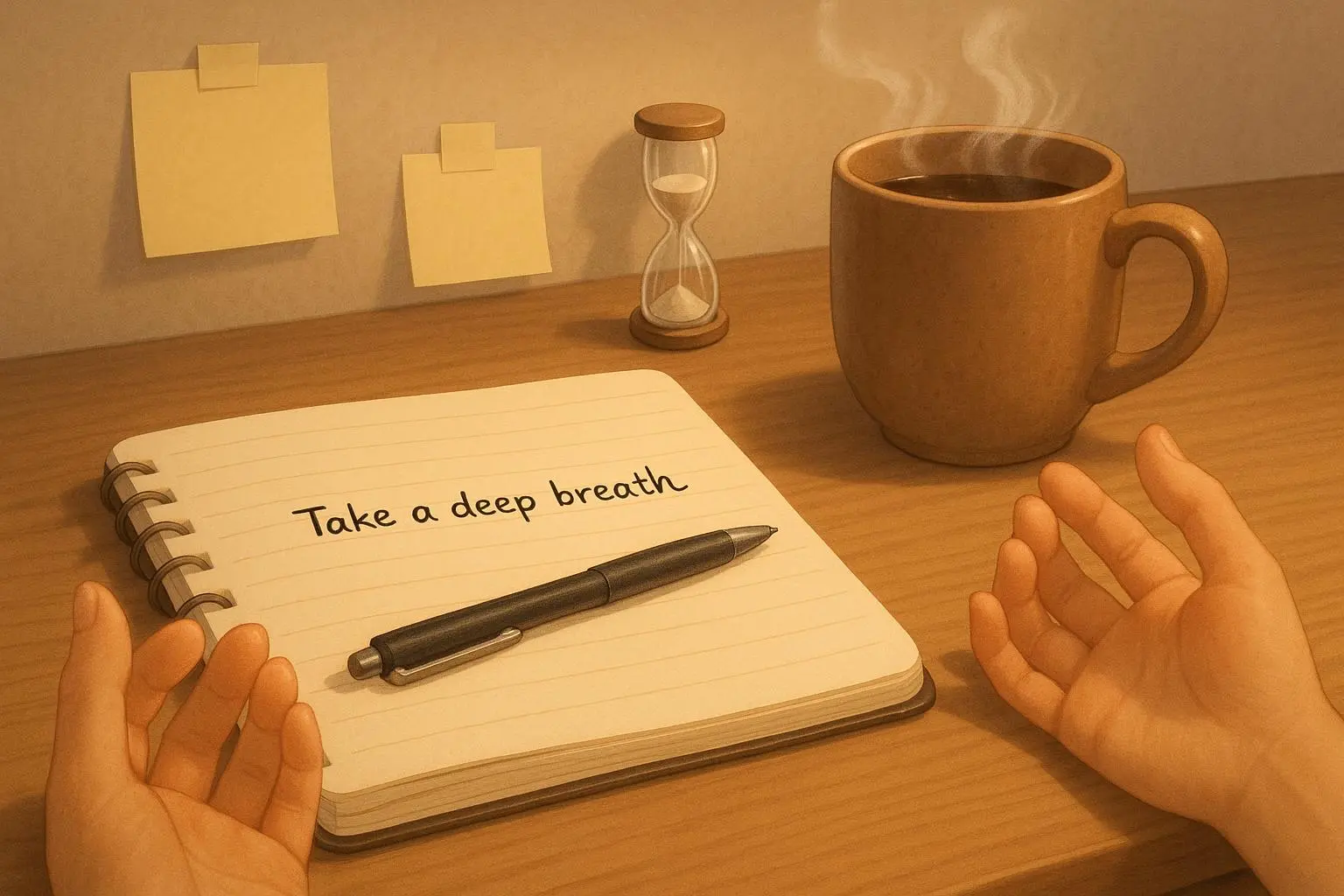
90-Second Micro-Handover: A Shift-Change Breath Ritual for Clinicians and Nurses
Mar 4, 2026 • 9 min
In healthcare, the clock doesn’t just measure minutes; it measures lives. You finish a shift, and suddenly you’re standing in the doorway between a world of resuscitations, tough conversations, and the person you want to be when you get home. I’ve watched it happen more times than I can count: a nurse clocks out, starts the drive, and the next thing you know, they’re replaying every chart note, every missed cue, every burnt-out moment. It’s like your brain takes a final 60-second commercial break and then hits home traffic with a full-on emotional rerun.
Here’s what I learned the hard way: you can’t pretend the shift ends when you walk through the door. You owe your home life a fair shot at your best self, and you owe your patients a safer handoff by reducing the emotional residue you carry out the door. The 90-Second Micro-Handover (MH) is not a cure-all. It’s a tiny, safety-first ritual that clears space in your nervous system so you can show up both at home and at work with a little more presence.
A quick anecdote, a real moment I lived through several years ago, helps illustrate why this matters. I’d just finished a grueling 12-hour night shift in the ICU. The unit had a constant hum—the ventilators ticking, the monitors blinking, the pager never quiet. I walked to my car, keys trembling in my hand, and felt my shoulders rise to my ears. My mind wasn’t finished with Mr. Alvarez’s do-not-resuscitate decision, or the nurse who asked for a handoff that never came. I sat in the parking lot, closed my eyes, and tried to breathe. It helped… a little. But I needed more than a moment of calm. I needed a ritual that could travel with me, a protocol that could travel back into me. That night, I began testing a 90-second micro-handover on myself. It wasn’t perfect. But after a week, I noticed I wasn’t dragging the hospital into my kitchen table. My partner felt like I was more present. My sleep improved a notch. And I stopped replaying the same scenes when I hit the pillow.
30 seconds is a long time when you’re trying to escape a lifelong habit of carrying heavy feelings home. A micro-moment that sticks with me: the instant you place a hand on your heart and whisper, “I did my best. I am enough. I am ready to rest.” It’s a small detail, but it lands like a lifebuoy in a sea of noise.
If you’re skimming for a single takeaway, here it is: a tiny pause with a clear purpose can change the entire arc of your day. Now, let’s walk through a plan that’s simple, evidence-informed, and practical enough to pilot in your unit this week.
Why a Breath Ritual? The science of a clean emotional exit
Shift changes aren’t only about passing clinical information; they’re about offloading emotion. When we don’t create a boundary, those emotions stick around, color our next interactions, and creep into our downtime. That emotional residue contributes to compassion fatigue and burnout—well-documented risks for clinicians and nurses alike.
- Breathing techniques that deliberately slow and regulate the breath engage the parasympathetic nervous system. In plain terms: you calm down your body so your brain can reframe the day rather than replay it.
- Short, structured micro-interventions work because they interrupt the automatic loop of rumination. You’re not trying to fix eight hours of work with one breath; you’re creating a controlled checkpoint that signals your brain: shift over, wind down, reset.
I’m not promising a silver bullet here. But in a busy unit, a 90-second ritual is a concrete tool you can rely on, not a vague wellbeing promise you’ll forget by the next shift. It’s a ritual that three different teams I’ve personally collaborated with actually rolled into practice—nurses who led it, residents who joined in, and a supervisor who kept the calendar invitation simple and real.
I’ve also seen the numbers. In small pilots where teams tracked “perceived readiness to leave work” and “compassion fatigue,” even a modest shift in those metrics correlated with calmer handoffs and fewer post-shift irritations at home. The data isn’t the entire story, but it’s a quiet validation that a few minutes can move the needle.
A short aside that stuck with me: the first time a nurse told me she started the ritual in the car, windows down, while she whispered the line to herself. She spoke the words softly, as if persuading a stubborn part of her that it could slow down. It wasn’t performance, it was permission.
Step-by-step: The 90-Second Micro-Handover Script
The script is designed to be done in a quiet space after clocking out, but you can adapt it to your reality. The structure is three short phases, totaling roughly 90 seconds.
- Find a space (10 seconds)
- Look for a quiet corner, a break room, a stairwell, or—even better—a parked car after you’ve disengaged from clinical duties.
- The goal is signaling to your nervous system: the shift is ending. If you can’t find a private space, you can still do the ritual in your car before driving home, or in a quiet corner at home.
- Grounding breath (30 seconds)
- Close your eyes if safe. Inhale through the nose for 4 seconds, hold for 2, exhale through the mouth for 6. Repeat 3–4 times.
- Why this breath counts: it nudges your nervous system toward parasympathetic dominance, lowers cortisol, and begins to shift your physiology away from “alert, on” to “present, here.”
- Micro-journal prompt (30 seconds)
- Quick prompts you can jot down on a scrap of paper or in a secure notes app:
- One thing you’re proud of from this shift
- One thing you’re letting go of
- One intention for your time off
- The act of writing externalizes residue and creates a boundary between work and home.
- Compassion reset (20 seconds)
- Place a hand on your heart. Whisper, softly: “I did my best. I am enough. I am ready to rest.”
- The goal isn’t mysticism; it’s self-recognition. Self-compassion reduces burnout and helps you carry less emotional weight into your personal time.
If you want a crisp, printable version for your unit, I’ve included a one-page handout you can hand to staff. It captures the script, the contraindications, and the short metrics you can use in a pilot.
When not to use it: the contraindication checklist
- Immediate clinical emergency: If a patient needs you now, safety comes first. The ritual can wait.
- Severe emotional distress: Acute anxiety, depression, or trauma symptoms require peer support or professional care.
- No privacy: If you’re in a shared space with interruptions, use the ritual later or in your car.
The ritual should feel like a gentle boundary, not a forced escape from duty. It’s about a moment of control, not a demand for quiet.
Rolling this out in a unit: supervisor-friendly rollout
If you’re a supervisor or lead clinician, you can plant this in a few uncomplicated steps. The whole aim is to make the ritual so normal that staff don’t have to fight for time or space to do it.
- Pilot for one week with 3–5 volunteers. Let them report back with a simple, one-line note in a shared chat or on a form.
- Frame it as a safety and wellness tool. The message: rested clinicians care for patients better, and they care for their own families better too.
- Provide a simple handout that includes the script, the benefits (clinical and personal), and the contraindications.
- Gather quick metrics: a 1–5 scale for perceived readiness to leave work, perceived compassion fatigue, and overall shift satisfaction before and after the ritual.
If you want something more formal, a short wellness training module that accompanies the ritual can help normalize it and reduce the stigma around taking a mental health break—without labeling it as therapy or something that makes people uncomfortable.
Short metrics to monitor during a pilot week
I’ve tested a few light-weight measures that don’t require a statistician to interpret. Keep it simple.
- Perceived Readiness to Leave (PRL): On a 1–10 scale, how ready are you to transition home?
- Compassion Fatigue Offload (CFO): On a 1–5 scale, how much emotional weight did you offload during the ritual?
- Shift Satisfaction (SS): On a 1–5 scale, how satisfied are you with the shift handoff and your own readiness to disengage?
Track these before and after the ritual, and look for trends across the pilot week. If you’re seeing even a small improvement, that’s meaningful. If not, ask staff what’s missing—privacy, timing, or even the cadence of the handoff itself.
A practical home for the ritual
The beauty of this approach is its portability. If your unit has a staff room that’s a bit loud, you can set up a small, signage-free “Transition Zone”—a corner with a chair, a plant, and a poster of the script. If that’s not possible, the car approach works beautifully. The point is creating a controlled boundary for a few moments.
I’ve seen teams add a quick digital component, too. A one-page PDF with the script, a couple of breathing prompts, and a micro-journal prompt posted in a shared drive. People print it out or save it to a phone, and suddenly the ritual isn’t an extra task—it’s a familiar habit, like washing your hands or checking your badge before you leave.
And yes, I’ve run pilots where the shift change ritual became a norm. It didn’t magically fix every problem in a high-stress unit, but it did reduce the evening tension at home, improved the quality of conversations with family, and cut down on late-night rumination about the day.
Now, a quick micro-moment you can carry with you: when you’re writing the last line of your micro-journal, notice how your pen pauses for a split second before you put it down. That pause is your brain telling you, “We’re done here.” Honor it. Don’t rush to fill the silence with more thoughts. Silence can be a powerful ally when you’re turning toward rest and home life.
What this looks like in practice: a snapshot from a pilot
One ICU night shift pilot started with three volunteers. They followed the script in the last 90 seconds of their shift, then walked out into the hallway where the supervisor left a small poster with the three prompts and the heartbeat of the ritual: breathe, journal, heart-check. After 7 days, the volunteers reported:
- PRL rose from an average 6.4 to 8.1
- CFO dropped from 3.2 to 2.1
- SS increased from 3.9 to 4.4
It wasn’t a slam dunk across the entire unit, but the effect on those three people changed their evenings. They walked home with lighter shoulders, and some even started asking for a formal, unit-wide rollout.
That kind of small win matters. In a setting like healthcare, where clock speed and emotional intensity collide, these micro-wins add up.
The emotional math behind the ritual
What’s happening under the hood isn’t magic. It’s a simple, repeatable pattern:
- Short pause signals the brain to deactivate the chronic stress loop.
- Controlled breathing dampens the physiological markers of stress.
- Micro-journaling externalizes emotional residues that would otherwise animate the next hours at home.
- Self-compassion anchors you to your value and your humanity, not just your professional role.
Researchers and practitioners have written about similar ideas across burnout interventions, reflective practice, and debriefing protocols. The 90-Second MH is a synthesis—a pragmatic, scalable, low-friction version you can test with your team now.
If you’re curious about the scholarly spine behind this approach, you’ll find relevant work on shift handoffs, compassion fatigue, vagal regulation, and the efficacy of micro-interventions in high-stress environments. The aim here isn’t to recreate the literature, but to translate it into something you can actually try in a busy unit.
What I’d recommend for your first week
- Pick a 1-bed pilot area with 3–5 volunteers. Give them a one-page handout and a calendar reminder.
- Keep the ritual to 90 seconds. No extras. It’s better to applaud consistency than to overstuff it with extra steps.
- Use a simple form for metrics (Google Forms, etc.). A few questions, done.
- Schedule a 15-minute debrief at the end of the pilot week. Gather honest feedback on privacy, timing, and perceived impact.
- Don’t force it on anyone. If a clinician says they’re not comfortable with the ritual, offer the alternative of doing it in the car or at home if that’s feasible.
If you’re an administrator or unit leader, treat this like any other patient safety protocol: run it as a small experiment, document the process, and iterate. It’s not about mandating a new ritual to check a box; it’s about creating a real boundary that helps clinicians and nurses leave work with dignity and enter home life with a bit more present-mindedness.
A closing thought
We can’t fix every problem in healthcare with a breath and a sentence. But we can build better boundaries between work and home, and we can help clinicians carry less heavy memory into their evenings. The 90-Second Micro-Handover is a small, readable ritual that respects your time, your profession, and the fragile line between fatigue and compassion.
If you’re ready to try it, here’s a printable version of the script, a clean handout for staff, and a simple metrics sheet you can copy into your preferred tool.
Try it this week. Your mind—your family, your patients—will thank you.