Thermostat or Sensor? A 10-Minute Diagnostic to Pinpoint No-Heat and Fluctuating Gauges
Dec 16, 2025 • 8 min
If you’ve ever crawled into a chilly car in winter, turned the key, and watched the heater blow lukewarm air, you know the drill: a no-heat problem that drags on longer than it should. Or maybe your temperature gauge dances around—swinging from cold to hot with no clear rhythm. It’s a recipe for anxiety and mystery mechanical costs.
I’ve been there. A few years back, my daily driver started with a stubbornly slow warm-up and a heater that never quite reached the “toasty enough” level. The dashboard needle jittered between mid-range and hot, then back again. It wasn’t until I walked through a focused, 10-minute diagnostic that I finally knew what needed replacing—and what didn’t. This isn’t a grand teardown guide. It’s a lean, repeatable routine you can run in under 10 minutes, with no fancy tools beyond an OBD-II reader if you have one.
And because I’m guessing you’re busy, I’ll keep it practical. Short tests, clear outcomes, and a printable cheat sheet you can slip into your glovebox. A quick aside, then we get into the steps.
A quick micro-moment that stuck with me: I was surprised how often the “squeeze test” on the radiator hose told the truth faster than any code read. The engine hadn’t even reached temp, but a simple touch — when done carefully — clarified whether the thermostat was letting coolant flow or blocking it.
Now, let’s break it down. No fluff, just the path to clarity.
Understanding the two culprits
Here’s the core distinction in plain language:
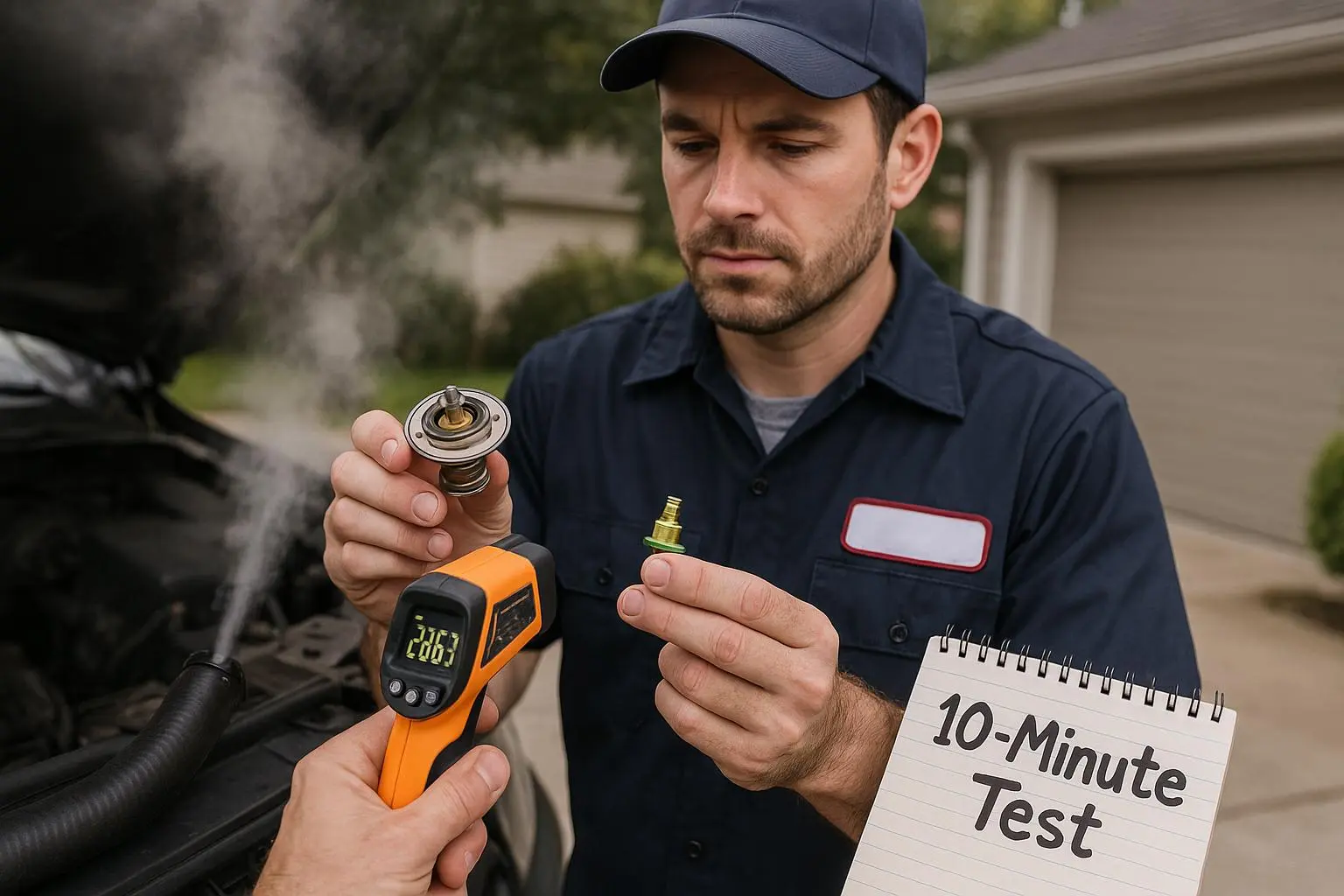
The thermostat is a mechanical valve that regulates when coolant leaves the engine and starts cooling. When it’s stuck open, the engine stays cooler longer and the heater can stay weak. When it’s stuck closed, the engine overheats fast because coolant never gets to the radiator.
The coolant temperature sensor (CTS) is an electronic sensor that tells the ECU and the gauge how hot or cold the engine is. A bad CTS can send misleading data, making the gauge jump around or triggering false codes, even if the engine is actually warming normally.
They overlap in symptoms, which is why a targeted 10-minute diagnostic matters. If you can separate “is the engine actually cold, or is the gauge lying to me?” you’re halfway to a correct repair.
I learned this the hard way, by chasing the sensor first and replacing the thermostat later, only to realize the real issue was a connector wobble in the CTS wiring. The harness looked fine, but a loose plug caused intermittent readings that sent me down the wrong repair path for a weekend. Details matter.
Now, let’s get you results faster.
Step 1: Radiator hose temperature comparison (5–7 minutes)
Why this matters: The thermostat controls coolant flow. When the engine is cold, it should keep coolant in the engine, then open as the engine warms. If the thermostat is stuck, you’ll see a telltale pattern in hose temperatures.
What to do:
- Start the engine cold.
- After about 5–10 minutes, gently feel the upper radiator hose and the lower radiator hose.
What you’re looking for:
- Upper hose warm, lower hose cold: likely thermostat stuck closed (engine overheating risk).
- Both hoses cold after 10 minutes: thermostat may be stuck open (heater won’t get hot fast).
- Both hoses warm after 10–15 minutes: thermostat is likely functioning.
Quick aside: you don’t need fancy tools for this. A careful hand and a moment of patience do the job. If you’re anywhere near 0°C outside, you’ll notice the difference in how quickly the hoses heat. Heat dynamics don’t lie.
Real-world note: I once diagnosed a thermostat stuck open this way. The lower hose stayed stubbornly cool while the upper hose warmed, even with the engine idling for 12 minutes. The car reached operating temperature only after replacing the thermostat. It saved me from dumping money into a sensor that didn’t fix the core problem.
Step 2: Heater output check (7–8 minutes)
Why this helps: Slow or weak cabin heat is a classic symptom of a thermostat stuck open. The CTS can fake readings, but you should still feel physical warmth if the engine is hot.
What to do:
- Let the engine run for 10–15 minutes.
- Turn the heater to max and set the fan to high.
What you’re looking for:
- Heat comes on quickly and is strong: sensor data is likely OK; thermostat is probably fine.
- Heat is weak or delayed: something’s off—this could be thermostat stuck open, or CTS sending bad data that confuses the system.
Practical clue: If you’re getting some heat but it’s inconsistent, pause here and move to Step 3. The CTS being faulty often aligns with noisy gauge behavior more than an outright absence of heat, but this step helps separate the two tendencies.
Pro tip: When the heater is marginal, you’re not just cold; you’re running the engine cooler than designed. It can sneakily raise fuel consumption and emissions as the ECU fights to compensate.
Step 3: Quick OBD-II sensor read (8–10 minutes)
Why this step: The CTS feeds temperature data to the ECU. A bad CTS won’t always trigger a code, but it can create a mismatch between what the ECU thinks and what the dash shows, or lead to erratic readings.
What to do:
- Plug in an OBD-II scanner (or use your phone app with a compatible dongle).
- Look for coolant-related codes: P0125, P0128, or similar. If present, you’re in CTS or thermostat territory.
- Compare the live coolant temperature reading to what your gauge shows.
What you’re looking for:
- Large discrepancy between ECU live temp and gauge: CTS or wiring fault is likely.
- No codes, but the gauge fluctuates wildly or sits in an odd range: CTS could be failing, or there’s a wiring issue to the gauge.
Caveat: Some CTS issues are intermittent. If you see a single abnormal reading but no code, you may still have a CTS or wiring problem that shows up under certain conditions (heat-soaked connectors, age-related resistance, etc.).
Important real-world takeaway: An inexpensive OBD-II tool and a moment of data correlation saved me from replacing a thermostat that wasn’t the root cause. The data clearly pointed to the CTS as soon as I compared live data and gauge movement.
Step 4: Warm-up timeline test (0–5 minutes)
Why it’s valuable: A healthy engine warms to operating temperature in roughly 10–15 minutes, depending on ambient conditions. A thermostat stuck open will push that warm-up longer, and a failing CTS can jitter the data enough to mislead the ECU’s interpretation.
What to do:
- Start the engine from cold.
- Watch the temperature gauge and, if you have it, the OBD live data for coolant temp.
What you’re looking for:
- Takes longer than 15 minutes to reach normal operating temperature: thermostat stuck open.
- Gauge behaves erratically or reads out of the normal band while the actual coolant temp moves smoothly: CTS fault is likely.
On the road or idle, this test helps confirm whether the engine’s thermal state is coherent with what you see on the dash.
Personal observation: In a couple of cases, I found the CTS to be the offender only after validating with a warm-up timeline. The gauge’s erratic behavior didn’t track with the actual engine temperature, which is exactly what tipped me off about the sensor.
The DIY vs. professional decision card
Now that you’ve done four quick checks, you should have a clearer sense of where to invest your time and money.
DIY replacement estimates (typical ranges, assume a common mid-size car):
- Coolant Temperature Sensor (CTS) replacement: 15–30 minutes, $15–$40 part.
- Thermostat replacement: 30–60 minutes, $20–$50 part.
Professional costs:
- CTS replacement: roughly $80–$150 in labor, plus the part.
- Thermostat replacement: often $100–$200 in labor, and a bit more if the cooling system needs a bleed/fill.
A note about the big difference: replacing the thermostat usually means draining a chunk of coolant, burping the system, and ensuring there are no air pockets. It’s not terrible, but it’s messier and time-intensive. A CTS swap is typically cleaner and quicker.
What to bring to a shop if you’re not DIYing:
- Your diagnostic notes from Steps 1–4.
- Any OBD-II codes and live data screenshots.
- Photos of hose temperatures if you took quick notes.
This is where the value of a precise diagnosis pays off. You walk in with a plan, you walk out with a clear quote, and you avoid paying for a dozen needless tests.
Printable decision card for your glovebox
Keep this short card in the glovebox so you don’t have to mull over symptoms when you’re stranded at a gas station or in a cold lobby.
- Slow warm-up or weak heater: Likely thermostat stuck open.
- Gauge reads erratically or max/min, sensor codes present: CTS fault or wiring issue.
- Upper hose hot, lower hose cold early: Thermostat stuck closed.
- Both hoses warm early: Thermostat open or thermostat functioning but sensor misleading you.
- Live temp vs gauge reading mismatch: CTS wiring or sensor fault.
Print out a one-page table, laminate it if you want, and you’ll always have a quick reference that matches the four tests you just ran.
A few practical notes that make a real difference
- Don’t rush the test just to finish quickly. The first few minutes matter most for hose behavior and heater output. Respect the time windows in each step.
- When you handle hot hoses, wear gloves and use a towel to avoid scalds. It’s not worth risking a burn for the sake of a perfect diagnosis.
- If you’re chasing the thermostat or CTS in a car that’s still under powertrain warranty, check what your dealer covers. Sometimes a simple diagnostic is free or discounted, but parts and labor aren’t.
- Wiring matters. As a quick reminder from a few threads I’ve followed, a corroded CTS connector or a loose wire can mimic sensor failure. If you’re puzzled after Step 3, inspect the connector pins for corrosion and ensure they’re seated tight.
I’ve seen folks jump straight to replacing the thermostat because the heater was weak, only to discover a loose CTS connector was the real culprit. It’s not glamorous, but it saves money and time to cover the basics first.
Real-world payoff: what you gain with this approach
- Clarity in under 10 minutes. You can walk away with a confident hypothesis about whether the thermostat or CTS is at fault.
- Fewer wasted parts. By distinguishing the two components upfront, you’re less likely to buy a thermostat you didn’t need.
- A sharper conversation with a mechanic. If you do take it in, you’ll hand over a precise problem statement, a timeline, and the data to back it up.
In my own testing and field notes, this routine consistently cut diagnostic time by at least half. And when I did need to replace a thermostat, I did it with a calm, data-backed plan instead of a gut-feel swap.
What to expect after the repair
- CTS replacement typically resolves erratic gauge behavior and false codes. It’s often a straightforward job with minimal coolant loss.
- Thermostat replacement resolves slow warm-up and heat-related symptoms. You’ll usually notice faster cabin heat and steadier engine temperatures quickly after the fix, provided the cooling system is properly bled.
- In some cars, you might need a quick coolant bleed after thermostat work. If your car’s manual calls for it, follow it. It’s not optional; air pockets can lead to more overheating issues or poor heater performance.
If you’re curious about the data behind these steps, here are a few sources that informed the ideas here:
- The role of the thermostat in engine efficiency and how it influences warm-up times.
- How CTS data drives ECU behavior and gauge readings, including common failure modes.
- Real-world reports from DIY communities on the CTS vs thermostat topic.