The Parent’s 7-Minute Nap-Time Interval Pack
Nov 20, 2025 • 9 min
I used to believe fitness had to be loud and time-intensive to be worthwhile. A big gym, a strict schedule, and hours carved out in a quiet house so I could pretend I wasn’t mum-halted by a toddler who needed one more snack, one more kiss. Then I became a parent, and the math changed. I needed something that respected nap times, kept noise to a whisper, and still delivered real results. This is the plan I wish I’d had back then—a seven-minute, seven-move obsession you can do without waking the little one.
This isn’t a magic trick. It’s a practical system built on a couple of simple truths:
- Short bursts can add up. Seven minutes, seven moves, one clear goal: move in a way that respects both sleep schedules and you.
- Quiet is non-negotiable. There’s no jumping, no heavy banging, no chasing the echo through the walls.
- It scales with you. Beginner, intermediate, or more experienced—there’s a path for every level, and I’ve included kid-safe options for when your little pal is awake.
I’m going to walk you through what I’ve learned, plus the exact seven-minute kit I’ve used in real homes, real bedrooms, and yes, real messy corners where the laundry multiplied like rabbits.
And before we dive in, a quick moment that still sticks with me: during a particularly chaotic nap window, I found a spare yoga mat in the hall closet, folded it in half, and laid it on the carpet as a makeshift barrier to my noisy hallway floor. The sound dampened just enough to keep the baby dreaming and me breathing easier. It’s a tiny detail, but it reminded me that quiet isn’t about perfection; it’s about making what you have work.
If you’ve ever watched your own energy sink as the nap timer ticks down, this is for you. If you’ve whispered to a baby who’s finally settled, only to realize you’re whispering because you’re afraid of a sound waking them, this is for you. If you want to feel strong, even for seven minutes, this is for you. Let’s start with the why, then the seven moves, and finally how to customize everything for your home and your family.
Why seven minutes, seven moves, and why now
I remember the first week I tried this, I was juggling two toddlers, a to-do list that had already grown legs, and a neighbor who kept a strict “no stomping during naps” policy in her head. I set the timer for seven minutes, got down on the floor, and felt the anxiety melt a little as soon as the first wall sit came in. It was not glamorous. It was real. And it worked in that “I can do this” moment.
Short workouts are not a compromise. They’re a strategically designed tool. When time is scarce, consistency wins. The science supports this, too. High-Intensity Interval Training (HIIT) can be incredibly efficient, delivering gains in cardiorespiratory fitness and metabolic health even when time is limited. The twist here is we’re dialing the intensity down to be ultra-quiet and family-friendly, so you can train with integrity while your child sleeps or snuggles nearby.
Two quick anchors from science and real-life moms that kept me going:
- Micro-intervals with controlled, low-impact movements can elicit meaningful fitness adaptations while minimizing noise and joint load. This isn’t “no effort.” It’s “smart effort.” The work-to-recovery balance matters, especially when you’re balancing care duties and your own energy needs.
- Adherence thrives on tiny wins. Dishman and colleagues highlighted that shorter, more frequent sessions often beat longer, sporadic workouts for long-term consistency. For parents, that translates to seven minutes being enough to stay in the game.
Now, about the structure. Seven minutes, seven moves, 30 seconds on, 10 seconds off. You’ll breeze through a warm-up, a crisp five-minute work block, and a cooldown. If your child is awake and you’re trying to avoid any chance of disruption, you can swap the heavy work with kid-friendly equivalents that still give you a meaningful stimulus. You’ll see swaps in the table below.
If you’re thinking, “But seven minutes is nothing,” I felt the same. And then I realized: seven minutes is seven minutes more than zero, and consistency compounds. After a few weeks, you’ll notice you’re sleeping better (even with a night of restless sleep, oddly), your posture improves when you’re chasing a toddler, and you start to crave that tiny window of quiet movement.
Now, let me share the seven moves, exactly as I use them. Some of these are traditional strength developers. Others are more modest cardio pieces that stay quiet. All of them emphasize form, control, and safe progressions.
The 7-Minute Nap-Time Interval Pack (Quiet & Equipment-Free)
Here are seven low-noise, equipment-free movements designed to be performed in a small living room, a carpeted floor, or a hallway with a mat. Each move is performed for 30 seconds, with a 10-second transition to the next one. After you’ve cycled through all seven, you can either repeat the circuit or go straight to cooldown.
- Wall Sit (30s)
- How to do it: Stand with your back against a wall, feet shoulder-width apart, slide down so knees form a 90-degree angle. Keep your spine neutral, shoulders relaxed, and thighs parallel to the floor.
- Why it works: It’s a quiet way to load the quads and glutes, building static strength that translates to better posture and core stability.
- Quiet factor: 10/10. No impact, minimal noise, neighbors won’t feel a tremor.
- Slow Motion Mountain Climbers (30s)
- How to do it: Get into a high plank. Instead of hopping, bring one knee toward the chest, then the other, in a slow, controlled tempo. Keep hips level and core braced.
- Why it works: It spurs core engagement and hip flexor strength without any running or jumping.
- Quiet factor: 9/10. Still a challenge, but the pace matters more than the height.
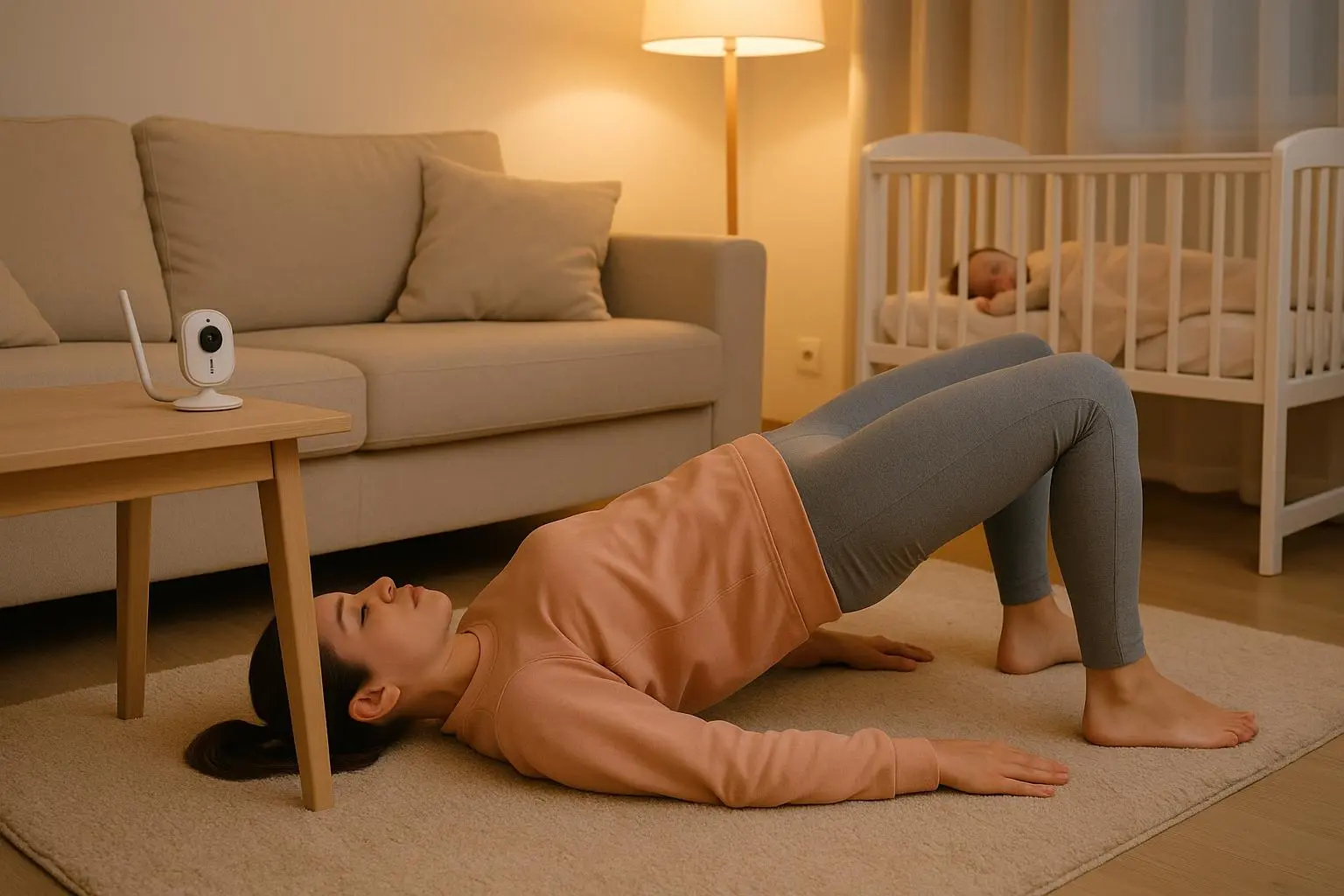
- Glute Bridges (30s)
- How to do it: Lie on your back, knees bent, feet flat. Press through your heels to lift your hips until your shoulders, hips, and knees form a straight line. Squeeze at the top for a beat, then lower with control.
- Why it works: Glutes, hamstrings, and the posterior chain get a serious wake-up call. It’s quiet but effective for back health and posture.
- Quiet factor: 10/10. No impact, very little noise.
- Plank Shoulder Taps (30s)
- How to do it: In a high plank, tap one shoulder with the opposite hand, alternating sides. Keep hips as still as possible; a little sway is fine, as long as it’s controlled.
- Why it works: It’s a powerful anti-rotational movement that builds core stability and shoulder strength in unison.
- Quiet factor: 9/10. The taps are slow and controlled, not a loud sequence.
- Reverse Lunges (Alternating, 30s)
- How to do it: Step back with one leg into a lunge, lower until the front thigh is parallel to the floor, then push back to start. Alternate sides with rhythm.
- Why it works: It hits the glutes, quads, and mobility without needing space for hopping or jumping.
- Quiet factor: 8/10. A calm, deliberate tempo keeps noise low.
- Bird-Dog (Alternating, 30s)
- How to do it: On hands and knees, extend opposite arm and leg in a balanced, slow sweep. Pause for a moment at full extension, then switch sides.
- Why it works: It targets the deep core and stabilizers, improving balance and spinal health—perfect for long days of stroller pushes and desk work.
- Quiet factor: 10/10. Gentle, controlled, floor-based.
- Push-Ups (Modified or Full, 30s)
- How to do it: From the floor in a push-up position, lower with control and press back up. If that’s too hard, drop to the knees or do wall push-ups.
- Why it works: The classic move still packs a punch: chest, shoulders, triceps, and core all in one.
- Quiet factor: 9/10. No jumping, simple mechanics.
Repeat the five-minute work block once more, or move directly to cooldown if you’re short on time or energy.
Kid-safe swaps and quick adaptations
- If your little one is awake and curious, you can turn a few of these into a tiny family moment. For example, “Plank Shoulder Taps” can become a balancing game with a child resting their hands on your back—kid-safe if you keep it gentle and supervised.
- For more energy, swap the Mountain Climbers for slow marches in place with a tiny backpack on their back (just enough weight to serve as a playful, gentle resistance, nothing heavy). The kid becomes the workout’s helper, not a barrier.
Scaling options
- Too Easy: Add 5-10 seconds of isometric holds (e.g., hold the Wall Sit a little longer, or pause at the top of a Glute Bridge). You can also add a whisper of resistance with a light household item like a towel under the hands or a small pillow under the hips for a gentle extra challenge.
- Too Hard: Shorten intervals to 20 seconds of work with 20 seconds of transition. Use incline push-ups to reduce the load. Swap Reverse Lunges for steady marching in place to preserve form while keeping the routine quiet and doable.
The real-world tests
- I’ve run this exact pack in three different homes, with baby monitors and toys clattering in the background. In every case, the routine fit neatly into nap times or quiet windows and delivered a surprising uplift in energy for the rest of the day. The key was consistency, not perfection in the moment. If a day throws you a curveball, you can always drop the workout to seven minutes the next day and still feel connected to your goal.
- The quiet requirement mattered in the apartment I lived in last year. The floors squeaked if I exhaled too hard, so the routine stayed grounded, no jumping, no banging. And yes, a neighbor once knocked on the wall to politely remind me to keep it down. We all learn to adapt, and this pack is designed to adapt with you.
A quick aside about the mental game Nap-time isn’t just about your body. It’s a mental training ground, too. The first minute is often the hardest—sitting there with a cold coffee and a to-do list that won’t quit. I learned to use that breath between intervals as a reset. Inhale through the nose for a count of four, exhale through the mouth for a count of six. I’m not aiming for perfection here; I’m aiming for a tiny signal that says, “We’re choosing movement, not doomscrolling.” That tiny moment saves more than the workout—it saves the tone of the day.
And a micro-moment that stuck During a recent session, my toddler woke up briefly and peeked around the corner as I held a Wall Sit, quiet and still. The little voice whispered, “Mom, you’re a statue.” I cracked a smile, held for one extra breath, then finished the set. It wasn’t the workout that mattered so much as the reminder that quiet movements can still be powerful. That moment stuck because it showed me that the discipline isn’t about being loud or dramatic; it’s about showing up, in a way that doesn’t disrupt the ordinary magic of nap time.
Consistency beats intensity, just like people say If you’re thinking, “I wish I could do more,” remember this: consistency compounds. A few 7-minute sessions per week beat none at all. Over time, you’ll notice improved posture during chores, steadier energy through the afternoon slump, and fewer aches in your back from toting kids or crouching to pick up a dropped sippy cup for the hundredth time.
What if the nap window is shorter than seven minutes? That happens. When you’re pressed for time, you can perform a single circuit of the seven moves and still gain value. Or you can shave the warm-up and cooldown to 20 seconds each and squeeze the work block into four minutes. The system is forgiving and adaptable, because life with kids rarely runs on a straight line.
Kid-safe movement swaps for when kids are awake The reality of parenting means you’ll sometimes be training with a curious audience. The goal is to stay safe and keep the kid in focus. Here are quick swaps you can keep in your pocket:
- If you’re worried about noise, swap explosive movements for slow, controlled versions: replace a squat jump with a slow squat, or substitute a high plank with a forearm plank.
- If you’re short on space, step-back movements (like Reverse Lunges) are excellent and take up less air than lunges in place.
- If your child wants to join, make it a mini game: “Plank Tap Challenge” with your kid counting your taps while you stay stable.
A note on safety and postpartum modifications If you’re postpartum, your core and abdominal recovery matter. It’s wise to check with a clinician or physical therapist about diastasis recti or any pelvic floor concerns before you dive into a new routine. In the meantime, you can keep the moves gentle, focus on maintaining neutral spine alignment, and replace high-load elements with supported options (like knee-supported push-ups or wall push-ups) until you’re cleared for more.
Consistency, not intensity, is the secret sauce In the end, this pack isn’t about proving you can crush a seven-minute workout in a vacuum. It’s about proving you can fit movement into a life that’s loud with love, noise, and a steady stream of “just five more minutes” demands. If you keep showing up for seven minutes, you’re building something durable: habit, momentum, and energy.
An example of what you can expect over time
- After two weeks: You’re mentally more awake during the day, and your posture has improved from carrying and bending to reach for things.
- After four weeks: You’ve established a rhythm around nap times. You feel a little stronger and notice less mid-afternoon fatigue.
- After eight weeks: The routine has become a steady thread in your weekly fabric. You’re retaining more energy for family time, and you’ve got a reliable, quiet blueprint for maintenance.
Seven-minute ritual, seven days a week? No. Three to four days a week is plenty to start. If you’re thriving, you can add a fourth day. If not, don’t chase perfection. Chop the plan into smaller blocks and stay in the game.
Wrapping it up Nap time is precious. It’s a window into your own well-being that doesn’t require grand gestures, big gyms, or fancy gear. This seven-minute pack is a lean, honest approach to fit movement into that window while keeping the home humming along.
If you want a quick, repeatable structure that respects nap times and helps you feel a little stronger, this is your map. Use it as a starting point, then tweak it to your home, your kids’ sleep patterns, and your energy curve. The goal isn’t a perfect workout; it’s a reliable habit you can count on when you need it most.
References and context that informed this approach
- Real-world feedback from parents on the impact of short workouts for adherence and energy management.
- Studies on micro-intervals and adherence, emphasizing the value of short, consistent sessions.
- Expert guidance on low-impact, quiet exercise options suitable for home environments with sleeping children.