The 7‑Day Mood‑Anchor Lab: Turn Fleeting Feelings into Lasting Micro‑Habits
Nov 24, 2025 • 9 min
You know that tiny moment when boredom or stress arrives and you do the thing you later regret? That exact moment is the opportunity most people miss.
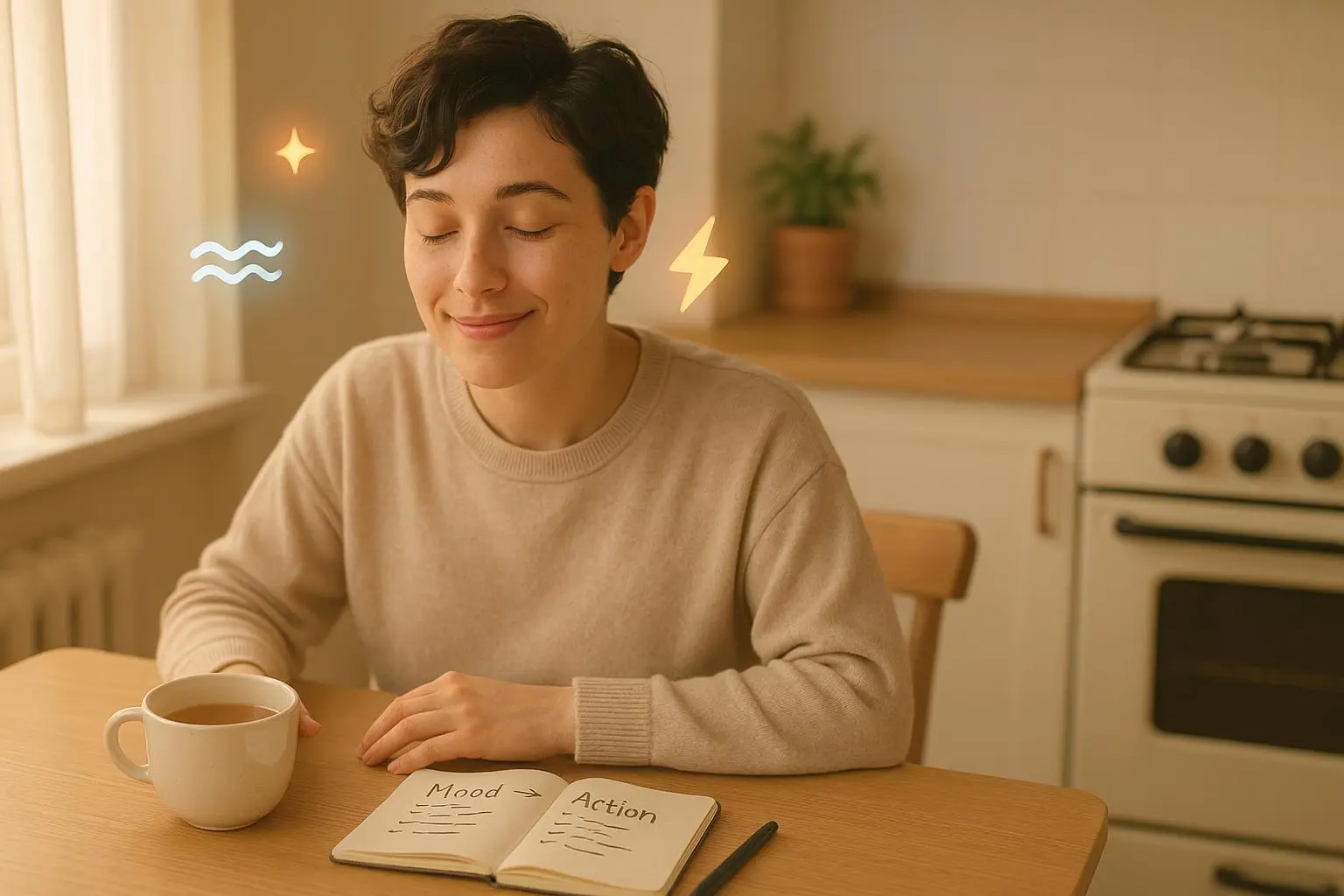
The Mood‑Anchor Lab is a short, practical experiment you run on yourself for seven days. Its job: turn those tiny emotional sparks—boredom, stress, relief, curiosity—into 60–120 second micro-habits that become your new default. No long meditations. No moralizing. Just tiny, repeatable actions and a clean way to test what actually sticks.
Here’s how to run it, what to watch for, and the exact scripts (if‑then templates) I use with clients. I’ll also show the ethical guardrails so you don’t accidentally train yourself to avoid feelings you actually need to feel.
Why this works (short version)
Two things make this sticky:
- Micro-habits are tiny enough your brain doesn’t fight them (think BJ Fogg's Tiny Habits).
- Emotional anchoring uses the mood itself as the cue—so you don’t need an external reminder. You already have the trigger.
Combine them and you get: If I feel X, then I do Y (Y = 60–120 seconds). Repeat. The brain rewires the link from mood → automatic behavior. Over time, that new behavior becomes the go-to.
Quick ethics note: respond, don’t exploit
This lab is about responding to moods with care, not avoiding or exploiting pain. If someone is in serious distress or the mood signals a problem (e.g., suicidal thoughts, addiction triggers), micro-habits are not a replacement for therapy or safety planning. Use tiny actions to regulate—not to anesthetize.
Here's the distinction I use with clients: the micro-habit should give you a breathing space or a tiny pivot, not a complete escape. If your response is "If stressed, then scroll"—that's a red flag. If your response is "If stressed, then box-breathe for 60 seconds," that's a tool.
The lab in one line
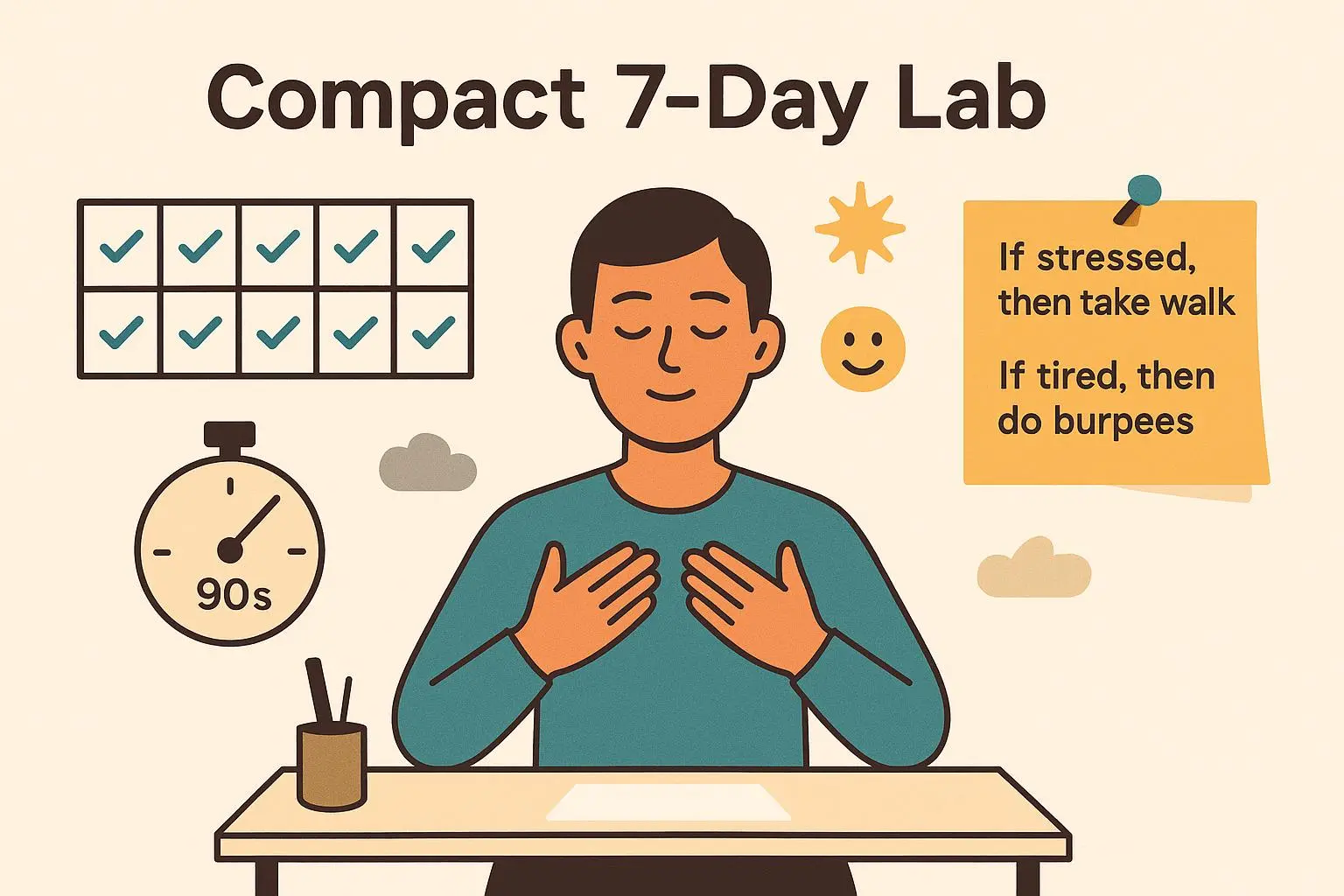
Observe for two days. Experiment for three. Refine for two. Track everything on a one-line sheet.
Day-by-day playbook (exact scripts and templates)
Below are the scripts I give people. Copy-paste them. Modify one word. Do not overcomplicate.
Day 0 prep (10 minutes)
- Choose a single tracking method: tiny notebook, a line in your phone notes, or Daylio app.
- Pick 2‑3 moods you see often (boredom, stress, curiosity, relief). Start small.
Days 1–2: Observe — become a mood scientist Script: "Today, when I notice [mood], I will write down: time, what happened just before, my usual impulse."
Example note: "12:04 — bored after finishing slide deck. Usual impulse: open Instagram."
Do this without judging. We’re collecting raw data.
Days 3–4: Pair mood → 60–120s micro-habit (the first experiment) Use the exact if-then template:
- IF I feel [mood], THEN I will [micro-habit for 60–120s].
Keep these habits as tiny as possible. If you think it’s too small, it’s fine. Smaller beats ideal when you want consistency.
Sample anchors (copy exactly):
- IF I feel BORED after finishing a task, THEN I will close my eyes and do 5 deep breaths (60s).
- IF I feel STRESSED after a call, THEN I will stand, roll my shoulders, and stretch for 90s.
- IF I feel RELIEF after completing something big, THEN I will write one gratitude sentence (60s).
- IF I feel CURIOUS about something, THEN I will open one article or one lesson for 60s.
Success signal: You executed the micro-habit. That’s it. Not “I felt better,” not “I finished a course.”
Failure diagnostic (fast): If you didn’t do it, ask:
- Was the habit too long? Shorten it.
- Did you forget? Add a simple retrieval cue (e.g., place a sticky note on your desk).
- Did the mood overwhelm you? Make the habit even smaller or pair it with a physical motion (stand up + 30s breathing).
Days 5–6: Refine and expand
- Review your log. Keep the anchors that hit 60–70% success. Tweak the ones that hover at 20–30%.
- Add one positive emotion anchor (relief, joy). Positive anchors reinforce habit identity: "I am someone who celebrates small wins."
Script for day 5: "Today I will adjust any micro-habit that felt 'too much' and commit to one new positive anchor."
Day 7: Review and plan forward
- Tally successes vs attempts.
- Decide which anchors go to “keep,” which get “change,” and which get “drop.”
- Set a simple plan: keep up the winning anchors for another 21 days, then reassess.
Tracking sheet (one-line per attempt)
- Time | Mood | Old impulse | Micro-habit | Outcome ✓/✗ | Note Example: 12:04 | Bored | Scroll | 5 breaths | ✓ | Felt calmer, 30s enough next time
Exact scripts you can paste into your notes
Pick your moods, paste these, and use them for days 3–4.
- IF I feel BORED after finishing a task, THEN I will do 5 deep breaths with my hand on my belly (60s).
- IF I feel STRESSED after a difficult interaction, THEN I will stand, do 90s of shoulder rolls and neck stretches.
- IF I feel CURIOUS, THEN I will open a learning app or one article for 60s to follow that curiosity.
- IF I feel RELIEF after completing work, THEN I will write one line of gratitude on my phone (60s).
- IF I feel ANXIOUS before starting something, THEN I will count my breath to 10 slowly (60–90s).
If one fails, shorten it. If two fail in the same way (e.g., you forget), add a physical prompt: a rubber band on your wrist, a sticky, or a phone widget.
A quick story — the time I hacked my afternoon doom-scroll
Two years ago I had the afternoon doom-scroll problem. After lunch I’d doom-scroll for 20–40 minutes, feel bad, and then try to willpower my way out. Predictably, I failed.
I tried the Mood‑Anchor Lab on myself. Day 1 I tracked: 14:05 — bored after lunch — usual impulse: scroll. Day 3 I set: IF bored after lunch, THEN walk to the kitchen sink and wash one cup slowly (90s). It sounds silly, but the motion and the tiny task created a physical breakpoint. Washing one cup took me out of my chair, gave me a tactile focus, and the act of finishing one small task broke the momentum.
Within three days the urge to scroll dropped by half. Within two weeks, I was using the same anchor to transition into a short walk or a 60‑second stretch. The micro-habit never made me enlightened, but it removed the automatic scroll and gave me a choice. That felt like owning a small, useful piece of my day.
Micro-moment: I still remember the sound of the water in that sink—soft, regular—like a tiny metronome reminding me I could choose something else.
What to expect: success signals and failure diagnostics
Success signals (early wins)
- You do the micro-habit without mental debate about “should I?”
- The old impulse weakens (you notice it, and it passes).
- You start adding small, related habits (stacking).
Failure diagnostics (how to fix common fails)
- "I forgot." → Make the habit shorter or add a physical cue.
- "The mood is too strong." → Use an even faster electrical anchor: 30s of grounding (feet on floor, 5 breaths). If emotions are clinical, seek support.
- "It feels pointless." → Swap the action for something that gives a tiny reward: movement, sensory grounding, or a note of accomplishment.
If you find the lab feels like "more effort to track than just dealing with it," try one of two things:
- Reduce tracking to a single daily tally: number of successful anchors that day.
- Add social accountability: tell one friend you’re testing this for seven days and ask for one check-in.
Long game: after the 7 days
If two or three anchors stick, nurture them. The goal isn't to have a dozen anchors—it’s to have reliable, healthy defaults for your most frequent moods.
Ways to sustain:
- Stack anchors into routines. Example: After lunch (time cue) + feeling bored (mood cue) → 60s walk.
- Move successful anchors into a simple habit tracker (Streaks, Daylio) and celebrate small streaks.
- Revisit every 30 days and trim anchors that feel automatic.
Tools that make this easier
You don’t need apps, but they help:
- Daylio for quick mood logging.
- Streaks for celebrating consistency.
- Notion or a simple note for the one-line tracking sheet.
Pick one tool and use it for the week. No switching.
Final note — be kind to the process
You won’t fix every knee‑jerk response in seven days. The goal is curiosity and experimentation: watch what habits your moods want to make you repeat, then try steering them gently.
If you’re skeptical—good. Approach this like a mini experiment. Try it for seven days. If one anchor helps you skip a regrettable habit even twice a week, that’s progress. Put another way: the only bad outcome is not learning anything.
Ready to try? Pick one mood and one micro-habit right now and write the if‑then sentence. Do it. That first tiny action is the whole point.