The 60-Second Feeding Pause
Mar 6, 2026 • 6 min
You’ve warmed the milk, checked the nipple, and your hands are barely dry from rinsing bottles when—boom—the baby fusses. You do the thing: shuffle faster, juggle the bottle, hope for the best.
Here’s what I learned the hard way: you can’t bolt calm onto exhaustion. But you can build a tiny habit that reliably shifts you out of autopilot—without adding time, equipment, or pressure. The 60-Second Feeding Pause is that habit. It’s one minute, done while you prepare a bottle or warm milk, that uses paced breathing, a tactile anchor, and a single-sentence intention to bring presence and safety into feeding.
This isn’t woo. It borrows from paced bottle-feeding practices and proven breath techniques to help parents reduce stress and improve connection in a realistic, repeatable way.
Why a minute matters
New parent time is brutally compressed. Long meditations are a fantasy when you’ve got a hungry human on a half-hour clock.
But physiology doesn’t need long stretches to change. Three slow breaths can lower your heart rate and cue your nervous system to relax[1]. A brief tactile focus pulls attention from racing thoughts to one reliable reality: the bottle in your hands. And a short intention—“I am here for this baby”—reframes the task from mechanical to relational.
Do that consistently, and small wins add up: calmer bottle prep, fewer tense feeds, and a little more awareness of the person you’re feeding (yes, the tiny one).
How I actually made this work
A year ago I found myself rushing midnight bottles with a mug of lukewarm coffee in one hand and resentment in the other. One night I set a timer for 60 seconds—just to see if pausing made any difference. I took three slow breaths, held the warm bottle for a few seconds, and said quietly, “This is for both of us.” The next feed felt softer. The baby fed without fussing as much. I’ve repeated that pause hundreds of times since.
Three concrete things changed for me: I noticed feeding cues sooner, I responded with less irritation, and the task itself felt like a sequence I owned instead of a machine I was running. Small practice, measurable outcome.
Micro-moment: once, the bottle had a nick in the nipple ring. Holding it in my palm during the pause, I felt the defect, fixed it, and avoided a leaky feed—tiny presence, immediate payoff.
The 60-Second Feeding Pause: step-by-step
Do this during the minute you’re already spending making or warming the bottle.
- Paced breathing (30 seconds)
- Breathe in for 4 counts, hold 1, exhale for 6.
- Repeat 3–4 times. Keep your shoulders soft.
- You’ll notice your heart rate slow and your mind settle[2].
- Tactile anchor (15 seconds)
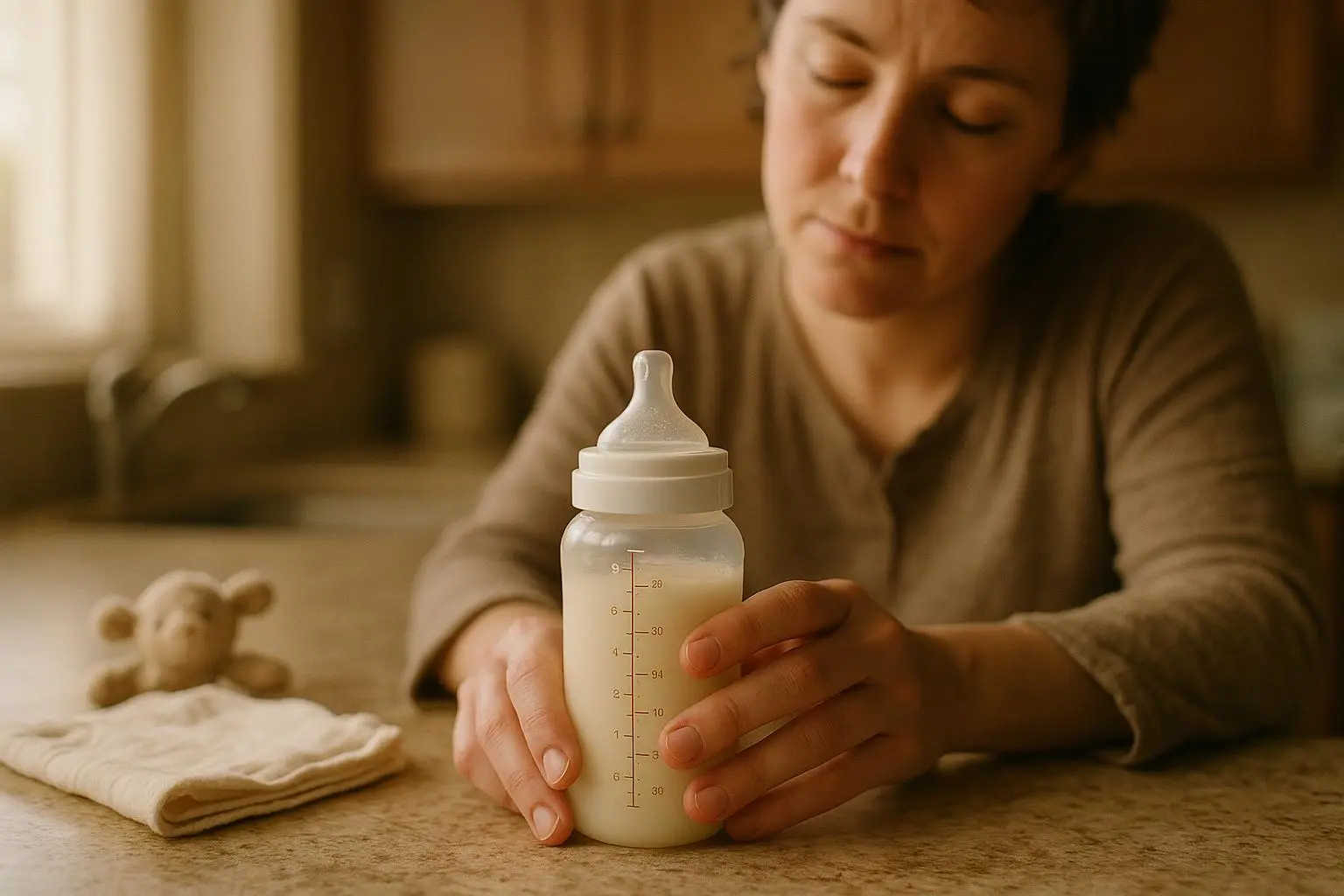
- Hold the bottle. Feel its weight and temperature.
- Notice texture, how the warmth spreads across your fingers.
- Let your attention be on sensation, not the next thing on your list.
- Intention setting (15 seconds)
- Say one short sentence silently or softly: “I am here for my baby,” or “May this feed nourish us.”
- Think of it as setting the tone, not a prayer or a command.
Total time: 60 seconds. No extra gear. No one needs to be asleep or calm for you to do it.
Safety—don’t let mindfulness be a distraction
Mindfulness should support safe feeding, not replace safety steps.
- Always prepare formula and store breastmilk according to guidelines. Use fresh formula or properly stored expressed milk[3][4].
- Test temperature on your wrist—milk should feel close to body temperature[4].
- Use a slow-flow nipple for bottle feeds to mimic breastfeeding rhythm and reduce gulping[5].
- Position baby semi-upright and watch cues like turning away or slowing suckling to pause and burp as needed[6].
The pause happens inside those safety checks—you’re not skipping anything, you’re making the checks intentional.
Adapting this for different feeding journeys
This practice is designed to be flexible.
- Formula feeding: integrate the pause while scooping, shaking, or testing temperature. The bottle is your tactile anchor.
- Pumping/supplementing: use the pause while warming expressed milk or even while the pump runs. Hold the bottle or your chest as your anchor.
- Direct breastfeeding: adapt the tactile anchor—feel the baby’s warm cheek or the weight of their head, breathe through the latch, set the intention quietly.
Parents who supplement often tell me this helps them feel less like they’re “just providing milk” and more like they’re engaging in a shared ritual.
When it’s hard to remember
Yes—some nights you literally have 10 seconds. Here’s what works:
- Pin a sticker by the bottle station that says “60s Pause” or use a one-tap reminder in your baby app at feeding times.
- Pair the pause with an existing cue: every time you turn on the bottle warmer, do it.
- Start with just one breath for the first week. Consistency beats perfection.
If you’re sleep-deprived, even a single breath before placing the bottle in your baby’s mouth reduces the chance you’ll snap when they spill milk.
Copy-ready messages for reminders
Use these for push notifications, app reminders, or notes by the feeding station:
- “Take 60 seconds: breathe, feel the bottle, set your intention.”
- “Pause, breathe, connect—mindful moments start with the bottle.”
- “Warming milk? Try 3 slow breaths and the phrase: ‘I am here for my baby.’”
- “Quick reset: feel the bottle, soften your shoulders, and offer calm.”
Short, friendly, and doable—no preaching.
What you can expect after a month
People who stick with the pause report:
- Noticeable dip in feeding-related stress
- Smoother transitions into feeds (fewer panicked fumbles)
- More frequent moments of connection—small but meaningful
This is not a miracle cure for sleep deprivation or postpartum anxiety. But if you’re looking for one habit that actually fits into feeding without stealing time, this is it.
Final note
Parenting doesn’t get easier overnight. But you can change how you meet the hard parts. The 60-Second Feeding Pause isn’t about performance; it’s a small choice to be present, safe, and kind—to your baby and yourself—before the first sip. Try it tonight. If nothing else, you’ll have a minute where you slowed down on purpose. That minute matters.
References
Footnotes
-
Cleveland Clinic. (2024). Feeding your infant: How to prepare and store baby formula. Retrieved from https://health.clevelandclinic.org/feeding-your-infant-how-to-prepare-and-store-baby-formula ↩
-
Brown, R. P., & Gerbarg, P. L. (2009). The Healing Power of the Breath: Simple Techniques to Reduce Stress and Enhance Well-Being. Shambhala Publications. ↩
-
Abbott. (n.d.). The bottle-feeding tips you need to know. Retrieved from https://www.abbott.com/corpnewsroom/nutrition-health-and-wellness/the-bottle-feeding-tips-you-need-to-know.html ↩
-
Philips. (n.d.). Advice for bottle-feeding. Retrieved from https://www.usa.philips.com/c-m-mo/articles-bottle-feeding/advice-for-bottle-feeding ↩
-
Elhees. (n.d.). The ultimate guide to paced bottle feeding for your newborn. Retrieved from https://elhee.com/blogs/the-elhees-journal/the-ultimate-guide-to-paced-bottle-feeding-for-your-newborn ↩
-
Welia Health. (2024). Slow down baby: The art of paced bottle feeding. Retrieved from https://www.weliahealth.org/2024/03/slow-down-baby-the-art-of-paced-bottle-feeding/ ↩