Make Late Guests Feel Welcome: 5 Scripts to Re-Open the Conversation
Nov 25, 2025 • 9 min
The exact second someone pops back into the room—or back on the call—is a little electric.
You can let it hang and watch everyone stiffen. Or you can move. Gently. Fast. With a line that makes the person feel seen, not judged, and gets the conversation humming again.
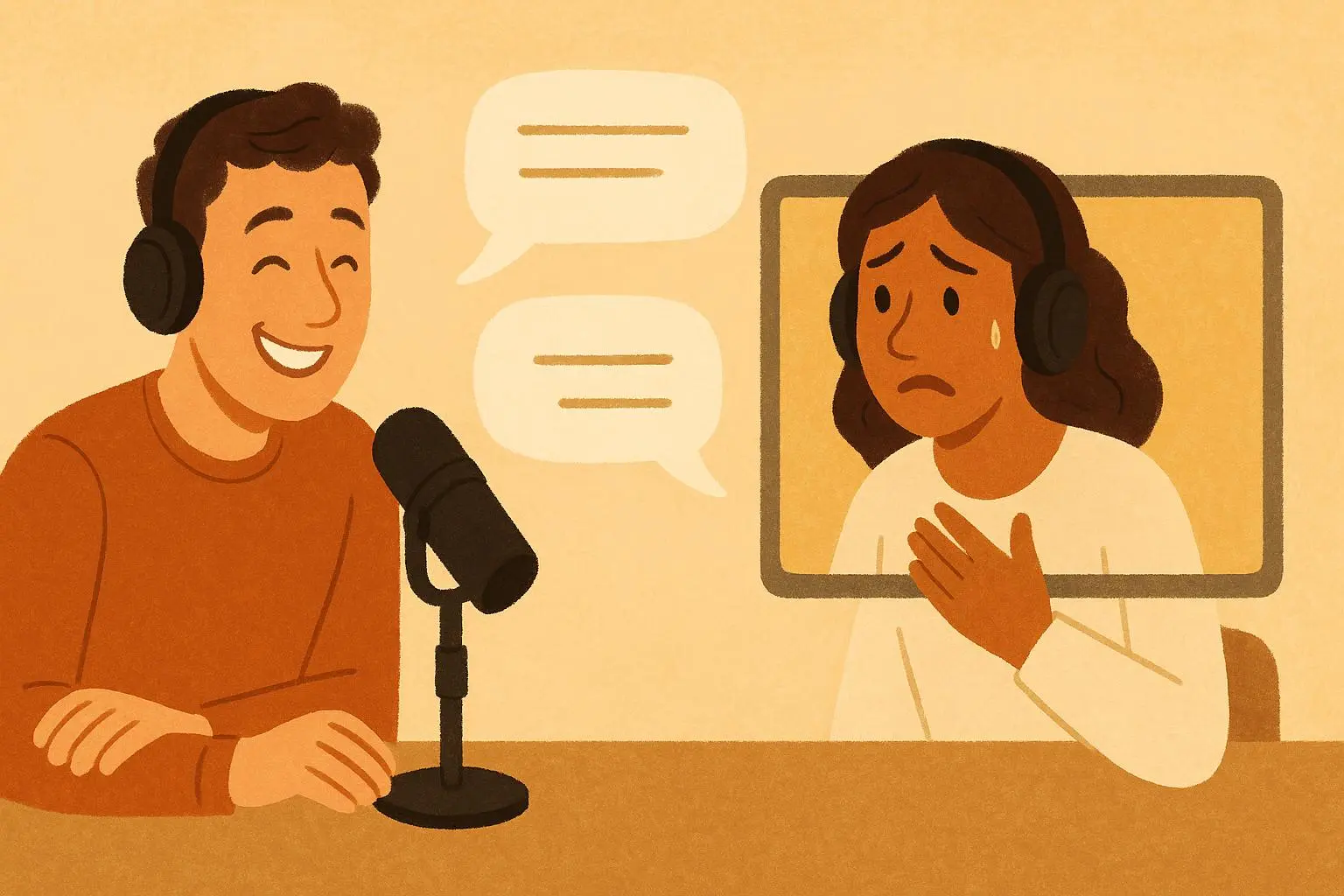
I wrote these five scripts because I’ve lost count of the times a guest came back red-faced after a Wi‑Fi wobble or a commute snafu and then stood there apologizing for 90 seconds. The show stalled. Energy died. Listeners shifted. The guest felt worse.
You don’t need to perform. You need a small, humane ritual that restores flow. Here are five precise, usable scripts—two for off‑air prep, three to use live—plus notes on what to keep, what to cut, and how to edit like a pro when things go south.
Why a script actually helps
Because hosts aren’t just moderators. We manage attention and emotion.
When someone returns late, they often default to apology mode: nervous, defensive, oversharing. That wastes time and gives the audience something they don't want: anxiety.
A short bridge—1–2 lines—is a permission slip. It says: you belong here, and we value what you bring more than the interruption.
Also: the audience doesn’t want the tech drama. They want the story, the insight, the joke. So we move back to value quickly.
Quick rules before you use any script
- Use the guest’s name. It humanizes the bridge.
- Acknowledge, don’t interrogate. No “Where were you?” or “What happened?”
- Offer a choice: recap or jump in. People like control when they feel flustered.
- Keep recaps under 15 seconds. Short recaps preserve momentum.
- If it’s a long interruption (over a minute), consider editing it out later.
1) Gentle Re-Entry (On‑Air) — the default go‑to
When you need something simple that sounds natural on air.
Script: “Hey [Name], welcome back — glad you could get back in. We were just talking about [topic]. Want a 10‑second recap, or jump straight in?”
Why it works: It frames the return as normal, offers agency, and sets an energy of readiness.
Editor note: If the co-host gives the recap, tell them: two lines, one sentence, “Here’s where we landed.” That keeps the momentum.
2) Quick Recap & Re‑Engagement (On‑Air) — for hot discussions
When the conversation has been moving fast and the guest needs context without slowing things down.
Script: “Quick version for you, [Name]: we’re debating whether [short premise]. Biggest point on the table is [1‑line idea]. What’s your take?”
Why it works: It gives orientation + immediate invitation. That combination reduces the guest's impulse to apologize.
Micro-moment: I always tuck a tiny confirmation at the end—“Does that track?”—and the guest nods. It’s 3 words that stop a 5-minute apology.
3) Sensory Prompt (On‑Air) — great for storytellers
When the guest had a narrative or personal anecdote interrupted.
Script: “Welcome back, [Name]. You were describing [scene detail]. What was the first thing you noticed when that happened—the sound, the smell, the sight?”
Why it works: Sensory prompts pull memory through emotion, not rote recall. People can answer quickly with a vivid image, and you jump right into the texture of the story.
User insight: Storytellers say this is gold. When you’re flustered, facts become fuzzy; senses are sticky. Use that.
4) Off‑Air Check‑In (Before Going Live) — private and trust-building
Use this one quietly, in the chat or on a quick call, before you bring them into the mics.
Script (whisper or DM): “No problem at all — we’re just starting. Want me to give the two-minute version of where we are, or do you want to dive in when I call you?”
Why it works: You give the guest control and reduce performance anxiety. They’ll appreciate the calm, and you’ll avoid a public apology spiral.
Editor note: If they choose a recap, give a crisp, time‑boxed summary. If they prefer to jump in, give them a quiet signal when it’s their moment.
5) Storytelling Jumpstart (On‑Air) — when you want authenticity
When you want the guest to orient through something personal, and you want an answer that’s immediate and human.
Script: “Since you just arrived, tell us one small thing that’s been on your mind lately—work, life, or something that happened on the way here.”
Why it works: Open-ended but focused. It validates their perspective and produces genuine content fast.
Pro tip: Follow with a one-sentence echo of what they said. Echoing is a powerful cue that their voice matters and the conversation is back in sync.
Editing strategies — the editor’s safety net
Sometimes the best welcome is invisible.
If a guest’s re-entry includes long apologies, “Can you hear me?” loops, or multiple starts and stops, trim ruthlessly in post-production.
Two practical techniques:
- Replace the messy audio with a 2–3 second musical sting, then cut to the guest's next coherent sentence.
- If the guest must say something on return, have them record a short, clean “Thanks for your patience” and edit the rest. Keep the moment human, but concise.
Audio engineers I know routinely cut 30–60 seconds of tech chatter. Listeners prefer seamless flow. Be kind to them.
When to skip welcoming them back
There are times you don’t want to interrupt the current speaker. Use judgment.
If the late arrival is a brief, sub-10 second appearance in a long meeting and the current presenter is mid‑explain, let it be. You can do an off‑air check-in at the next break.
If the group momentum is high and pausing would cost more than the inclusion, defer. But offer the guest a moment to comment at the next natural pause.
A real story: what I learned the hard way
A few years ago I was co-hosting a live panel. One guest, call her Lina, dropped out mid-story because her kid needed attention. She came back five minutes later, breathless and apologetic. I panicked and said, “Okay, tell us what happened,” trying to be conversational.
She launched into a long apology and then attempted to restart her story from the top. The audience cooled. My co-host and I were scrambling to stitch the thread back together. At the break, a listener told me it felt uncomfortable.
So we tried something different the very next week. When a guest reconnected, I said: “Lina, great to have you back. You were in the middle of this moment—what’s the first image that stays with you?” She answered in one vivid line and we were off. The show felt alive. Lina sounded relaxed. The listener emails were warmer.
Outcome: Two small changes—stop inviting apologies, and use a sensory entry—saved minutes of awkwardness and improved the show's pace. We started standardizing the approach for every return.
Tiny details that matter (the micro-moment)
Always pause for one half-second after you invite them back. It gives the guest permission to breathe and choose to jump in. That tiny silence is a kindness—and it keeps them from blurting out an apology.
Adapting for different settings
- Virtual meetings: Use the collaborative recap. Ask a teammate to paste 2–3 bullet points in chat. Quick, visible context saves time.
- Live events/stages: Use the sensory or storytelling jumpstart if the guest is returning from offstage. It helps them re-enter the performance.
- High-energy groups: A light joke or personal aside can humanize the moment. But keep it friendly, never mean.
- Recurring late guests: Address patterns privately. One-off scripting helps; chronic lateness needs a calendar or logistics fix.
What to keep and what to trim (editor notes)
Keep:
- The guest’s name.
- Short, neutral acknowledgment.
- A clear choice (recap or jump in).
- A 1-line recap, max.
Trim:
- Long apologies.
- Host-to-host meta-discussion about the tech.
- Overly detailed replays of what was missed.
A short checklist you can memorize
- Name. Check.
- One-sentence orientation. Check.
- Choice offered. Check.
- Invitation to speak. Check.
- Pause to let them choose. Check.
You can memorize that in a minute and it will save you embarrassed minutes on stage.
Handling a guest who’s late and unprepared
If they’re late and say, “I don’t have anything ready,” use this: “Cool — we were just talking about [topic]. What’s one small idea you’d want the audience to leave with about that?”
It’s gentle and gives them a task small enough to do on the fly. It reduces the “I’m unprepared” paralysis.
Final thought: it’s not about perfection
Your goal isn’t to manufacture flawless radio. It’s to make space.
A warm, short script transforms a cringe moment into a human one. It tells the guest, the co-hosts, and the audience: this is how we include people here.
Practice one of these lines until it sounds like your voice. Use the off‑air check when possible. And when you edit, be merciful to the listener and fair to the guest.
A little preparation turns an awkward interruption into a demonstration of good hosting—and that’s the real skill.