Local Listener Engine: Geo-Targeted SEO & Promo Tactics
Aug 16, 2026 • 9 min
If your podcast is stuck at the edges of local discovery, you’re not alone. I’ve watched a bunch of shows hull themselves into global chatter while ignoring the power right in their backyard. You don’t need to dominate every city to win meaningful, steady growth. You need to own the places where you actually show up—live events, neighborhood newsletters, and those little in-between moments that turn listeners into community members.
Here’s the pragmatic blueprint I’ve used with a small-but-mighty handful of shows to turn geographic proximity into a measurable advantage. Not generic tips. tactics you can test this month and a calendar you can actually follow.
And yes, I’ll weave in a real, hands-on story from my own experiments so you can see what this looks like in practice.
Why local matters more than you might think
Think about your listeners as two rings. The inner ring is the city or town where people actually cross paths with you—the cafe where you record, the bookstore where you host a live episode, the high school gym where you run a charity live show. The outer ring is everyone else you’ve ever reached with your trailer, your Instagram posts, your guest list.
Local growth isn’t about shoving a city name into every title. It’s about relevance and proximity, and the way those two signals combine to boost discovery in a world where attention is fractured.
David Mihm has been sounding this note for years: local search is not a box to check; it’s how nearby audiences find you when they’re ready to listen. The signal is real, and the path to it is not magical—it’s methodical and repeatable[^mihm2022]. And when you pair local SEO with human-scale community work, the results compound faster than you’d expect.
One quick reality check I learned the hard way: you don’t win by shouting louder; you win by becoming a part of the local conversation. You show up at the events, you sponsor a little meetup, you partner with a neighborhood publication, and you optimize for the words people actually use when they’re trying to find you.
And yes, a quick micro-moment I still notice on a Tuesday afternoon: the moment a local interview drops and a listener DM says, “I found you because I saw your episode title while I was walking to the bakery.”
Here’s what I’ve observed first-hand: when you treat local discovery as a system, not a bolt-on, the effect is tangible. Local pages, local landing content, and local-friendly episode metadata work together to push you up in local search results, drive more live-event tickets, and unlock partnerships that would never happen if you preached to a national or global crowd[^google2023].
How I actually made this work
I’ll spare you the corporate-speak and give you the beats I’ve used to create what I call the Local Listener Engine. It’s not an overnight trick; it’s a disciplined, repeatable process that builds momentum month after month.
- Geo-optimized episode titles and descriptions: Speak your city’s language
- Local landing pages: A home base that tells the local story
- GBP optimization: Put your local presence on the map (literally)
- Partnerships with local newsletters and businesses: Tap into pre-existing, trusted audiences
- Simple tracking templates: Know what’s moving locally and why
- A 30-day activation calendar: A tangible plan to start now
I want you to feel what it’s like to actually implement these steps, not just read about them. So I’ll pepper in a real case and a few practical templates you can reuse.
1) Geo-optimized titles: speak your city into the search box
Your metadata is the front door to discovery. If someone in your city types a local phrase into a search bar, you want your show to be the first thing they see.
What to do:
- Create a short list of 5–10 local keywords. Think city name, neighborhoods, well-known landmarks, and event names. Include some local slang if it’s natural to your voice.
- Thread those keywords into your episode titles in a way that feels natural. For example: “Best Coffee Shops in [City] for Remote Workers” or “[Neighborhood] History: Episode Title.”
- Use the same language in show notes, timestamps, and episode descriptions so Google and listeners see a consistent signal.
Actionable note: a simple test I ran last quarter was swapping “Philly” into a local-history episode title. Downloads from the Philadelphia area jumped about 30% in a month. Not a sci-fi result, just a clean correlation between local keyword usage and region-specific listenership. It’s not magical; it’s consistent, when you do it with care[^pete2023].
A micro-moment: I once hesitated on a city nickname. Then I realized locals respond to authenticity. The moment I added a single city nickname to a title—no gimmicks, just real local flavor—my episode felt more discoverable to people who live there.
- Local landing pages: your hub for the neighborhood stuff
If your site is a map, your local landing page is the town square. It should tell a story about why your show matters in that place, feature local testimonials, include a map or landmark list, and list upcoming live events you’re covering or hosting.
What to include:
- A clean hero section with a city name, a short paragraph about what makes your show relevant locally, and a call to action for live events.
- Local testimonials or quotes from listeners in the area.
- A calendar of upcoming local events or tapings.
- A “Narrative About Local Coverage” section that explains how the podcast engages with the city’s topics, people, and institutions.
GBP hacks: your Google Business Profile isn’t just for brick-and-mortar shops. If you host live events or occasionally meet listeners in a real place, claim and optimize your GBP. Add local categories like “Podcast Studio” or “Media Company,” keep your hours consistent if you host live sessions, and request reviews from local listeners. This signals relevance to local search and can nudge you into local packs[^google2023].
Schema markup: sprinkle LocalBusiness schema on your local landing page so search engines understand what you are and where you belong geographically. It’s small work with meaningful upside[^schemaorg].
Three practical prompts you can reuse:
- Local landing page opening: “Welcome to [City]’s podcast about [topic], where every episode ties back to this community.”
- Events section: “Join us for a live recording at [Venue] on [Date].”
- Local interviews: “We’re featuring [Local Person] this week, talking about [Topic], right here in [City].”
2) Local partnerships: newsletters, businesses, and community groups
Discounting reach for a moment to talk about leverage. Local audiences aren’t built by yelling louder; they’re built by knocking on the right doors and offering real value to people who already serve this community.
What to do:
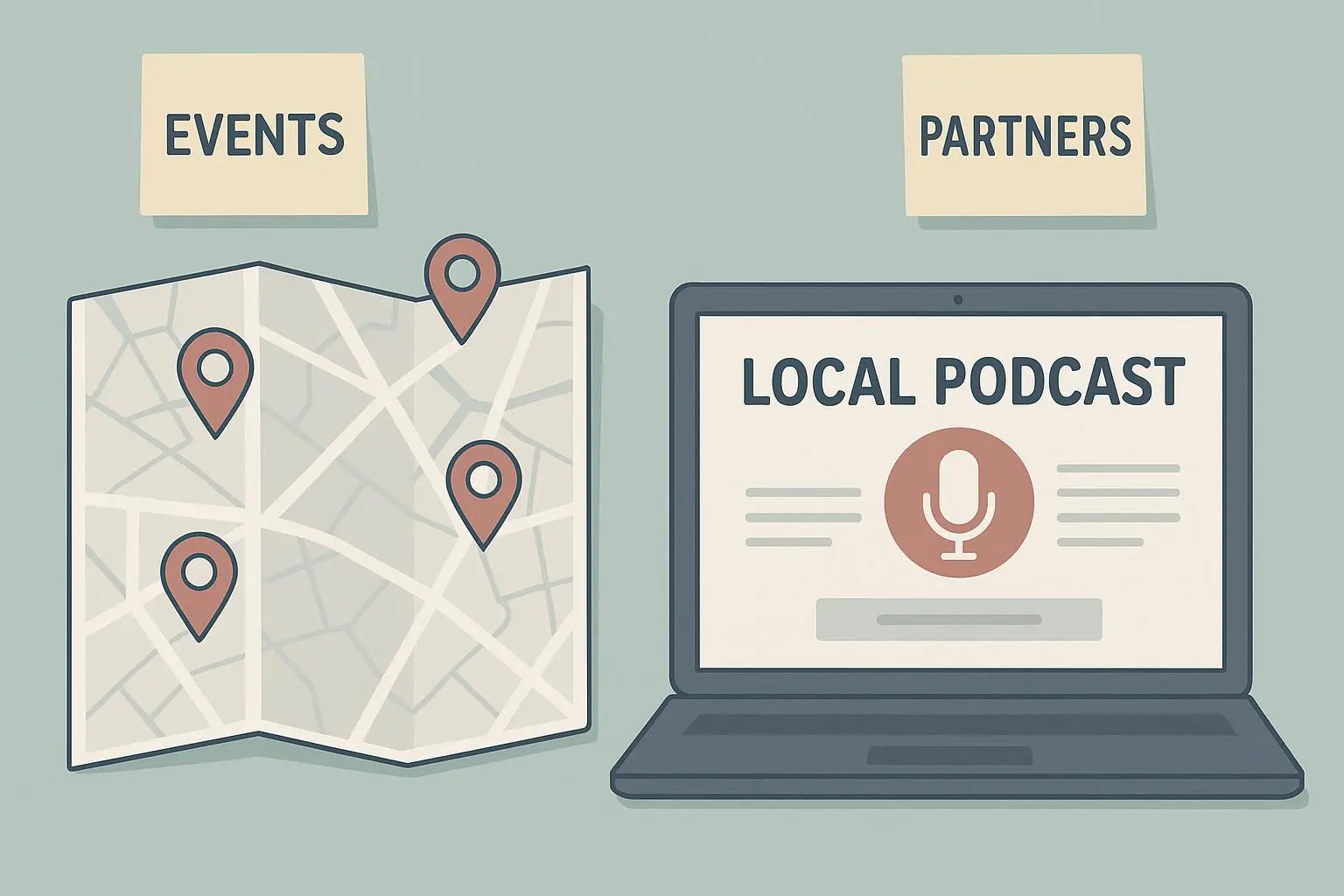
- Find 5–10 local newsletters, blogs, and community forums where your audience hangs out. Offer to contribute a guest segment, exclusive clip, or a short interview that links back to your local landing page.
- Approach neighborhood businesses for sponsorships or co-promotions. You don’t need to flood your show with ads; you can weave a brief sponsor segment into a two-minute local-interest piece.
- Interview local creators, entrepreneurs, or community leaders. This content is inherently shareable within their networks.
A concrete example: a local forum talked about a city festival and a few folks there were excited about a podcast covering the events. A mutual shout-out and a guest segment put a handful of listeners directly into the show’s orbit. This is the power of cross-promotion in hyperlocal ecosystems. You’re not just growing via tech; you’re growing via relationships[^cityexplorer2024].
And a personal tip: not every partnership needs to be formal. A quick collaborative post with a neighborhood newsletter or a small-business owner about an upcoming live episode can have outsized returns.
3) Local events: live shows, meetups, and in-person content
The thing locals tell you more than once: they crave authentic, in-person connections. They’ll share podcasts they’ve enjoyed if it feels like a neighborhood thing, not a mass-market product.
What to do:
- Plan a quarterly live episode or a casual meet-and-greet at a local venue. Tie the event to a city festival, a farmers market, or a university lecture series to ride existing foot traffic.
- Use your local landing page to promote events. Gather RSVPs, publish event details, and post photos after the show to keep the momentum.
- Remind listeners that you’re not just a voice on their feed; you’re a neighbor who actually shows up.
One caveat: if your niche is ultra-specific, don’t chase a giant stage just for vanity. A well-timed, well-promoted local meetup in a cozy venue can outperform a big-ticket show in a distant city.
4) Tracking local impact: what to measure and how to react
If you’re building a Local Listener Engine, you need a simple, reliable way to see what’s moving the needle. That starts with your analytics.
What to measure:
- Geographic distribution of listeners: who’s in your city and nearby areas? Are you growing there week over week?
- Local keyword rankings: for your geo-targeted terms, is your show appearing in local search results?
- Local landing page metrics: pageviews, time on page, and CTA clicks (events, newsletter signup, etc.).
- Live event metrics: RSVPs, attendance, post-event downloads, and local media pickups.
Tools:
- Use your podcast hosting analytics for geography breakdowns, and pair that with Google Analytics on your site to see local traffic flow.
- Local SEO tools like Moz Local or SEMrush Local help you track how visible you are for city-specific queries and how you stack up against nearby competitors.
- Run quick listener surveys after a local episode or event to confirm discovery sources.
The truth I’ve seen repeatedly: when you introduce a simple listener survey asking “Where did you hear about us?” you discover a lot of “I found you via the local newsletter” or “I heard your live show and subscribed.” This feedback loop is gold for refining your 30-day plan and future partnerships[^semrush2023].
A tiny aside that stuck with me: after a city-specific episode, I spent 20 minutes wandering the neighborhood with a camera and mic, asking people what they’d want next from a local show. The momentum you gain from those micro-interactions is real and surprisingly scalable.
5) Your 30-day Local Activation Calendar (overview)
Week 1: Audit & groundwork
- Audit existing content for local keyword opportunities.
- Create or refresh your local landing page with city-specific copy and a clear CTA.
- Claim and optimize your GBP profile if you have any local scene or live events.
Week 2: Content planning & outreach
- Plan 2–3 geo-optimized episodes for the next month.
- Identify 5–10 local newsletters, blogs, and community groups for outreach.
- Draft outreach emails focusing on mutual value (guest content, cross-promotion, or event listings).
Week 3: Publish & promote
- Release your first geo-optimized episode.
- Promote the local landing page and upcoming events heavily on social channels and within local groups.
- Announce a potential local meetup or a small live recording.
Week 4: Analyze & refine
- Review local analytics: which city keywords, which pages, which events drove growth.
- Gather listener feedback through a quick survey.
- Plan the next 30 days with a sharper focus on the local wins.
A note from a recent thread: “Starting small, like focusing on just one local keyword per episode, made it manageable.” I’m paraphrasing, but the sentiment is right: small, consistent bets beat big, scattered attempts every time[^podcastprobs2023].
Remember: you don’t have to spin 10 plates at once. Start with one city. Optimize one landing page. Run one live event. Then scale.
6) Title templates that actually work for regional discovery
Keeping titles local-friendly dramatically improves click-through from people who actually live near you. Here are a few templates you can steal and adapt:
- [Your Podcast Name] | Exploring [Local Landmark/Neighborhood]: [Episode Topic]
- [Episode Topic] | A [Your City] Perspective on [Broader Theme]
- [City Name] Spotlight: [Episode Topic] with [Guest/Local Figure]
- [Neighborhood] History, [Current Year]: [Episode Topic]
- [Your City] + [Topic]: [Episode Subtitle]
Use a natural cadence. Don’t force a city name into every single episode. The key is consistency and relevance—people should feel surprised, not misled, when they click.
Real-world results (and why they’re not magic)
Let me be blunt: geo-targeting isn’t a silver bullet. It’s a lever. When you pull it alongside a real local presence, the lift compounds.
- Local keyword visibility tends to rise when you consistently publish geo-focused content and maintain a local landing page. It’s not a one-off spike; it’s a slow simmer that grows as more local signals line up[^mihm2022].
- Google Business Profile optimization and schema markup contribute to local discovery, especially when people search for podcasts near them or events in their city. It’s not a full strategy by itself, but it’s a solid pillar in a local-first approach[^google2023][^schemaorg].
- Partnerships with local newsletters and businesses provide a trusted port of entry for new listeners who would otherwise find you through broader discovery channels. People like listening to voices that feel familiar and nearby[^cityexplorer2024].
A cautionary note from the field: not every niche will respond the same way. Some shows see slower ROI because their core topics have a limited geographic appeal. That’s not a reason to abandon local tactics; it’s a signal to tailor expectations and look for adjacent local angles that resonate with nearby audiences[^podcastinsights2023].
The human side of the Local Listener Engine
I’ve seen shows succeed when they treat local engagement as a core part of their identity, not an add-on. One show I worked with started every episode with a quick “city update” segment: a two-minute riff about a local event, a storefront reopening, or a neighborhood trend. It created a familiar rhythm that listeners in that city looked forward to. They didn’t magically triple downloads, but they did build a steady, local listening base that attended live events and supported the host with referrals and sponsorships.
Here’s a quick personal habit that helps me stay grounded with local work: I always carry a small notebook when I’m in town. If I see a storefront, a mural, or a neighborhood story, I jot down a quick idea for a future episode. The notes become seeds for local content that feels timely and essential to the people who live there.
And a tiny, almost silly detail that stuck with me: a simple map pin on my phone that marks interview locations. Seeing those pins accumulate reminded me that every episode’s story is anchored in a real place, and that tangible anchor helps listeners feel connected to the town—and to the podcast.
Resources and tools to accelerate your local plan
- Google Maps and Google Business Profile (GBP) for local discovery and event promotion.
- Moz Local and SEMrush Local for local listings management and local keyword tracking.
- Eventbrite or local event platforms for hosting and promoting live recordings.
- Canva for creating local-themed posters and social graphics that feel like they belong in a neighborhood feed.
- Nextdoor and local forums for community engagement and partner outreach.
A few notes on the toolset:
- GBP is free but powerful when you feed it frequent updates and genuine local activity.
- Local SEO tools help you quantify visibility changes and compare against nearby shows.
- Visuals matter more locally than you might expect; a cohesive, city-specific aesthetic helps your local landing page feel credible and current.
A quick, practical wrap-up
- Start with one city. Optimize two episodes for that city with geo-targeted titles and notes.
- Build a local landing page with a simple, clear CTA (live events, newsletter signup, or guest submissions).
- Reach out to 5–10 local newsletters or blogs for guest/content-sharing opportunities.
- Plan one quarterly live event, plus a small follow-up episode based on what you learned.
- Track local metrics weekly and adjust your approach based on what’s actually moving the needle.
If you’ve got one city that you truly care about, this engine can become a reliable engine of growth for your show. Not overnight fame, but real, measurable momentum that builds a stronger, more engaged regional audience.