Guest Host Voice Guide: Keeping Brand Consistency When Other Voices Take the Mic
Dec 24, 2025 • 9 min
You can't always be there. Flights get canceled, kids get sick, VPNs fail. But your audience expects the same show, same rhythm, and the same personality—whether it's you or someone else talking into the mic.
Here's a practical, no-fluff playbook I use when a guest host steps in. It includes a one-sheet you can hand over, rehearsal scripts, a 5-minute warm-up, sign-off and segue templates, producer checklists, contract language, and remote-friendly tools. Read it, use it, adapt it. The goal: keep your show recognizable without turning guests into parodies.
Why this matters (fast)
Your show is a relationship. Listeners come back for a tone as much as for the topic. When tone drifts—too formal, too jokey, too "corporate webinar"—people notice. They don't always complain. They unsubscribe. The fix is not policing every word. It's giving guests the right scaffolding so they can do their best work and still sound like your show.
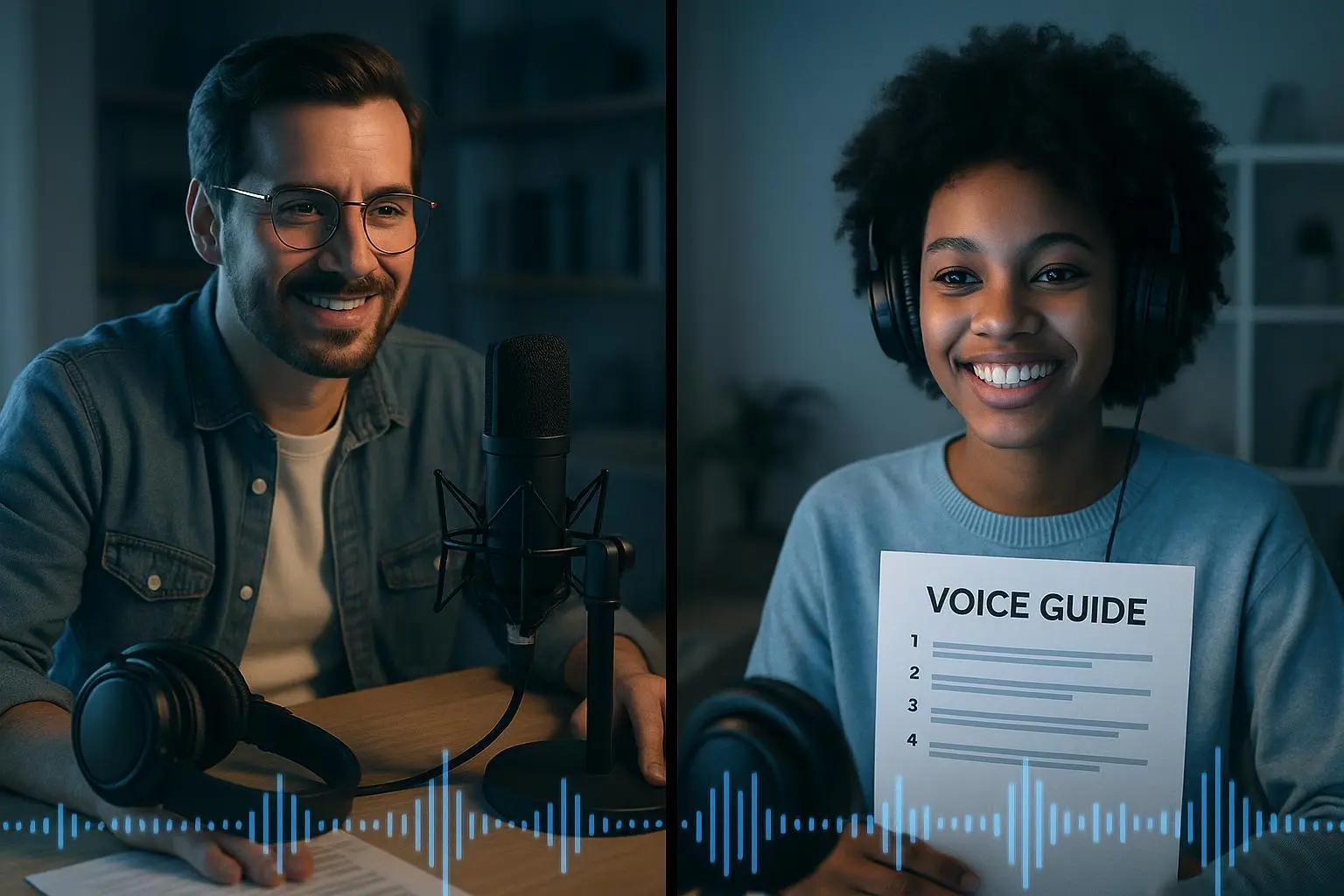
The single most useful thing: the Guest Voice One-Sheet
Think of the one-sheet as instructions for a mimicry that's also flexible.
Make it one page. No more than 300–400 words. It’s not a thesis; it’s a cheat sheet.
Include:
- A 1‑sentence identity statement (“We are a curious, slightly snarky tech-help show that explains things simply.”)
- Tone spectrum with quick sliders (Formality 3/10, Humor 6/10, Speed 7/10)
- Three “Do” phrases and three “Don’t” phrases (what to lean on and what to avoid)
- Two example sign-offs and two forbidden words or phrases
- One short paragraph about pacing (target WPM range or descriptive cue: “comfortable, conversational, like explaining to a friend at a coffee shop”)
Why this works: guests usually panic over "how to be you." The one-sheet removes the guesswork fast.
Micro-moment: on one shoot, a guest circled "Don't use corporate jargon" on the one-sheet and texted me, "Got it—except 'pivot'?" I replied: "Only if you're pivoting a mattress." It got a laugh on the recording—and kept the brand intact.
How I actually made this work: an honest story
Two years ago our lead had a last-minute emergency the morning of a three-episode recording block. We had a high-profile guest host lined up—smart, experienced, totally different delivery. Panic was real: marketing had promoted the episodes, sponsors were locked in, and the audience expected the usual voice.
I wrote a one-sheet in 20 minutes and sent it with three rehearsal items: the intro, the sponsor read, and the sign-off. Producer set up a 10-minute remote run-through. We did the 5-minute warm-up (I’ll share it below), practiced the signature sign-off twice, and ran the intro three ways—enthused, amused, and reflective—so the guest could see the range.
Result: the guest delivered two excellent episodes. Listener feedback: some loved the fresh take; others told us it "still felt like home." Downloads dropped by 2% that week—within normal variance—and sponsor feedback was positive. The lesson: preparation beats perfection. The scaffolding let the guest be themselves while honoring the show's identity.
What to include in rehearsal scripts and templates
Transitions are where shows lose their voice. Give guests short scripts they can adapt, not memorize.
Intro templates
- Friendly/energetic: “Hey, it’s [Guest]. Stepping in for [Host]. Today we’re digging into [topic]. Stick around—this one’s a good one.”
- Calm/reflective: “I’m [Guest], filling in for [Host]. Today we explore [topic], the kind of conversation you’ll want to hear in full.”
Mid-roll sponsor templates
- Natural: “A quick word from [Sponsor]. When we’re back, we’ll unpick [next segment].”
- Short and punchy: “[Sponsor] makes this show possible—back in 60 seconds.”
Sign-off templates
- Signature sign-off (formalized): “That’s our show. I’m [Name], and you’ve been listening to [Show]. Subscribe, tell a friend, and we’ll see you next time.”
- Casual (if brand leans casual): “Alright, that’s a wrap. I’m [Name]. Catch you next time.”
Give one “do not read” example too—show the wrong rhythm or the cringe phrasing. Seeing the contrast helps.
The 5-minute pre-show warm-up that actually works
I keep this boringly short and fiercely specific. The producer runs it.
- Tone check (1 min): Guest reads three brand-tailored lines—one upbeat, one matter-of-fact, one playful. Producer says “softer” or “brighter.”
- Jargon drill (2 min): Read five key show terms. Guest paraphrases each in the show’s voice. Correct phrasing if needed.
- Pacing practice (1 min): Read a denser paragraph at target speed. Pause coach on breath points.
- Signature line drill (1 min): Sign-off and one transitional phrase twice.
This routine locks in habits. Short drills create muscle memory; long lectures do not.
Micro-moment aside: on a remote episode I heard a guest breathe oddly loud into the mic during the sign-off. A 10-second breath-control cue fixed it and the rest of the show sounded pro. Tiny things matter.
Remote tools and producer techniques
If you’re recording remotely, the producer becomes the off-stage director.
Tools I recommend and why
- Riverside.fm — allows private producer notes and high-quality local recording. Producers can “whisper” corrections without cutting the audio.
- Notion or Google Docs — shared rehearsal scripts and the one-sheet live. Use comments during the run-through.
- Otter.ai — quick transcription to flag forbidden phrases after rehearsal.
- Slack or private chat — a single emoji system works. We use a green smile for “great”, a yellow wave for “slow down”, and a relaxed face to signal “less formal.”
Producer checklist (use it every time)
- One-sheet sent and confirmed (48 hours prior)
- Rehearsal script delivered (24 hours prior)
- 5-minute warm-up scheduled and completed
- Audio levels checked and headphone feed confirmed
- Sponsor copy pre-approved and tone-checked
- Emergency fallback plan (producer or co-host is ready to jump in)
Pro tip: create a small producer cue sheet with one-line commands the guest can see on a monitor—“Pause | Smile | Speed up | Slow down.” Visual cues save verbal interruptions.
Contract language to protect your voice (but don’t be a tyrant)
Include a short clause in your guest contract that sets expectations without sounding authoritarian.
Example snippet: “The Guest Host acknowledges that the Program operates with a defined Brand Voice as described in Exhibit A. Guest Host agrees to reasonably adhere to the Brand Voice during recordings and approved promotional material. Reasonable deviations that enhance authenticity are permitted; material deviations, as reasonably determined by the Producer, may require re-recording or edits prior to publication.”
Why this phrasing? It balances brand protection with creative freedom. You want to avoid stifling the guest—authenticity is valuable—but you also need recourse if someone derails your tone on a paid promotion or signature segment.
If you pay a guest, include payment triggers tied to compliance for sensitive elements (sponsor reads, legal disclaimers). That keeps everyone aligned on business-critical parts.
Handling creative freedom vs. consistency
There’s no single answer here. My rule of thumb:
- Lock down intros, sponsor reads, and sign-offs.
- Allow freedom in conversational segments, especially interviews.
- If the guest has a strong personal brand that brings listeners, lean into their style—but prep them on what not to do.
If a guest insists on a radically different approach, negotiate: maybe one episode as "guest's take" clearly labeled so listeners know what to expect.
How to handle backlash when the host is absent
Some listeners will react. Here’s a simple triage:
- If it's minor complaints: respond with a pinned reply or quick newsletter note explaining the substitution and pointing to episodes that align with core tone.
- If it’s a serious tone mismatch (sponsor reads wrong, major deviation): issue a short apology, explain re-recording/edits, and outline next steps. Transparency wins trust.
- Track metrics: compare drop-off points mid-episode. If drop-off spikes during a particular transition, you have a clear signal to fix that exact moment.
Quick templates you can copy
Guest Voice One-Sheet (one-liner layout)
- Identity: [one sentence]
- Tone: [3 word descriptors]
- Do: [3 phrases]
- Don’t: [3 phrases]
- Sign-off: [exact line]
- Target pace: [e.g., "conversational, 150–170 WPM"]
Intro script (energy-adjustable)
- “You’re listening to [Show]. I’m [Name], filling in for [Host]. Today: [topic]. Let’s get into it.”
Sponsor read (script + allowed ad-libs)
- “This episode is brought to you by [Sponsor]. [One sentence scripted line]. You can get [offer] at [link].” (Allowed ad-libs: 1–2 sentences max; avoid technical jargon)
Sign-off (signature)
- “That’s it for today. I’m [Name]. Thanks for listening to [Show]. Subscribe and we’ll be back next week.”
Final checklist before you hit record
- One-sheet in guest’s hands and acknowledged
- Rehearsal scripts loaded in shared doc
- Producer has whisper capability and emoji system ready
- Warm-up completed and signed off
- Contract items relevant to voice are agreed
- Audio levels checked and sponsor copy approved
One last thing: train for the long game
If you frequently use the same freelancers or rotating guests, build a short “voice training” program. A 30-minute session once a quarter with your producer will pay off in fewer rehearsals, less re-recording, and a stronger brand presence.
You want guests who can be themselves without derailing your show. Give them the scaffolding, practice the key moments, and protect the moments that matter (intros, sponsors, sign-offs). The rest? Let it breathe.