Emotional Triggers Lab: Harness Mood States Without Getting Hijacked
Nov 22, 2025 • 9 min
You know that tiny voice that says “just one scroll” or “you deserve this cookie”? That’s an emotional trigger talking. It’s not the enemy. It’s a cue. The trick is turning that cue into a tiny, intentional action that actually helps.
This piece is practical—not academic fluff. You’ll get a short framework for identifying triggers, scripts you can copy, two micro-experiments (stress-eating and doomscrolling), an ethics check so you don’t exploit yourself, and a four-week lab plan you can run this month. I’ll also tell one story from my own life where a 60-second tweak cut a bad habit in half.
Why this works: emotions are information. They come with physical signs you can learn to read. When you treat them as signals instead of commands, you stop being hijacked and start choosing. Here’s how.
Why emotional triggers are so persuasive
Triggers tie present moments to past needs or stories. Your body responds first—heart rate, tight chest, a hollow stomach—then the thought rushes in: “I need X.” That sequence is predictable and fast. If you don’t notice the physical cue, your brain hands control to the habit that followed that feeling before.
Neuroscience and clinical work show we can slow that chain with simple detection and a replacement action. You don’t have to meditate for 20 minutes to get control. You need a readable sign and a tiny plan.
The three-step ID method (do this first)
Here’s a short protocol I use and coach people to use. It fits in your pocket.
Step 1 — Monitor the body. Notice heart rate, breath, jaw tightness, heat in the face, restlessness. These are your alarm lights.
Step 2 — Name the emotion precisely. “Frustrated” or “bored” works. Avoid vague “stressed.” Precision matters—different feelings need different fixes.
Step 3 — Trace the thought. Ask: what thought popped up a second before the feeling? It might be “I’m behind” or “I’m missing out.” That thought points to the story your trigger is replaying.
Do those three things and you’ve already created the breathing room needed to choose.
An ethical baseline: don’t exploit yourself (or others)
Here’s what I insist on when I teach this:
- Use triggers as data, not manipulation.
- Your micro-action should satisfy a real, healthy need (rest, connection, competence), not be a shortcut to avoidance.
- Avoid external micro-rewards that create new dependencies (endless sugar, dopamine hacks).
- Be able to explain your system to someone else without cringing.
If your plan relies on a “reward” that undermines your values, rewrite it.
How I actually made this work (a real story)
A few years back I had a habit: late-afternoon doomscrolling that bled into dinner. It was mostly boredom-plus-a-bit-of-anxiety—classic avoidance of the last, ugly two hours of the workday. I tried the usual: blocking apps, deleting feeds. Those worked for a day and then I’d sneak back.
What finally changed it was embarrassingly small. I noticed my jaw clench when the urge hit. I started a script: when jaw + urge = true, I stand and make a drink (no phone). The drink is a micro-reward—hot tea or citrus water—plus a 90-second physical break. Most days the urge passed while the kettle boiled. On the days it didn’t, I still felt less guilty and more in charge.
Outcome: my evening scrolling dropped from 90+ minutes to 25–40 minutes in three weeks. More than the minutes saved, I felt less shame coming to dinner. It was the simplest experiment that actually stuck.
Micro-moment: one small detail that stuck with me—putting the kettle on used the same hand motion I used when I reached for my phone. That tiny switch in motor pattern broke the habit more than any mental pep talk.
Scripts you can copy (short, neutral, non-judgmental)
Scripts should be 1–2 lines. Say them silently or out loud. Keep them value-aligned.
Stress script “I’m feeling stressed. This feeling is a cue, not a command. Three deep breaths. Water. One 20-minute chunk on the smallest next task.”
Boredom script “I’m bored and looking for stimulation. I can choose something that leaves me better. Two minutes: stretch, then one small activity.”
Loneliness script “I feel disconnected. Scrolling isn’t connection. Call or text one person, or read for 10 minutes.”
Use these exactly as written the first week. They’re short enough you won’t resist.
Micro-experiments: replace the reaction with a tiny action
These are designed to be 60–180 seconds long. Short actions are easier to repeat and track.
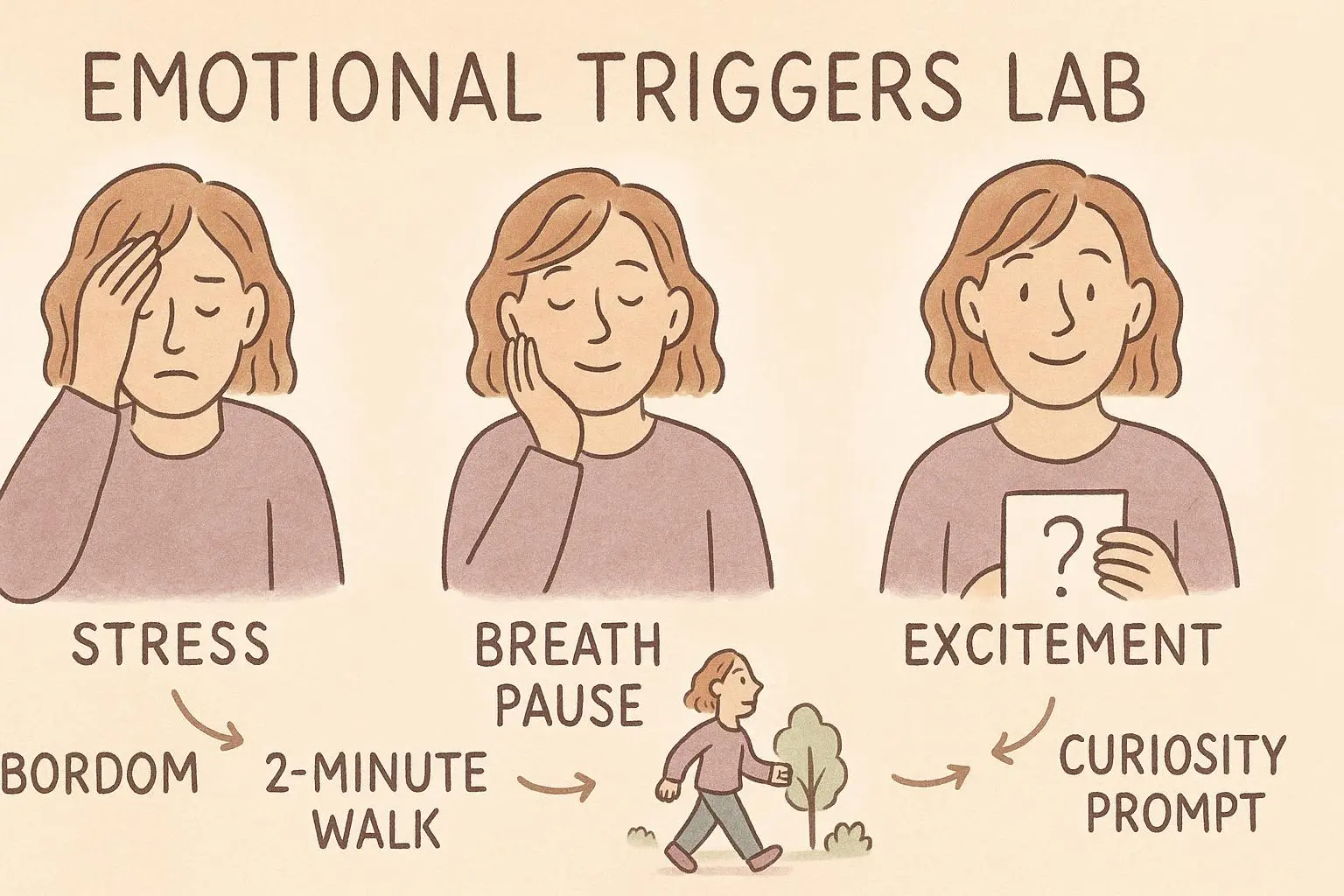
Experiment 1 — Stress-eating redirect Setup: When you notice stress signs or the thought “I need to eat now,” do the quick triage.
Micro-action (60–90 seconds):
- 10 slow breaths, emphasizing the exhale
- Stand and do a two-minute walk to another room
- After walking, name three things you can control about the situation
Micro-reward:
- Allow yourself one intentional sip (tea, water) or 90 seconds of a favorite song.
Tracking: mark a simple Yes/No whether the urge passed or you still ate. After two weeks you’ll see patterns (which triggers, which replacement actions worked).
Experiment 2 — Doomscrolling interrupt Setup: Notice the pre-scroll signals: jaw clench, breath shallow, sense of restlessness.
Micro-action (120 seconds):
- Set a 2-minute timer.
- Put your phone face-down or in another room.
- Do one of: open a physical book, make a drink, call someone for 60 seconds, or step outside.
Micro-reward:
- If the urge passes, allow yourself a one-line journal of how you feel—a small dignity reward.
Tracking: note what emotion preceded scrolling (lonely, anxious, bored). That helps you match a better replacement next time.
Two case studies (real patterns, real numbers)
Case study — Marcus (stress-eating) Pattern: stress → eating during project deadlines. Intervention: used the stress script + 5-minute walk + break tasks. Result: stress-eating dropped by about 60% over two weeks. He still ate when hungry, but stopped using food as control.
Case study — Priya (doomscrolling) Pattern: evening boredom → 90+ minutes scrolling. Intervention: 2-minute timer + choice: call a friend or read. Result: nightly scrolling dropped to 20–30 minutes consistently; she reported feeling less shame and more control.
Both stories show a thing I want to emphasize: the goal isn’t perfection. It’s shifting the default from “automatic reaction” to “small, chosen action.”
Troubleshooting: when the micro-action fails
If the replacement doesn't work, don’t abandon it. Ask:
- Did I mislabel the feeling? (Anger vs. frustration vs. tired)
- Was the action mis-matched? (Calling someone when you actually need rest)
- Is the reward reinforcing or undermining?
Adjust one variable at a time. Change the action first; only change the naming step if you really suspect mislabeling.
Building your personal trigger laboratory (4-week plan)
Week 1 — Observe Pick one trigger. Log three fields for every episode: physical sign, emotion label, automatic reaction.
Week 2 — Script Write two short scripts for that trigger. Practice them aloud twice daily.
Week 3 — Micro-experiments Pick one replacement action. Test it for three days and log results.
Week 4 — Refine Swap or tweak the replacement action based on your log. Celebrate small wins and cut dead tactics fast.
This week-by-week plan is intentionally small so you actually follow it.
Ethical guardrails (again, because this matters)
Ask these before you commit:
- Am I choosing this action freely, or am I trying to avoid discomfort by tricking myself?
- Would I recommend this plan to a friend?
- Is the micro-reward aligned with my values and long-term goals?
If the answer raises red flags, revise. Ethical use builds resilience, not new dependencies.
Tools that help (quick picks)
- Habit journal or Day One-like app for logging triggers.
- A simple timer on your phone for micro-actions.
- Headspace or Calm for guided breathing if you need structure.
- A physical cue (a cup, a plant, a small object) you move to mark success.
You don’t need a new app. You need readable data and one small, repeatable action.
What to expect (realistic outcomes)
Short-term: more awareness and fewer automatic reactions. Expect slips—this isn’t about never being tempted.
Medium-term (2–6 weeks): muscle memory for the new cue-action loop. You’ll replace an avoidant pattern with something that actually helps.
Long-term: better emotional intelligence and fewer moments of shame. That’s the real outcome—feeling like you run your life, not your triggers.
Final takeaway
Triggers are not your enemy. They’re signals packed with useful information. Learn to read the body, name the emotion, and run a tiny, value-aligned experiment. The aim isn’t to eliminate feelings. It’s to stop being hijacked by them.
If you try one thing from this article: pick your most common trigger and create a 2-line script plus a 90-second replacement action. Practice it for a week. If you log it, you’ll learn faster than if you just rely on willpower.