Emergency Decision Map: Drive, Limp or Tow
Feb 25, 2026 • 9 min
That sickening thump‑thump‑thump. The car pulls to one side. Your heart does this small stutter, and suddenly you’re deciding between doing something risky or making what feels like the boring call for help.
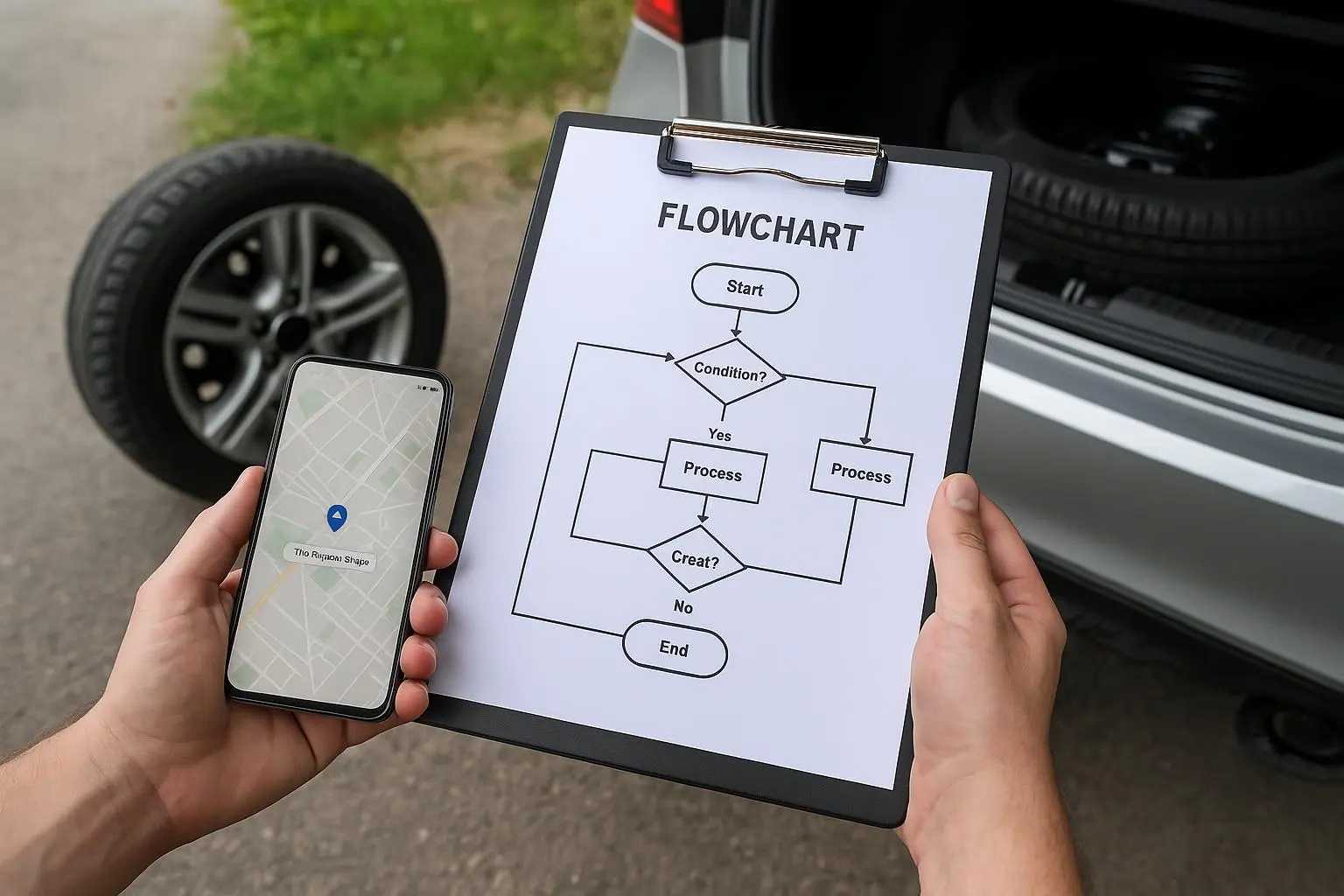
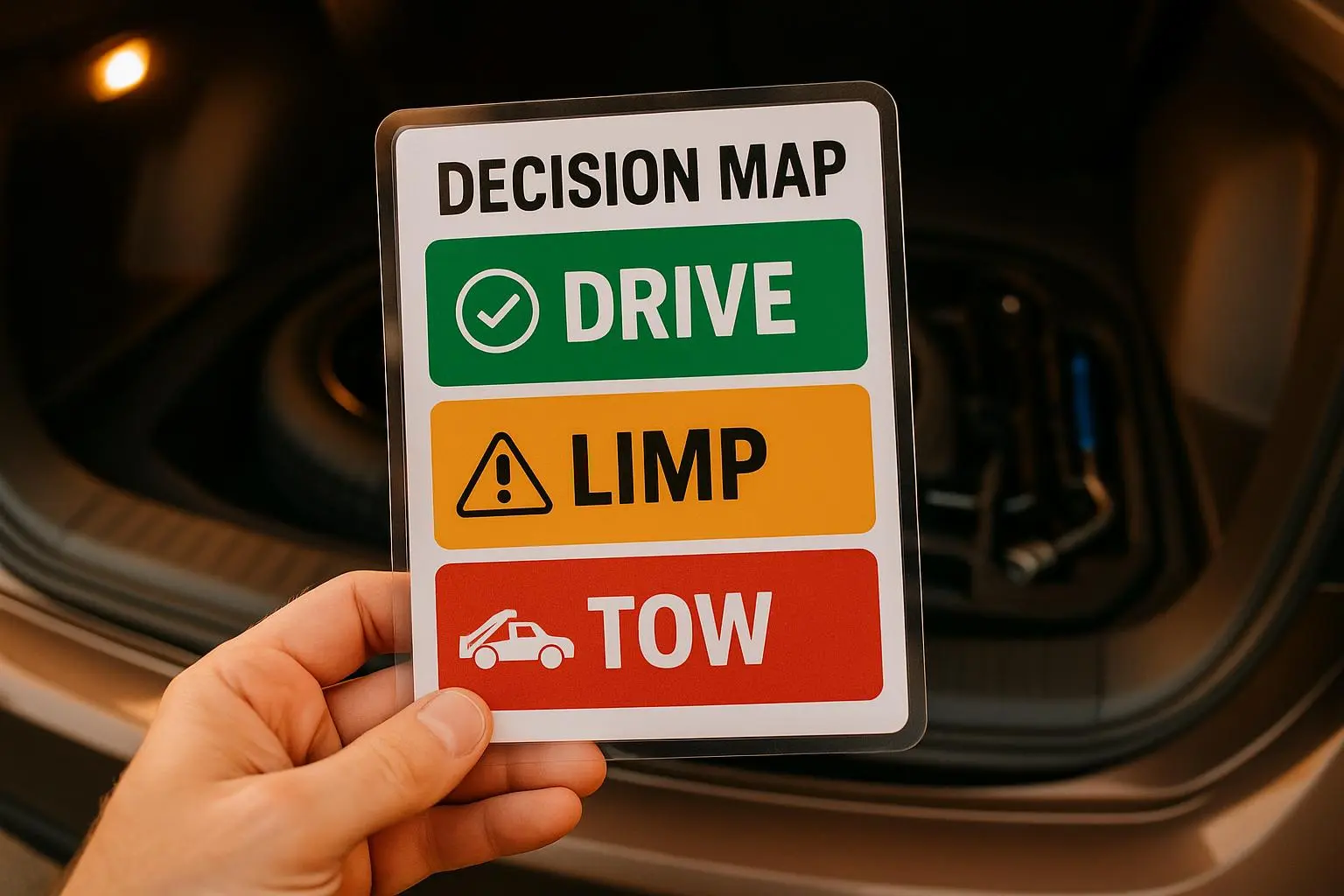
Here’s a truth I’ve learned: when a flat happens, your safest moves are the simplest ones. This is a practical, printable decision map—small enough to laminate and keep in your glovebox—that walks you, in plain English, through the three options: Drive (move very short distance), Limp (use the temporary spare/donut), or Tow (call a pro). No fluff. Just what to check, what to say, and conservative speed/distance rules so you don’t make a minor problem far worse.
The first 60 seconds: safety trumps everything
When you hear the blowout, priority one is finding a safe place to stop. I’m not asking for heroics—just the safest spot you can reach.
Ask yourself, quickly:
- Are you on a high-speed road or a narrow shoulder?
- Is visibility poor—rain, fog, or night?
- Is traffic heavy and fast?
If the answer to any of those is “yes,” default to Tow. Don’t attempt to change a tire on a blind curve or a fast shoulder. Period.
Quick micro-moment: I once pulled over at dusk behind a truck, thinking the truck shielded me. A semi passed and threw up a pebble that smashed my taillight. Small detail, big consequence—pick a spot with real clearance.
Phase 2: check the resources (the spare, the kit, and you)
If you’ve stopped somewhere reasonably safe—wide shoulder, parking lot, or quiet side street—inspect your situation.
Checklist (do this in under a minute):
- Is the flat a slow leak (tire still holding some air) or completely flat?
- Do you have a spare? Is it a full-size or a temporary spare (donut)?
- Do you have a jack and lug wrench, and do you know how to use them?
- How far and what kind of roads separate you from a safe shop or home?
If you don’t have a usable spare or the location is borderline, call a tow.
Donut basics (read this once, then forget it until you need it):
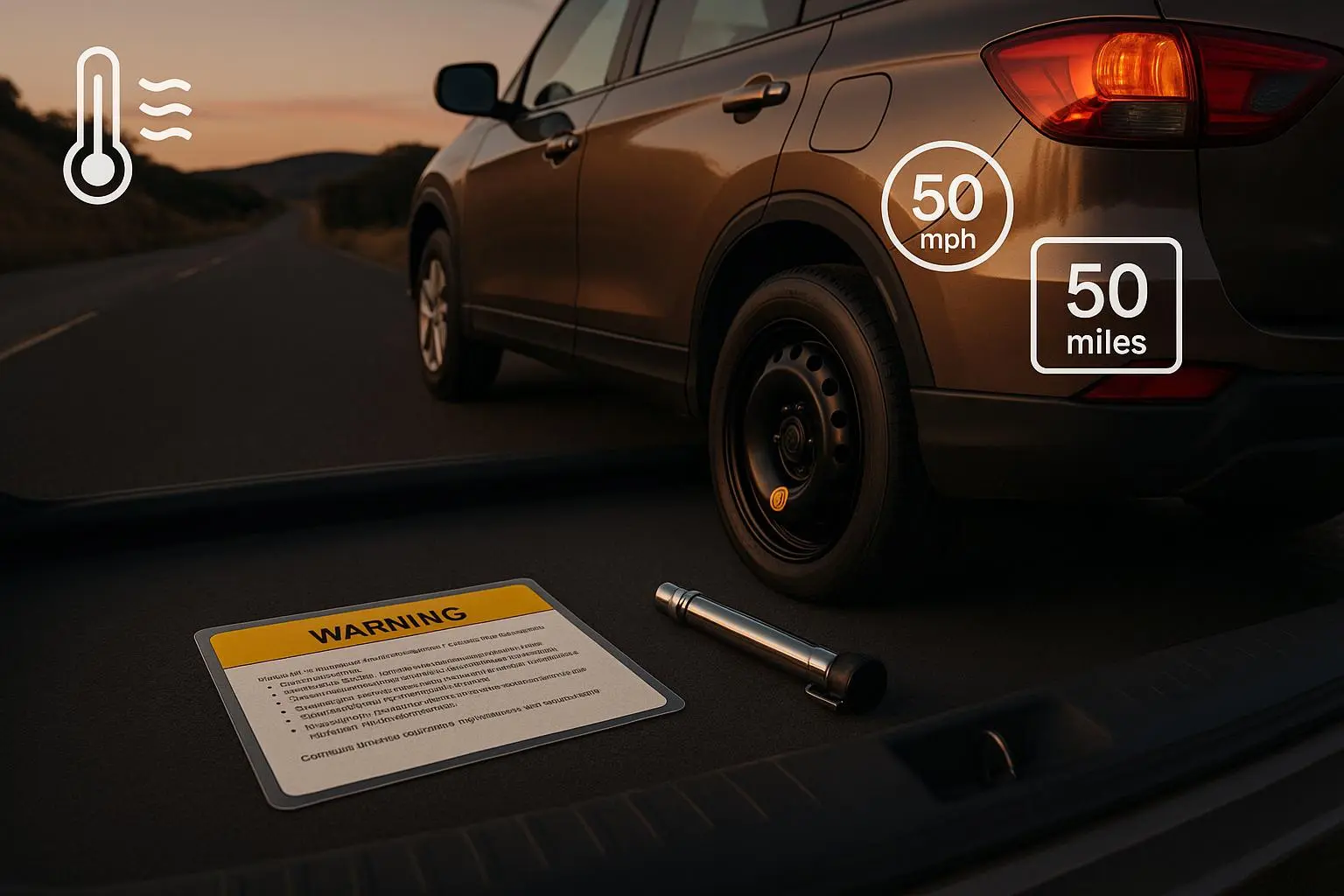
- Max recommended speed: 50 mph (I recommend 45 mph or lower)
- Max cumulative distance: 50–70 miles in ideal conditions
- Donuts are not built for sustained highway speeds or heavy braking
A friend of mine ignored the speed advice once. He did 65 mph for 20 minutes on a donut and didn’t notice anything wrong—until the shop told him the spare had deteriorated from heat stress. He walked away fine, but the spare was trash. Donuts look fine long after they stop being safe.
Decision matrix: how to pick Drive, Limp, or Tow
This is the one-page brain for the moment of panic.
- Unsafe location (narrow shoulder, blind curve, heavy fast traffic, bad weather) → Tow
- Safe location AND tire is slowly leaking AND destination is <1 mile to a safe parking/garage → Drive (very short move)
- Safe location AND you have a good donut AND destination is short and on low-speed roads (city/parking) → Limp
- Safe location AND no spare or spare damaged OR destination exceeds donut limits → Tow
Don’t overcomplicate it: if you feel unsure, tow. The cost of a tow is almost always cheaper than replacing a rim, suspension parts, or worse.
How I actually used this map (a real story)
A few years ago I blew a rear tire on an unfamiliar two‑lane road at 7 p.m., rain starting. I pulled onto a very narrow gravel shoulder. For 30 seconds I debated changing it. Then the trucker behind me flashed his lights impatiently. I took a breath, called my insurance roadside number, and asked for a tow.
A tow truck arrived in 22 minutes. The driver put my car on the flatbed and took me to a shop that was still open. The shop replaced the tire and inspected the rim; heat and sidewall damage from even a short, unplanned coast would have meant a bigger bill. Cost of the tow: $0 (covered). Cost of rim replacement if I’d driven on it: $600+. That tow was the best “boring” decision I made all year.
Lesson: you’ll never regret choosing safety over a small savings.
Conservative speed & distance guide for donuts
These numbers err on the side of caution. If you’re tired, in bad weather, or on rough roads, cut the speeds and distances further.
- Dry interstate (low traffic): Max 45 mph, up to 50 miles
- City streets / stop‑and‑go: Max 30 mph, up to 35 miles
- Wet or icy roads: Max 25 mph, up to 20 miles
If you’re carrying heavy cargo or multiple passengers, cut the distance in half. If you’re on hilly terrain—consider a tow.
Short scripts: what to say when you call for help
Calling can feel awkward when you’re nervous. Use these plug‑and‑play lines.
For AAA or insurance roadside: “Hi, I have a flat tire at [exact address or mile marker]. I’m safely pulled over on the [right/left] shoulder. Traffic is [heavy/light], and the weather is [clear/rain/fog]. I need either a tire change or a tow to [nearest shop/home].”
For an independent tow company: “Hello, I need a flatbed tow for a passenger car. Location: [exact location]. Destination: [shop or home]. The tire is flat and I prefer a flatbed if possible.”
If you’re in immediate danger (narrow bridge, heavy traffic), say so. Operators prioritize safety.
When “Drive” is actually okay
Drive only if:
- The leak is slow and controllable
- You’re moving less than 1 mile to a well-lit, safe place (garage, gas station, parking lot)
- You’re not on a major highway or in bad weather
- You understand driving even a short distance on a flat risks rim damage
If you attempt this, go very slowly, hazard lights on, and steer smoothly. Don’t weave, don’t brake hard, and be ready to stop.
When “Limp” makes sense—and when it doesn’t
Limping on a donut is a calculated compromise. Use it when:
- Your spare is in good condition and inflated to spec
- Your route is low‑speed and the destination is within conservative distance limits
- You’ll go straight to a reputable shop and not put off repair
Don’t limp if:
- The spare is older than 6–8 years or shows cracks
- You have to travel on high-speed or mountainous roads
- The spare was already used (donuts often are one‑time use)
If you’re unsure whether your spare is roadworthy, toss the towel and tow.
Why towing is often the right choice
Towing avoids:
- Rim damage (expensive: $400–$1,200 for many modern wheels)
- Brake or ABS sensor damage from driving on a compromised wheel
- The danger of changing a tire in a hazardous location
- The risk of a failed spare leaving you stranded farther from help
Yes, tow costs money. But a single bad decision can multiply that cost several times over. If you have a roadside membership (AAA, insurance add‑on), call them first. Many users report the membership pays for itself the first time they need a tow.
Checking your spare before you need it (do this monthly)
- Measure pressure with a digital gauge—donuts often sit underinflated.
- Inspect for dry rot, cracks, or punctures.
- Confirm you have the correct jack and that lugs are accessible.
- Store the spare and tools where they won’t collect moisture or grime.
I keep a $20 digital gauge in the glovebox. It’s small, cheap, and has saved me from trusting a spare that looked fine but read 18 psi.
Extra tips that matter
- Turn hazards on immediately when stopped. Visibility is your lifeline.
- If you can, move uphill of traffic or behind a guardrail when changing a tire.
- Keep the roadside assistance proof and local tow numbers in your phone under “Roadhelp.”
- If you’re changing a tire, put the car in park and engage the parking brake. Use wheel chocks if available.
- If a shop is closed, don’t aim for a “cheaper” shop farther away—get to any reputable place within safe limits.
Printable one‑page action map (how to laminate and use it)
- Fold this page into quarters and laminate it.
- Keep it in the glove compartment with your vehicle registration and roadside card.
- In an emergency, follow the bold prompts:
- Unsafe location → Call Tow
- Safe location + slow leak + <1 mile → Drive
- Safe + good donut + short low‑speed route → Limp
- Otherwise → Tow
Closing—prepare before you panic
A flat tire is predictable chaos. You can’t stop it from happening, but you can decide ahead of time how you’ll react.
Laminate this map, check your spare monthly, enroll in roadside assistance if you can, and store the tow numbers in your phone. When the moment comes, you’ll be glad you chose the boring, safe option.