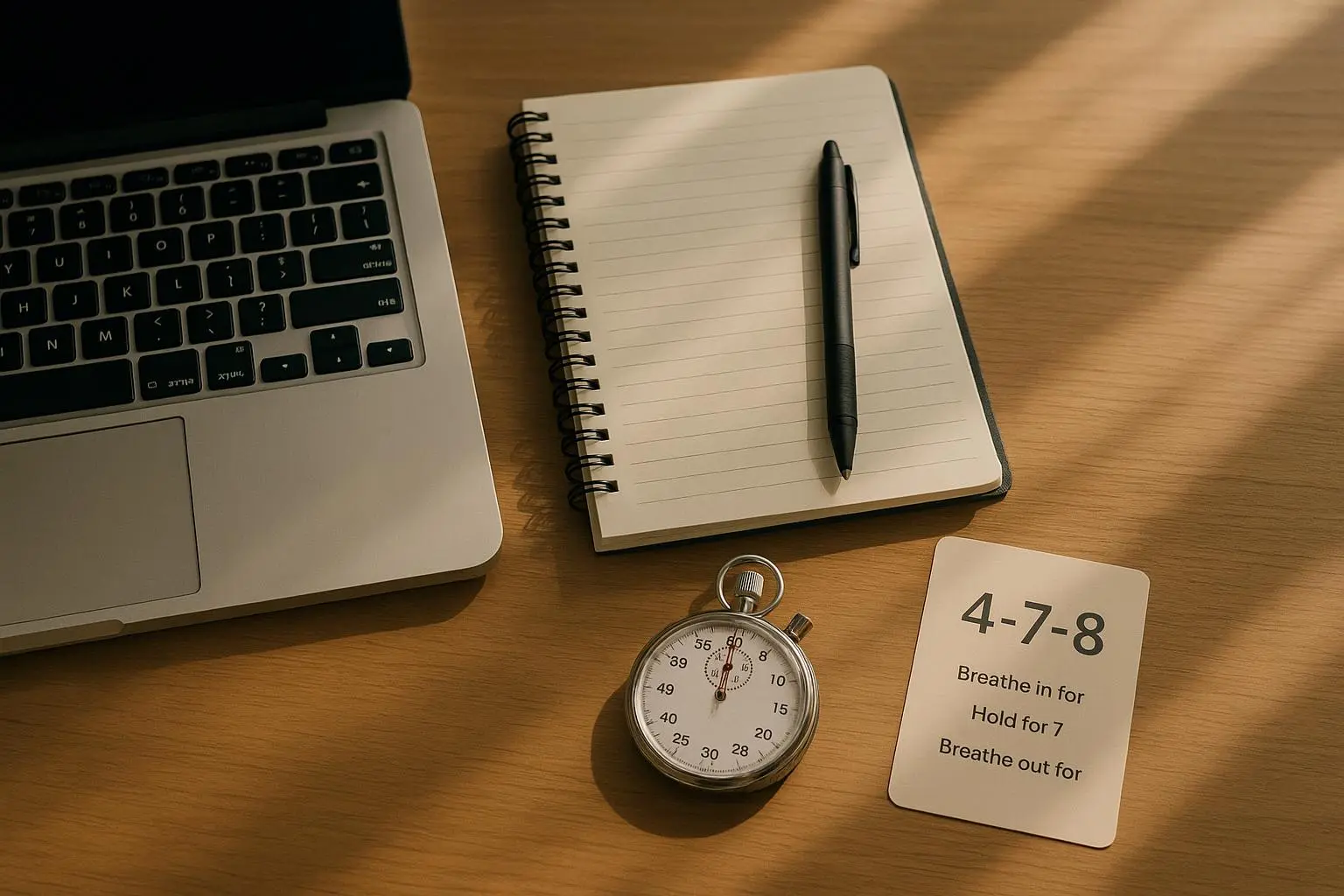
Easy Breathe: A Founder’s Quick-Start With 4-7-8
Sep 23, 2026 • 9 min
If you’re a founder, you know the drill. The day is a constant loop of decisions, emails, demos, and a clock that never seems to slow down. And when you’re under that kind of pressure, your body and brain pay the price. I learned this the hard way during a late-stage fundraising sprint. I’d just finished a 60-minute investor call and sat there staring at a slide deck, my heart thudding, my mind spinning. The next meeting started in 15 minutes. I didn’t have time for meditation. I had time for one quick breath.
That breath turned into something simpler: a 4-7-8 breathing cycle. It’s not magical. It’s practical. It’s fast. And for founders, it can be the difference between a knee-jerk reaction and a deliberate choice.
And yes, I’m going to give you something you can actually use in real life. Not a long theoretical exercise, but a blueprint you can drop into a busy day.
A quick moment I keep tucked in my pocket: in the hallway right before stepping into a room, I’ll pause, place the tip of my tongue behind my upper teeth, and breathe in through the nose for four counts, hold for seven, exhale for eight. I notice that the hallway light is a shade brighter, the air feels cooler, and my timing feels more precise. It’s a tiny ritual, but it buys me a tenth of a moment of clarity when it matters most.
A micro-moment that stuck with me: the moment you feel the exhale finish and you realize your heartbeat isn’t leaping anymore. It’s not dramatic. It’s a soft permission slip to proceed with intention.
What you’ll get here
- A practical, founder-tested approach to 4-7-8 breathing
- Micro-scripts you can read aloud to yourself in under a minute
- Real stories from the trenches (and yes, I’ve got a 100–200-word founder story tucked in)
- Quick tips for turning a breath into a sustainable daily habit
First, the why. Why this breathing pattern? And why now, for founders?
The science is simple, even if the feel isn’t flashy. Slow breathing—especially patterns like 4-7-8—activates the parasympathetic nervous system, the part of you that shifts from fight-or-flight to rest-and-digest. When you’re about to present to a room full of potential investors, or you’re staring at a product outage, that shift can calm the mind, steady the hands, and sharpen decision-making. It doesn’t erase stress, but it changes the tempo of your response.
I didn’t want to fill you with abstract claims. So I’ll tell you what happened when I began adding micro-breaths to real moments. The pitch that once felt like a sprint across hot coals became a controlled, deliberate 3-minute routine I could repeat as needed. Outcomes weren’t magical overnight, but they showed up as increased focus, fewer impulsive reactions, and a small, measurable improvement in how I slept after long days.
The research backing this is steady but not loud. Diaphragmatic and controlled breathing has been shown to affect attention, negative affect, and stress in healthy adults. It also interacts with the vagus nerve to modulate autonomic responses, which matters when your default mode is “go go go.” For founders, that means fewer blood-pressure spikes, less cognitive fog, and better emotional regulation during tough conversations.
How to start: the quick-start routine
You don’t need a retreat. You need a hallway, a chair, or a quick seat next to your desk. Here’s a practical sequence you can run in under a minute, with micro-scripts you can read aloud if you want a touch of discipline.
- Position and settle
- Sit comfortably with your spine upright but not stiff.
- Place the tip of your tongue against the ridge of tissue behind your upper front teeth and keep it there through the cycle.
- Let your shoulders drop away from your ears. Plant your feet or sit with your legs uncrossed.
- Exhale completely
- Exhale through your mouth with a soft “whoosh” so you can feel your lungs empty. This primes the system for the new inhale.
- Inhale for 4 counts
- Through your nose, quietly, into your diaphragm. Count: 1-2-3-4.
- Hold for 7 counts
- Don’t rush. Let the breath settle in your chest and belly.
- Exhale for 8 counts
- Through the mouth again, with the soft “whoosh.” Count: 1-2-3-4-5-6-7-8.
- Repeat
- Do four breaths total to complete one cycle.
If you’re space-constrained or short on time, you can scale. Start with one cycle. Two or three cycles can be plenty when you’re in the middle of a sprint. The ratio matters more than hitting the exact numbers from the first day. If you’re stressed and can’t hold for seven seconds yet, adjust to something like 2-3-4 and ease into it. Consistency beats perfection.
The 4-7-8 script bank: micro-scripts you can use in the moment
Pre-pitch power-up
- Cue: Right before you walk into the investor room.
- Script: “One round of 4-7-8 for clarity and calm.” Do 1–2 cycles.
- Why it helps: It doesn’t erase nerves, but it makes the nerves manageable. You show up when you’re grounded, not rattled.
Between calls reset
- Cue: The moment one meeting ends and the next begins.
- Script: “Quick reset. Between calls, 4-7-8 to clear the mind and prepare for the next.” One cycle.
- Why it helps: You’re switching gears, not dragging energy from the last conversation.
Decision-making pause
- Cue: You’re staring at a dozen options and your brain feels crowded.
- Script: “Pause, breathe, decide. One round of 4-7-8 for perspective.”
- Why it helps: It creates a micro-decision boundary. You’re choosing how you respond, not reacting impulsively.
Setbacks and critical bugs
- Cue: After bad news, a bug that blocks delivery, or a churn.
- Script: “Regroup, 4-7-8, strategize. Let’s process this calmly.” 2–3 cycles.
- Why it helps: It reframes the moment as data to be processed, not a verdict on your future.
Night wind-down
- Cue: Your brain is looping tomorrow’s to-dos.
- Script: “Time to switch off. 4-7-8 to drift to sleep.” 3–4 cycles.
- Why it helps: Sleep is a startup asset. Better sleep means better decisions tomorrow.
The founder story (inside this guide, but real)
During a pivotal fundraising week, I found myself stuck in a loop. We’d just finished a marathon day of investor calls, and the next one was a late-stage, high-stakes meeting with a syndicate that could decide whether we crossed the finish line. My brain felt like it had run a marathon in itself—ruminating about projections, questions I hadn’t prepared for, and the fear that a small mistake would derail months of work.
I stepped into a quiet hallway and tried the breath. Four counts in, seven holds, eight out. It wasn’t magical. But after just one cycle, my hands stopped shaking. My voice found its calm. The room I had built in my head—where the lead investor slammed down a verdict—softened. I walked into the room and spoke with a pace I hadn’t managed in days. The questions came, I answered clearly, and I didn’t feel like I was performing under pressure. We won a small but meaningful commitment that night.
That moment became a decision ritual for me. Not every breath saved the day, but every breath gave me a choice: respond or react. And for a founder with a timeline that doesn’t bend to human fatigue, that choice matters more than any slide deck tweak.
A quick thought about habit formation
You can’t taxi this in as a “one-and-done.” The real power comes from turning micro-breathing into a pattern that shows up when you most need it. I started with one cycle after a stressful call, then two cycles after the next, and soon I had a habit tucked into the edges of my day: a breath before meetings, a breath after the call, a breath before sleep. It didn’t take long to realize the most meaningful wins weren’t dramatic; they were cumulative: less impulsive talk, more precise questions, better listening, and less crankiness on the Monday stand-up.
Small details that stick
The tongue position isn’t a gimmick; it stabilizes the jaw and the diaphragm. It’s a neutral anchor that makes the breath feel more deliberate rather than shallow.
A simple whisper of “calm” during the inhale helps. It’s not essential, but it cues your brain to associate the breath pattern with a calm state.
Visual cues matter when you’re sprinting. I’ll often imagine a door opening into a quiet room just before the inhale. It sounds silly, but it nudges my posture and pace in the right direction.
What about the science, without the lecture
The 4-7-8 pattern is a structured form of slow breathing designed to engage the parasympathetic system. It’s not a miracle, but it reliably reduces sympathetic arousal when practiced with consistency.
Studies show that slow breathing can improve attention, regulate negative affect, and reduce perceived stress in healthy adults. It’s not a fix for clinical anxiety, but it’s a dependable, accessible tool you can use in the field.
If you want the deeper literature, there are systematic reviews on how slow breathing modulates autonomic function and cognitive control. You don’t need to read them to use this; you can skim the practical takeaways, but the science underpins the method.
Practical tips to keep this usable
Tie it to a cue you already have. If you already stand up for a quick stretch between meetings, pair the breath with the stretch. If you go to the hallway to brainstorm, use that walk as your breath trigger.
Use a simple timer. If you’re new to counts, you can use a 4-7-8 timer that guides you for the four counts in, hold seven, out eight. Apps can help, but a basic timer on your phone works just as well.
Don’t overdo it. Four breaths equals about 40 seconds total if you’re tracing the full cycle. On a tight day, one cycle in a minute is enough to reset your pace.
Build it into sleep hygiene. If you’re burning the candle at both ends, a short 4-7-8 sequence before bed can help you quiet racing thoughts and improve sleep quality. It’s not a cure-all, but it lifts the lid on better rest.
What I’d wish I knew earlier
It’s not a replacement for hard work. It’s a tool to align your energy with your goals in the moments that matter most.
The effect is incremental. Don’t chase a dramatic shift in a day. Expect small, compounding improvements over weeks of practice.
You’ll forget. The most important thing is to start again. If you miss a day, do one cycle the next time you remember. The pattern is forgiving.
It scales with your team. When I shared a quick breath ritual with my co-founders, we found that taking a joint breath before a quarterly planning session created a shared moment of calm. It’s a small ritual, but it builds a sense of alignment.
A natural conclusion: your breath as a tool, not a badge
Starting a habit that makes you a calmer, more focused founder isn’t about adding noise to your already busy life. It’s about carving out a reliable, fast tool you can lean on in moments that matter. The 4-7-8 breathing pattern isn’t a cure for burnout, but it’s an effective way to keep your mind, nerves, and decisions in alignment when the pressure is loud.
If you’ve felt the pressure of pre-pitch jitters, the drag of back-to-back meetings, or the sting of late-night thinking, give this a try. One cycle before the next call. Two cycles when you’re stuck. Build it into your nightly routine. See what happens when you give your brain a pause, just for a moment.