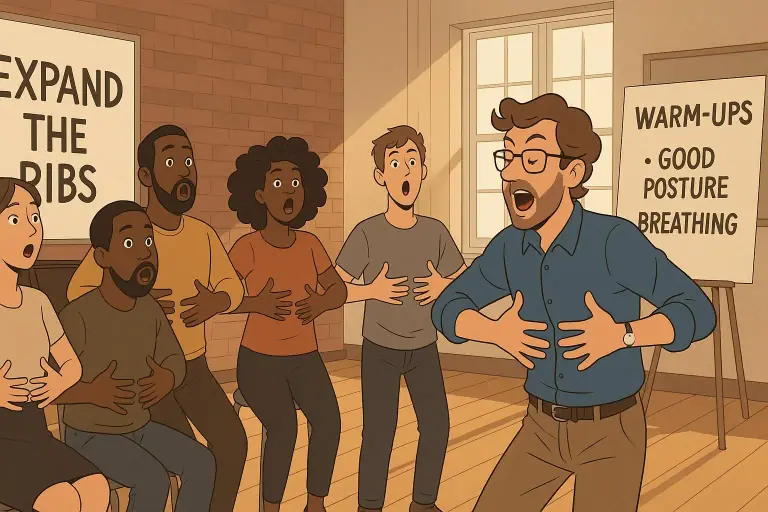
Coach’s Pocket Guide: 6 Cues & Two Warmups for Ribcage Mobility
Oct 11, 2026 • 8 min
You have ten minutes before rehearsal officially starts. The sopranos are checking phones, tenors are joking, and you know—if you don’t get breath work in now—phrasing and stamina will suffer by the second piece. This guide is the lifeline: six verbal cues you can say in a sentence, two five-minute warmups (one standing, one seated), and short scripts to fix the three things I see most—shoulder-lift, breath-holding, and breath-leak.
This isn’t a lecture on anatomy. It’s a practical, coach-first playbook you can use tomorrow. Read fast. Use faster.
Why ribcage mobility matters (and why ten minutes helps)
Ribcage mobility equals usable breath. When the ribs move in all directions—front, sides, and back—the diaphragm has room to do its job and the intercostals assist without tension. Stiff ribs mean singers lift shoulders, hold the breath, or push out air too fast. You can trace half your rehearsal problems back to that.
Also: short, focused work wins. I’m not arguing ten minutes replaces weekly technique lessons. But in group settings, consistent micro-practice builds the habit. Think of this as maintenance: quick, repeatable, and repeatable again.
The six cues that actually land
These are short, image-driven, and easy to repeat between pieces. Say one, demo one, then sing.
"Imagine your ribs are an umbrella opening."
- Why it works: Encourages lateral and posterior expansion instead of just thrusting the chest forward.
- How to use: Say it, place hands on sides of ribs, inhale together.
"Breathe into your back pockets."
- Why it works: Targets posterior space—many singers never feel that part.
- How to use: Lightly touch lower back while inhaling, cue again if people look blank.
"Fill from the bottom up, like pouring water into a glass."
- Why it works: Prevents high, clavicular breathing and encourages diaphragmatic engagement.
- How to use: Demo a slow inhale that visibly starts low.
"Keep your shoulders soft and heavy."
- Why it works: Direct, non-technical reminder that arrests shoulder-lift.
- How to use: Combine with a gentle shoulder drop so the image matches action.
"Feel the expansion in all directions—360 degrees."
- Why it works: Simple helpline cue to check the whole ribcage, not just the front.
- How to use: Use during sustained inhalation drills.
"Sigh out slowly—deflate, don’t pop."
- Why it works: Teaches controlled release for sustained tones and avoids breath-leak.
- How to use: Practice with a long sigh on an 'ah' or 'sss'.
These cues are intentionally short. You’ll find the language matters more than anatomy in a room of nervous singers. The image sticks; the science backs it up.
Micro-moment: once, a tenor who’d never felt his back expand burst out laughing mid-warmup—because the “back pocket” cue actually worked. He kept his hands there the whole rehearsal like he wasn’t letting the breath escape his jeans.
Two 5-minute warmups you can run standing or seated
Both are designed for groups, require no props, and give measurable improvement in 5 minutes if you keep the language tight.
Standing 5-minute ribcage warmup (space-friendly)
Gentle arm-swing breathing — 60 seconds
- Stand hip-width. Inhale as you sweep arms forward/up to shoulder height; feel ribs open. Exhale as arms lower. Repeat 8–10x.
- Cue: "Umbrella up on the inhale—open the sides."
Side-bend reach — 2 minutes
- Inhale, reach one arm overhead; exhale and lean slightly to the opposite side. Keep hips stable. Alternate with deliberate breathing, 4–6 per side.
- Cue: "Breathe into the side that's stretching—like opening an accordion."
Gentle torso twists with breath — 2 minutes
- Hands on hips. Inhale; exhale as you twist right. Inhale center; exhale left. Keep breathing connected.
- Cue: "Wring out the old air on the twist—refill on center."
Why it works: Arm movement gives proprioceptive feedback. The side stretches teach lateral expansion. Twists encourage posterior rib movement.
Practical tip: If you’re short on space, reduce the side-bend reps and increase the twists. You still get posterior activation.
Seated 5-minute ribcage warmup (for constrained spaces or mobility issues)
Seated cat-cow with breath — 2 minutes
- Sit at edge of chair, feet grounded. Inhale—lift chest, open ribs (cow). Exhale—round and release (cat). Repeat 6–8x.
- Cue: "Chest blooms on the inhale; release like a flower folding on the exhale."
Seated side stretches — 2 minutes
- Inhale, raise arm, exhale bend gently to the other side. Keep sit bones grounded. 3–4 per side.
- Cue: "Create space between the ribs—one rib at a time."
Seated gentle rotations — 1 minute
- Inhale center; exhale twist to one side, using hands for mild resistance. Repeat 2–3x per side.
- Cue: "Feel the spiral—untwist the stiffness."
Why it works: Grounding the pelvis gives poor breathers stability. Seated work helps singers who tend to brace when standing or who have lower-body limitations.
Quick execution note: Time each block. Keep the tempo steady (metronome or silent count) so singers don’t rush and end up clavicular-breathing.
Quick scripts: fix shoulder-lift, breath-holding, breath-leak
When you see the habit, stop. Say one short line, then demo.
Fixing shoulder-lift
- Observation: Shoulders shoot up on inhale.
- Script: "Drop your shoulders—imagine they’re heavy. Open sideways, not upward. Width, not height."
- Demo: Inhale with hands on ribs; lower shoulders deliberately.
Fixing breath-holding / tension
- Observation: Faces tense, singers hold before the note.
- Script: "Keep a little flow in—don’t lock the breath. Think of a slow stream entering and leaving."
- Demo: Do a soft continuous inhale-exhale and sing a gentle sigh.
Fixing breath-leak (air escapes too fast)
- Observation: Short phrasing, weak tone.
- Script: "Sigh out slowly—hug the midsection gently on the exhale. Imagine your ribs guiding the air, not letting it fall out."
- Demo: Exhale on a hiss for 6–8 seconds with visible rib control.
These scripts are conversational and quick. Say them once, show once, move on. Repetition across rehearsals is what changes habits.
A short story: when a ten-minute warmup saved a concert
Last winter I was coaching a community choir for a one-night-only holiday gig. Rehearsal time was chopped—just one hour the night before. The altos had a habit of pushing and lifting; tenors were breathing high. We had three songs, one with a long unaccompanied phrase.
I decided to ditch the usual twenty-minute scale routine and run the standing 5-minute warmup, the seated 5-minute set, and used two cues: "umbrella" and "sigh out slowly." I kept corrections blunt: "Drop the shoulders—again." We did one run-through of the toughest piece after the warmup.
Outcome: The long phrase, which had been a train wreck in earlier rehearsals, came off clean that night. Dynamics were controlled; the top note held without strain. The choir later told me they felt more confident—most of them could point to the "umbrella opening" as the thing that finally made the second breath make sense. I learned two things: 1) targeted ten-minute work can translate to performance gains, and 2) pick two cues and stick with them—too many images confuse singers mid-piece.
When you’ll need a visual or extra help
Not every cue lands the first time—especially with less experienced singers or younger groups. If "back pockets" leaves faces blank, add a quick visual: place your hands flat on your posterior ribs and demonstrate the push. A small mirror at the side of the room or a brief smartphone clip can help remote choirs.
If mobility is genuinely limited (injury, chronic tightness), encourage daily standalone practice—three minutes morning and night—using the same cues. Small doses, repeated, beat big but infrequent sessions.
Common questions you’ll get—and how to answer them
Q: "Isn’t this just diaphragmatic breathing?" A: Kind of. But people confuse "belly breathing" with bracing the belly. We’re after rib movement that lets the diaphragm move—360 degrees.
Q: "Will five minutes really help?" A: Yes—if done consistently. Ten focused minutes before rehearsal, three times a week, shows much better short-term gains than a single long session.
Q: "How do I measure progress?" A: Listen for longer phrases, steadier dynamics, less neck tension, and fewer dropped notes on sustained tones. Track one metric per month (e.g., number of singers who can hold an 8-second dynamic without breath-leak).
Practical rollout plan for conductors (what to do next rehearsal)
- Week 1: Run the standing warmup, use cues 1 and 5, correct only shoulder-lift with the short script.
- Week 2: Add the seated warmup for those who need it; repeat cues 2 and 3. Keep feedback brisk—one line per correction.
- Week 3: Combine both warmups on concert nights; run the long phrase twice after warmups and track improvement.
Keep a checklist in your score: before rehearsal write “Warmup: 5s standing / 5m seated — cues: umbrella, back pockets.” Small anchors like that make the routine consistent.
Tools and tiny extras that help
- Metronome app for pacing breathing (60–80 bpm for slow inhales/exhales).
- Simple mirror or phone for demonstrating posterior expansion.
- A soft ball or rolled towel can be helpful for proprioception—have singers place hands to feel ribs move.
Final thought (short and practical)
You don’t need to become a breathing guru overnight. Use the six cues, run the two warmups, and keep corrections tight. Ten minutes, consistently, will give you more breathing control, fewer performance flubs, and healthier singers.
Use images that land in the room, demo the motion, and repeat the cue like a chorus leader—again and again. Habits change with repetition, not with perfection.