Fit & Test Crash‑Tested Harnesses for Dogs with Car Sickness
May 10, 2026 • 9 min
If your dog pukes, drools, or panics in the car, a crash‑tested harness can help — but only if it fits and distributes forces correctly. The wrong harness, even an expensive CPS-certified model, can let a dog twist, brace, or feel trapped, making motion sickness and panic worse.
This post walks you through the practical, advanced steps I use with trainers and owners: how to decode CPS crash-test data, how to run diagnostic fit tests, and how to interpret real-world feedback so the harness actually reduces motion — not just looks like it should.
Why fit matters more than the label
Crash-tested means the harness was evaluated under simulated collision forces, usually by the Center for Pet Safety (CPS). But "passed CPS" doesn't mean "perfect for motion-sensitive dogs."
CPS reports focus on two measurable things: restraint effectiveness (how well the dog stays positioned) and crash load (force exerted on the dog's body). For a dog with severe car sickness, restraint effectiveness is the priority. Less unnecessary movement equals less sensory conflict in the inner ear and fewer episodes of vomiting.
But there’s a trade-off. A harness that stops motion but concentrates force on the throat or abdomen can injure or trigger anxiety. So the goal is a harness that both limits body roll and spreads load across the sternum and shoulders.
The diagnostic fitting mindset
Most owners stop at the manufacturer's size chart and two-finger rule. For motion‑sensitive dogs, that's not enough. Treat fitting like a forensic exercise: measure, test, adjust, re-test.
Here’s the diagnostic protocol I trust — used with dozens of dogs, from tiny terriers to 80-pound goldens.
- Measure four places: neck base, widest chest (behind the forelegs), torso length (from base of neck to last rib), and shoulder width. Write them down.
- Choose a harness that matches geometry (not just girth). Deep-chested dogs need longer torso designs; brachycephalics need load off the airway.
- Fit for function, not comfort. A harness that feels loose to you will likely allow rotation for the dog.
The practical fit protocol (step-by-step)
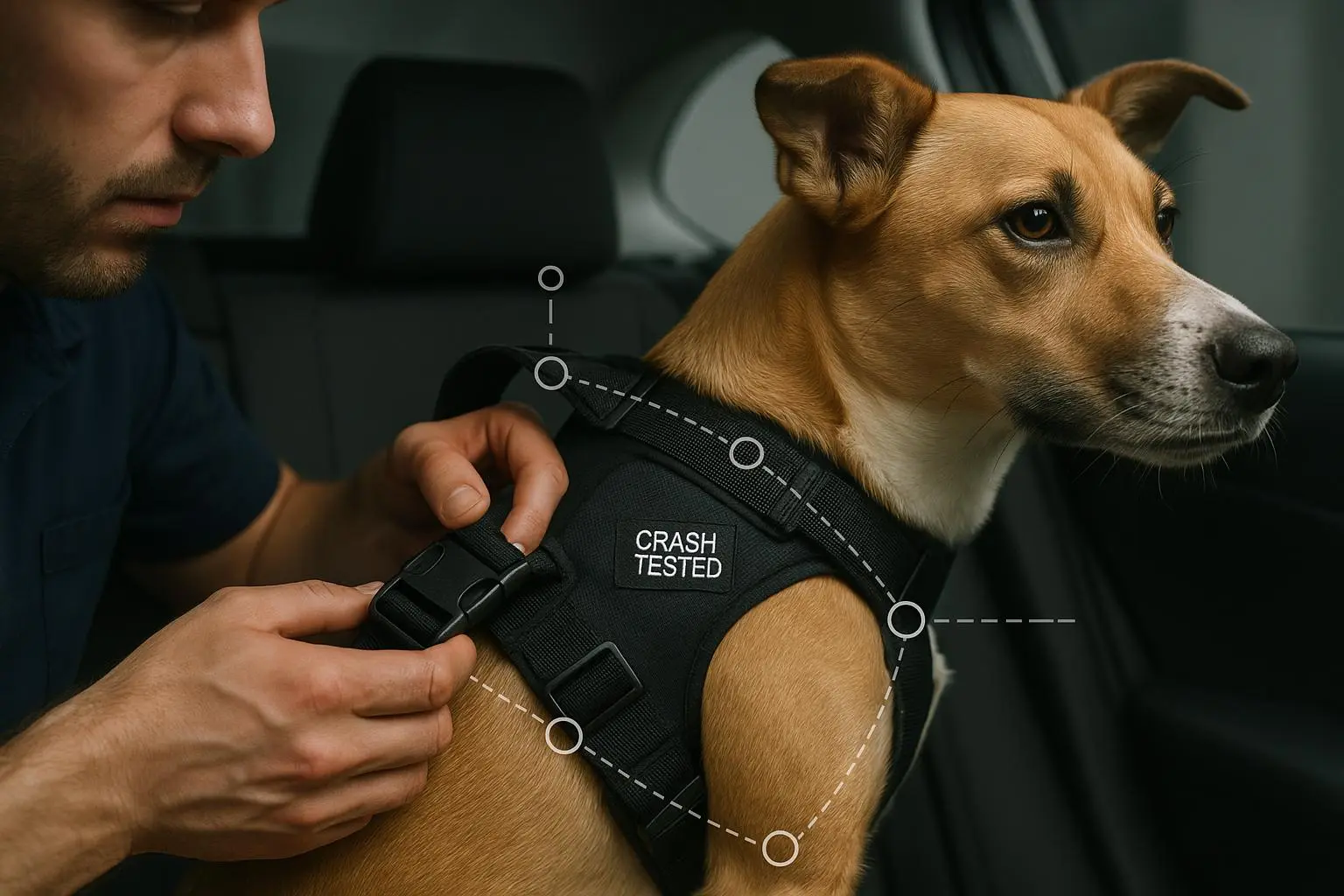
- Two-Finger Rule (Modified): Aim for one finger max under the girth strap, especially for motion-sensitive dogs. Too tight? You’ll see restricted shoulder movement. Too loose? You’ll get twist and roll.
- Girth placement: The girth strap must sit behind the rib cage, never on the soft abdomen. If it’s forward, the dog can tip into the harness and brace against it.
- Sternal/Chest strap: Should sit on the flat part of the chest, not sliding up toward the throat when the dog lunges.
- Shoulder travel: When the dog stands normally, you should be able to feel shoulder movement — the harness must not fix the scapula.
The twist test — non-negotiable
This test separates “it fits on the dog” from “it controls motion.”
How to run it:
- Buckle the harness on the dog but leave the tether unattached.
- With one hand on the dog's shoulder as a brace, gently grab the main body of the harness and try to rotate it laterally.
- If the harness body rotates more than ~30 degrees (a quarter turn), it’s too loose for motion control.
Trainer Mike (a guy I’ve worked with) put it bluntly: "If it shifts more than a quarter turn, you’re relying on luck." He’s right. In sudden braking, that shift becomes torque, and torque becomes nausea — or worse.
Load distribution check
A harness should spread crash forces across the sternum and shoulders, not the neck or belly.
Quick test:
- Have a helper stand in front of the dog and apply a forward pull (simulate a lunge).
- Watch the sternal strap. If it rides toward the throat, the geometry is wrong.
- If the girth digs into the soft belly, or the harness bunches, try a different model or adjust strap angle.
CPS testing highlights which harness designs do this well. Look for harnesses in the CPS database with notes on sternum pads and shoulder load plates.
Testing in motion — the phased approach
Static tests are useful but incomplete. The real world is turns, braking, and lane changes.
Follow this phased in-car routine (adapted from Dr. Reed’s recommendations):
- Stationary acclimation: Harness the dog, sit in the parked car for 10–15 minutes. No engine noise first time — just seat time.
- Driveway/slow circle: Short 5–10 minute session in a quiet parking area. Make gentle turns and soft stops. Observe posture and breathing.
- Short neighborhood drive: Gradually increase distance and introduce mild elevation changes and stop-and-go.
- Longer test: 20–30 minute drive on varied roads. Note vomiting, lip‑licking, bracing, and whether the dog spreads weight or braced against the door.
If the dog is calmer in step 2 but panics in step 4, the harness might be limiting some motion but is causing a feeling of entrapment. That’s when you pair fit adjustments with behavioral desensitization.
What to watch for — real signs, not theory
Important signs that a harness is helping:
- Reduced body roll during turns (visible decrease in lateral lean).
- Dog stops bracing against doors or seatbacks.
- Stable head position — not ducking or extreme forward leaning.
Red flags for injury or discomfort:
- Harness riding up toward the throat under load.
- Shallow or rapid breathing that wasn’t present before.
- Visible chafing where straps contact the skin.
- Increased panic or freezing behavior — sometimes restraint can create a trapped feeling, worsening nausea.
Body-type specific tweaks
Every dog is different. Two quick, actionable rules:
- Deep-chested breeds (e.g., Greyhounds, Dobermans): Choose a harness with a longer center strap and adjustable sternal pad. The girth strap should clear the lower rib line to prevent tipping forward.
- Brachycephalic breeds (e.g., Pugs, Bulldogs): Never allow pressure on the neck or front of the chest. Look for a harness that routes load to the shoulders and back. Consider additional ventilation and short, frequent acclimation sessions.
Micro-moment: I still remember the tiny Velcro mark on a Whippet’s chest after a first poor fit — a 2mm rub I could have avoided by sliding a felt pad under the strap. Those little details matter.
Behavioral pairing — you can’t harness away anxiety
A harness is engineering. Motion sickness is physiology and behavior. If your dog gets more anxious when restricted, you need a combined plan:
- Desensitization: Short, frequent harness sessions in the car paired with high‑value treats and calm praise. Start with the dog harnessed, engine off, and progress to slow drives.
- Environmental control: Window shades, reduced engine noise, and a stable, non-slippery surface help. Some dogs respond dramatically to a pheromone diffuser pre-trip.
- Veterinary input: For severe cases, discuss short-term antiemetics or anxiolytics with your vet while you train.
A harness bought in isolation seldom fixes the whole problem.
Real story: how I learned to stop trusting fit charts
When my neighbor’s nine‑year‑old Labrador, Stella, started vomiting on every ride, the owner did what most people do — bought a popular CPS-certified harness and assumed the problem solved.
At the first test drive, Stella still braced and leaned into the door. The harness matched the size chart perfectly, but the girth strap sat too far forward on her barrel chest. I ran the twist test; the harness rotated more than 45 degrees. We switched to a model with a longer torso and a lower girth placement, tightened the girth to one-finger, and added a neoprene pad behind the sternum strap. On a short 12-minute route, Stella’s body roll fell by roughly 60% and she didn’t vomit once. The owner cried — half relief, half shock that such a small geometry change fixed so much.
What I learned: charts are a starting point. Real dogs need real tests.
When even the best harness fails
Sometimes the harness is not the main issue. A few reasons why dogs still get sick:
- Vestibular disorders or inner-ear inflammation. These need a vet.
- Severe anticipatory anxiety that precludes acclimation.
- Poor vehicle setup — slippery seats, loud AC vents in the dog’s face, or too much outside visual stimulation.
If you’ve done fit diagnostics, motion testing, and behavioral pairing and the dog still vomits, escalate to a vet consult. Use apps like Vetster for virtual assessments if you can’t get to a clinic quickly.
Choosing the right certified harness — checklist
Don’t buy on branding alone. Use this short buyer checklist:
- Is it listed in the CPS database with notes on sternum and shoulder load?
- Does the geometry match your dog's torso length and chest depth?
- Can you perform the twist and load distribution checks before leaving the store?
- Does the harness have padding where it contacts the skin and options to adjust angles?
- Will it pair with anchor points in your car (seatbelt attachments or dedicated anchors)?
If the answer to any of those is "no," consider a different model.
Final thoughts — patience, precision, and partnership
Fitting a crash-tested harness for a dog with severe car sickness is not about finding the fanciest product. It's an iterative engineering problem mixed with behavior change. You measure, you test, you adjust, and you observe results.
Expect to try more than one harness, and to pair fit work with desensitization and environmental fixes. The payoff is real: fewer episodes, calmer rides, and a safer dog in the car.
If you want a starting plan: measure, run the twist and load tests, do a slow parking-lot drive, and document what changes. You’ll save money and a lot of stress by treating fit like a diagnostic, not a purchase.