AdCreative AI: Getting Started Generating High-Converting Social Ad Images from Text
May 31, 2027 • 9 min
You need more ad creatives. Fast. The feeds are saturated, CPMs are creeping up, and the only thing that keeps campaigns fresh is new, on-brand visuals. AdCreative AI promises to turn a written brief into dozens of platform-ready images in minutes. That sounds like magic—and it kind of is, as long as you know how to use it.
This is a practical beginner’s guide. I’ll show you how to set up your brand profile, write briefs that actually produce useful images, iterate like a pro, and avoid the common traps that make AI outputs feel generic. Expect clear steps, a real story from my own campaigns, and the small details that matter.
Why this matters (short version)
Creative quality drives performance. Studies show visual quality accounts for over half the variance in ad ROI.[1] That means getting the imagery right is not a “nice to have”—it’s the lever that moves costs and conversions. The problem: human designers aren’t fast enough for the scale most paid channels demand. That’s where AdCreative AI fits: speed + scale, with predictive models trained on millions of high-performing ads.
But speed without direction gives you a pile of pretty images and no wins. Here’s how to avoid that.
Step 1 — Set up your account the smart way
Signing up is usually frictionless. The real work starts in the Brand Profile—don’t skip it.
What to upload and why:
- Logo files (SVG preferred) so overlays scale cleanly across ratios.
- Brand colors as HEX codes—this prevents the AI from “guessing” your palette.
- A small gallery of 6–10 hero images that reflect actual product use or your typical lifestyle photography.
- Your preferred fonts or a note about typography style (e.g., "rounded sans, bold headlines").
- Short brand voice bullets: 3 lines max, e.g., "friendly, no-BS, confident."
Why this matters: the AI uses these assets and signals to bias its layout, image selection, and overlay treatments. If your brand info is weak, the outputs will be weak.
A quick, practical note: I uploaded an old PNG logo once and the overlay looked pixelated across 9:16 outputs. Swapping to an SVG fixed it instantly—saved me an hour of tinkering.
Step 2 — Write a brief that guides the model (don’t be coy)
Think of the brief as the recipe. The clearer the ingredients, the better the dish.
Include these components every time:
- Product/Service in one line: "Eco running shoes — lightweight, waterproof."
- Offer/Goal: "20% off first purchase" or "Sign up for a free 14-day trial."
- Primary CTA: "Shop now" vs "Learn more"—these imply different creative treatments.
- Target audience snapshot: age, intent, and one psychographic cue. Example: "25–35, urban runners, values sustainability."
- Emotional hook in 3–5 words: "freedom," "confidence," "urgency," or "comfort."
Example good brief: "Eco running shoes. 20% off first purchase. CTA: Shop now. Audience: 25–35 urban runners who care about sustainability. Hook: 'Run confidently in any weather.' Tone: aspirational, energetic."
Why "benefit > feature": Saying "waterproof" tells the AI a feature; saying "run confidently in any weather" suggests visuals (rain, motion, joyful runner) and a stronger overlay copy. That change alone often lifts relevance.
Step 3 — Generate variants and what to expect
Hit generate and expect a batch designed for multiple placements:
- 1:1 (Facebook feed)
- 4:5 (Instagram feed)
- 9:16 (Stories/Reels)
The platform will usually propose overlay copy and CTA placements. It may also score variants with a predictive performance metric. Use those scores as directional, not gospel.
What to look for on first pass:
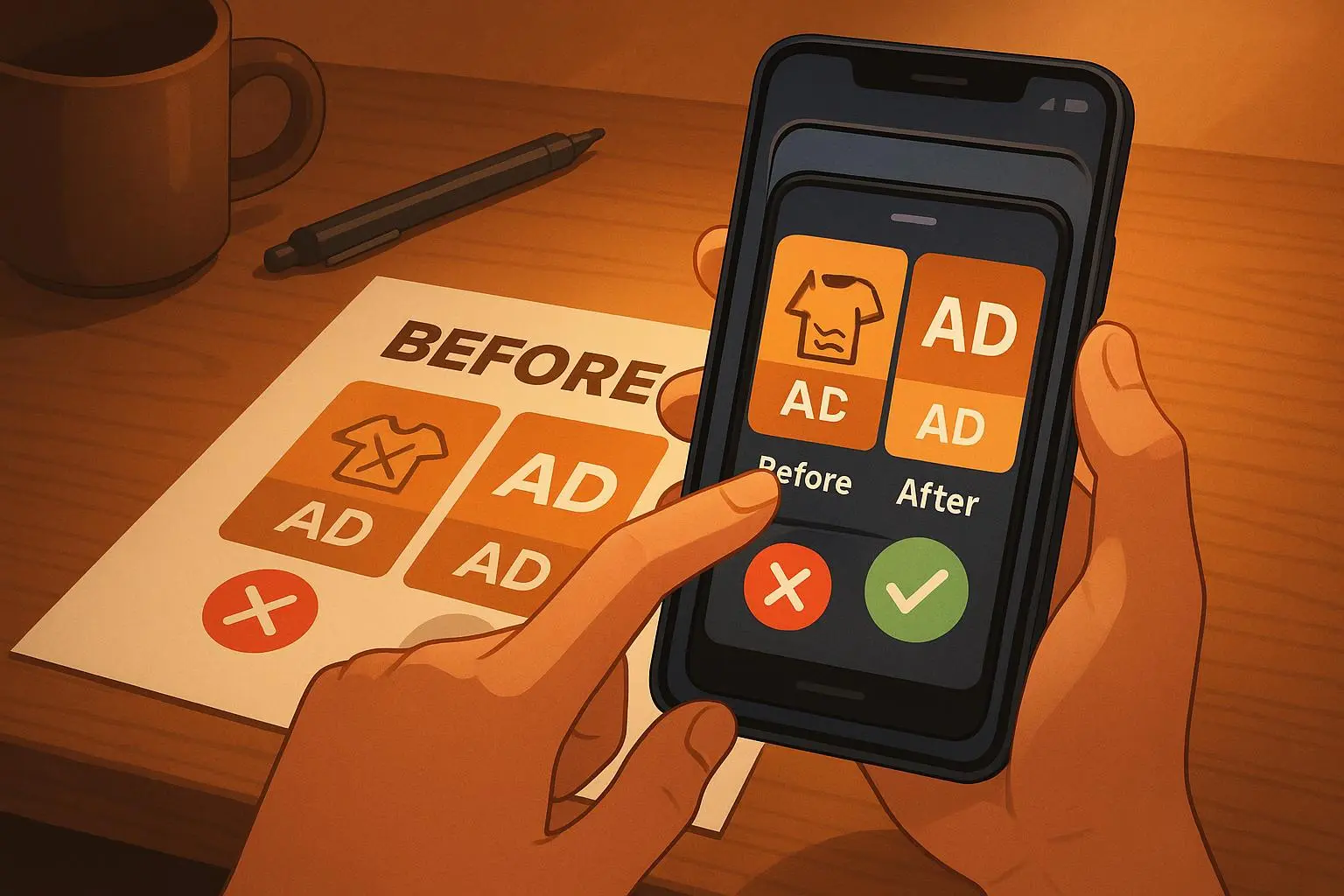
- Visual hierarchy: is the CTA readable at mobile size?
- Text density: is copy crowding the image? (Facebook and Instagram penalize heavy text.)
- Brand alignment: are colors and logos applied consistently?
- Authenticity of imagery: do models and scenes match your audience?
Expect to swap or tweak 15–30% of outputs on average. The layouts are often the best part—the AI understands composition. The images themselves (particularly stock models) can feel generic. That’s okay; get the layout right, then swap imagery if you need more brand authenticity.
A short story: the six-hour creative sprint that saved a launch
Last spring I was running a hybrid launch for a DTC bedding brand. We needed 60 creatives across feed and Stories before launch day. Normally that’s a week of design work.
I fed AdCreative AI a tight brief: "Comfort-focused bedding, 20% off launch, target: 28–45, sleep-deprived professionals, hook: 'Better sleep in 7 nights'." Uploaded four lifestyle hero shots and the SVG logo.
Result: 48 variants in 45 minutes. I reviewed them, favorited 12 layouts, replaced two model images with our in-house photos, and exported all sizes. Total human time: about six hours across review and minor edits.
Outcome: the campaign launched on schedule, CTR improved 12% against our previous baseline, and we iterated three more creative rounds in two weeks. The lesson: precise briefs + rapid iteration beats slow perfection when you need volume.
Step 4 — Iterate with intention (don’t treat it like random A/B)
AI gives you volume. You still need a testing framework.
A pragmatic test plan:
- Round 1 (Discovery): 20-30 variants run at low budget for 3–5 days to find top performers.
- Round 2 (Scale): Move top 4–6 creatives into higher spend with 2–3 targeting tweaks.
- Round 3 (Refine): Swap imagery or headline on top-performing layouts to squeeze extra lift.
Keep at least one control creative (your best existing ad) in rotation to measure true lift. Users report lifts like 15% CTR initially, but expect plateaus after a couple of weeks; that’s normal. Use the AI to keep feeding new iterations.
Practical tips for platform optimization
- Aspect ratios matter. Let the tool export exact sizes for each placement—don’t rely on manual resizing.
- Text overlay density: keep headline copy under 7–9 words for mobile readability.
- CTA contrast: use a button color with a 4.5:1 contrast ratio against the background to pass visual clarity.
- For Stories/Reels, prioritize vertical motion or split-screen hero shots; static product-only images often underperform.
If you use Facebook Ads Manager, name your creatives with a consistent convention (e.g., AC_AI_23_9x16_primaryCTA) to automate reporting and attribution.
When to bring a human designer back in
AI is a co-pilot, not an autopilot. Bring designers in for:
- Brand-defining hero images (main campaign creative)
- Complex product shots that need composition control
- Custom typography or unique visual motifs you want replicated at scale
A common workflow that works well: AI for the first 80% of ideas and variations; human for the final 20%—the polish and brand signature.
Ethics and guardrails you must set
AI-generated images can accidentally produce misleading or sensitive content. Follow these guardrails:
- No deceptive imagery for people/products (no fake testimonials).
- If you use AI-generated people, disclose when necessary and avoid depicting real individuals falsely.
- Check for cultural sensitivity—some generated contexts may be tone-deaf.
- Keep a log of prompts and asset sources for compliance audits.
Regulators are paying attention: the FTC has guidance about synthetic media in advertising—read it and keep your legal team in the loop.[2]
Advanced moves (once you’re comfortable)
- Feed the AI your best-performing creatives after a test and ask it to "mutate" them—small changes often yield big freshness with minimal creative drift.
- Combine Copy.ai or a similar tool to produce punchier headlines and feed those as overlay text to improve relevance.
- Integrate exports into your Creative Asset Library with tags (audience, offer, hook) so future briefs can reference past winners.
What users actually report (short synthesis)
From forum and review signals:
- Speed is the most celebrated benefit—20 variants in an hour is common praise.
- Quality is highly dependent on input—brand assets and precise briefs drastically improve outcomes.
- Stock imagery authenticity is a complaint—expect to swap in your own photos for niche audiences.
- Performance gains are real but often plateau—human strategy remains essential.[3][4]
Micro-moment: one tiny detail that mattered
On a $200 A/B test, swapping a “Shop Now” button from white to a saturated brand orange increased clicks by 9%. It was a stupidly small tweak that only stood out because the AI’s layout was already solid. Small contrast choices matter.
Final checklist before you hit publish on a campaign
- Brand assets uploaded (SVG logo, HEX colors)
- Brief includes benefit, CTA, audience, emotional hook
- Generated variants reviewed for hierarchy and text density
- 1–2 authentic images reserved to swap if stock feels off
- Tracking UTM parameters and controls set in Ads Manager
- Compliance check for synthetic media and claims
Bottom line
AdCreative AI is a productivity multiplier for social ad production. It won’t replace strategic thinking or good data, but it will let you explore more ideas faster. If you put the work into a strong brand profile and sharp briefs, you’ll get layouts and copy that are immediately useful—then it’s your job to test, iterate, and humanize the winners.
If you walk away with one thing: don’t feed the AI vague one-liners. Be specific about benefit, audience, and emotion. The quality of what you get back mirrors the quality of what you put in.
References
Footnotes
-
Nielsen Norman Group. (2021). The Impact of Visuals on Conversion Rates. Retrieved from https://www.nngroup.com/articles/visuals-conversion-impact/ ↩
-
Federal Trade Commission. (2024). Guidance on the Use of Synthetic Media in Advertising. Retrieved from https://www.ftc.gov/synthetic-media-guidance ↩
-
Facebook IQ. (2020). How Images Drive Ad Performance on Social Media. Retrieved from https://www.facebook.com/business/news/insights/how-images-drive-ad-performance ↩
-
Google Marketing Platform. (2019). Creative That Clicks: The Role of Imagery in Digital Advertising. Retrieved from https://marketingplatform.google.com/about/blog/creative-that-clicks-imagery-digital-ads/ ↩
Ready to Optimize Your Dating Profile?
Get the complete step-by-step guide with proven strategies, photo selection tips, and real examples that work.